

What Is The 25-Year Rule For Satellites?

With nearly 15,000 active artificial satellites up there as of 2026, space is filling up fast, so it comes as no surprise that there's a 25-year rule in place to keep things in check. The rule states that any satellite or spent rocket stage in low Earth orbit (up to around 1,240 miles) should be brought down within 25 years of finishing its job. The 25-year requirement was first introduced in 1995, but it was only accepted worldwide in 2002 when the Inter-Agency Space Debris Coordination Committee (IADC) adopted it for the first time.
The thing is, the 25-year number has nothing to do with the lifespan of the satellite since that countdown actually starts once its working life is over. The figure was specifically picked out by taking into account orbital debris models, which worked out the least amount of propellant a satellite would need to shove itself down into a lower orbit.
The catch is that once a mission ends, there's barely any fuel left. Working out how far down the satellite can push itself to where the air is thick enough to finish things off is the whole point. That sweet spot is at around 370 miles above the Earth's surface. There, any satellite plowing through at 17,500 mph sheds a little speed due to resistance, falling down further into thicker air. Once it drops into the 370-mile zone, the whole process takes roughly 25 years to play out.
25 years was a bit too long, though
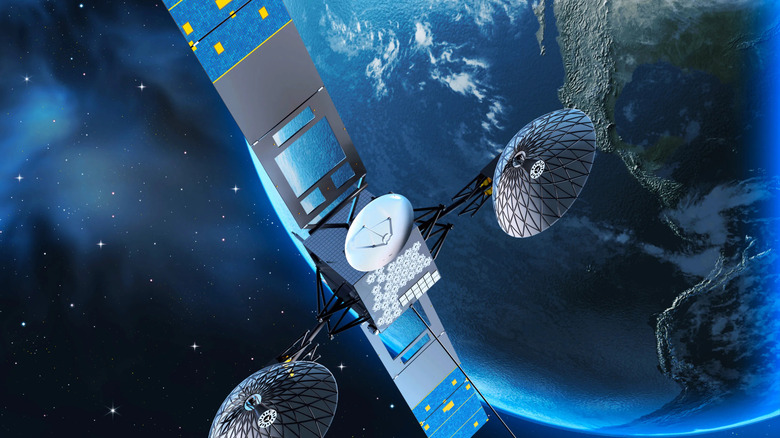
There's one problem with the original 25-year rule for satellites, though: the timeframe is simply too long. There are far too many satellites up in orbit, occupying increasingly crowded lanes. That's why in September 2022, the Federal Communications Commission (FCC) unanimously voted to cut that deadline down to just five years. The European Space Agency (ESA) followed in late 2023.
The new rules also mean that satellites don't spend a greater part of their lives simply waiting to drop out of orbit. Many LEO satellites run for five to ten years before reaching the end of their lifespan. Starlink satellites are actually on the shorter end of that timeframe, averaging five years.
When it's time for a satellite to say goodbye, the satellite fires its thrusters, often the same ion thrusters that keep satellites flying by nudging them back up against drag. Point them against the direction of travel instead, and the satellite sheds speed and drops into thicker air.
Not everything has the required amount of propellant for the job, though, like smaller spacecraft that operate lower down at around 250 miles above the Earth. They simply don't need the fuel, since they are already too low and can just let the drag do the work on its own. There's also another category called geostationary satellites that never come down at all, orbiting over 22,000 miles above the surface of the Earth. These typically never come back down to burn up in the atmosphere and instead move to the graveyard band where those satellites go to die.