

Want A Non-Smart TV? These Are Your 5 Best Options
We may receive a commission on purchases made from links.
It seems like nearly every tech manufacturer out there has been chasing the philosophy of smart integration for years. Everything from your TV to your toaster connects to the internet and has been imbued with some kind of computer-based functionality. With TVs, this is primarily used for running streaming applications, but there has been a growing subculture of people who prefer to use more basic appliances. Some might simply prefer that the only smart utility connected to their TV is a dedicated streaming box, reducing the overall amount of software bloat. Others might want to "unplug" completely and keep their entertainment system detached from the internet altogether, only utilizing devices like a DVD player.
Whatever your reasons might be, the unfortunate truth of the matter is that there simply aren't many non-smart TV's being made anymore. Models like the once-popular Insignia N10 Series or the Scepter U515CV-U have been completely phased out. However, just because the market for TVs without smart capabilities has shrunk, doesn't mean it's gone away entirely. There are a few decent options out there if you know where to look.
Some standard non-smart TVs are still bing made for mass consumption. Some are designed to function as business displays and have no need for smart software. Others might come stock with smart capabilities, but have an option for deactivating them during setup. A few are even made by top TV brands.
Westinghouse HD Series and DVD Combo
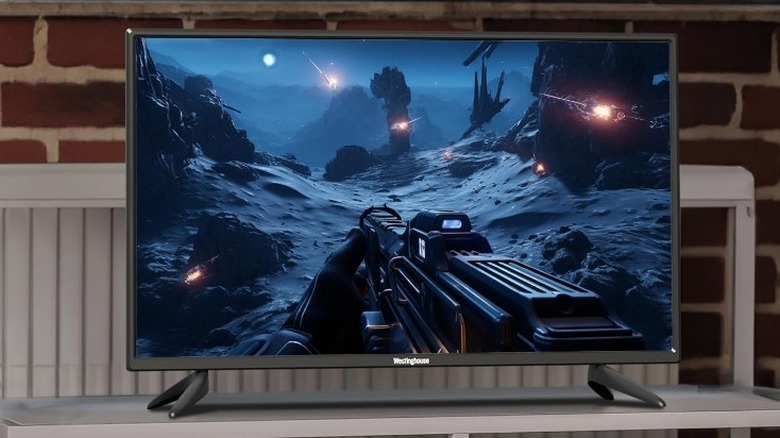
You might initially be concerned every option on this list is going to be from no-name brands only found in the murkier corners of Amazon, but that isn't the case. Westinghouse might not be one of the biggest TV brands on the block, but it has been around for over a hundred years, and it's one of the few brands still producing modern, consumer-targeted televisions without smart capabilities.
The brand actually has two different models in this category. The first is the standard Westinghouse HD Series, which you can get in two sizes, with both being on the smaller side. The smaller of the two is a 24-inch 16:9 LED screen with a 720p resolution that retails for $115.99. The larger is a 32-inch 16:9 720p TV that goes for $149.99. They both have HDMI, USB, VGA, composite, optical, and coaxial connection ports and 2.0 channel stereo audio.
The other model it makes is essentially the same thing, but with a DVD player built in. This one also comes in 24-inch and 32-inch sizes, both of which have 720p resolution. This could be a great option for someone seeking a compact, all-in-one physical media player.
Both of these models have a flat 4.0 out of 5 on Amazon. Customers generally appear to be happy with the picture, ease of use, reliability, and value. The major complaint that pops up most commonly seems to be with the sound quality. Basically, you should expect to pair it with a soundbar, as the built-in speakers are apparently weak and quiet.
Impecca LED TV
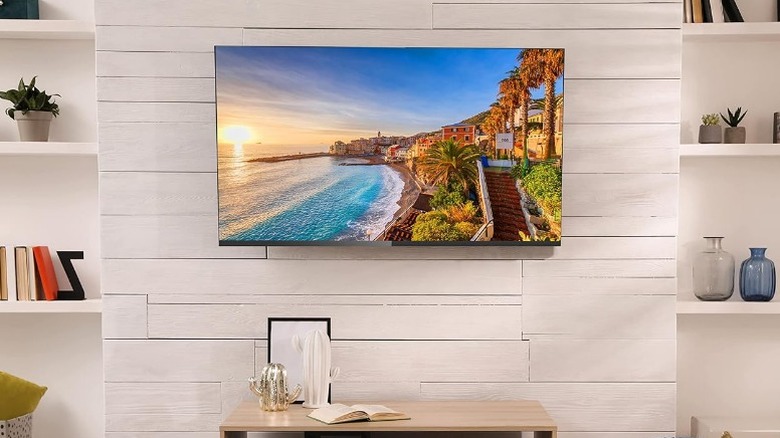
Budget-oriented brand Impecca makes a range of different electronics and that includes non-smart TVs targeted for consumers. There are currently three different sizes and four models available.
The company has a $169.97 TL2400H 24-inch 16:9 720p LED display with a 60Hz refresh rate, 8.5ms response time, Dolby Vision, and two 6W speakers. There was also an option to get the TL2404 version which came with a built-in DVD player, though this one may have been discontinued as it it appears to be out of stock across major retailers. The next step up is a $199.97 TL3202H 32-inch 16:9 (with 4:3 support) 720p LED that has a 60Hz refresh rate, 8.5ms response time, ATSC tuner, Dolby Audio, and two 8W speakers. Finally, for $344.97, you can get the Impecca TL4302F 43-inch 16:9 (with 4:3 support) 1080p LED. This seems to be the most popular of the brand's non-smart models. It goes for $344.97 on Amazon, 349.97 at Target, and $372.31 at Lowe's. This one also has the ATCS tuner and Dolby Audio. It has a 60Hz refresh rate and a 5.0ms response time.
These aren't rated as highly or as frequently as Westinghouse options. Even the 43-inch, which seems to be one of the more popular options, only has a 3.8 out of 5 on Amazon from just 59 reviews. Once again, people generally seem happy with the screen and picture quality, but they're less than pleased with the sound quality from the built-in speakers.
Samsung BEC-H Series
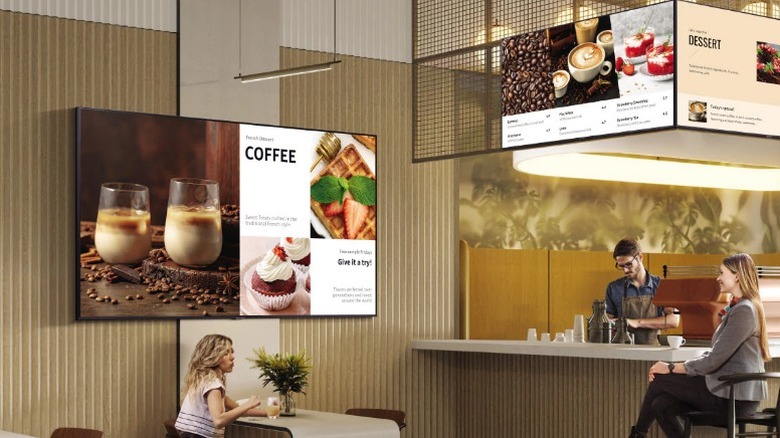
While the options for consumer grade non-smart TVs are largely limited to budget brands, there are other options out there from more premium brands targeting business needs. Samsung, for instance is considered the best major TV brand in terms of customer satisfaction, and the company makes a couple of non-smart TV models designed for use as digital signage displays. The Samsung BEC-H Series of TVs is one such product line.
These are 16:9 4K TVs that have just about all the amenities you might want and they come in seven different sizes: 43-inch ($372.90), 50-inch ($536.90), 55-inch ($699.99), 65-inch ($777.41), 70-inch ($875.00), 75-inch ($999.99), and 85-inch ($1,679.00). Each of them has a 60Hz refresh rate, HDR10, 250 nit brightness and PurColor picture enhancement.
It's worth noting that while this isn't really a traditional smart TV, it does have a Samsung Crystal UHD 4K Processor that allows for AI upscaling and a heavily cut-back Tizen OS. It can also connect to the internet, but gives you the option to skip that portion of the setup.
Several users have claimed that it functions well as a non-smart TV. Others claimed that they liked that it didn't have the capability to "spy" on them. The TV only has a 3.6 score on Amazon and only 46 reviews, but it seems that most of the negative reviews are from people who received defective products or have issues with the app designed for posting signage to the TV. Most praise its brightness, image quality, low-reflective screen, and sturdy design.
Panasonic CQE2U Series
The Panasonic CQE2U Series is similar to the Samsung, in that it is a TV with the performance specs you would expect from a major brand, but primarily designed for businesses and classrooms to use as displays. It has Wi-Fi connectivity and a dialed-back version of the Android OS, but it isn't a smart TV in the traditional sense, as it lacks much of the app functionality that you would typically expect.
There are six different versions of this TV currently available, and they're all fairly pricy. There's the $883.00 Panasonic TH-43CQE2U 43-inch, the $945.99 TH-50CQE2U 50-inch, the $1,416.00 TH-65CQE2U 65-inch, the $2,304.00 TH-75CQE2U 75-inch, the $4,386.99 TH-86CQE2U 86-inch, and the $10,098.00 TH-98CQE2U 98-inch. They're all UHD 4K IPS panels with brightness ranging from 400 to 500 nits. They have a few extra features as well, such as a built-in TV tuner, and Sports Mode. In terms of connectivity, it has USB C and four HDMI 2.2 video input options. So there are certainly some justifications for that pricing scale outside of Panasonic's brand recognition.
These used to be available at Walmart, but no longer appear to be sold from most of the major retail outlets that sell the other TVs listed thus far. However, you can find them at CDW and B&H Photo for the prices listed above. Unfortunately, this means that there is little in the way of user feedback.
Sony Bravia
If you don't want a non-smart TV from a smaller brand and you don't want a business display TV, there is a third option. Consumer Reports ranks Sony as one of the most reliable TV brands out there, placing it right alongside LG and Samsung, and it has a line of TVs that lets users whether it functions as a smart TV or not.
Sony's high-end Bravia line of TVs all of these come with smart TV functionality, but you don't have to use it. Right when you're setting it up, a Bravia TV will ask you if you want to Set Up Google TV or Set Up Basic TV. The Google TV option will activate all of the TV's smart functionalities, while the Basic TV mode will allow you to use it as if it weren't a smart TV at all. This makes it one of the better options, since it allows you to chose from a wide range of screen types, sizes, and price points. You can get a standard LED option like the Sony Bravia 3, a Mini-LED like the Bravia 9 or an OLED like the Bravia XR8B with sizes ranging from 43 to 100 inches. These all have the benefit of the latest tech, like Dolby Vision, Dolby Atmos, AI upscaling, Motionflow and more.
The reviews for these vary from model to model, but they generally seem to hover between 4 and 5 stars on Amazon. There are few complaints about the image quality, brightness or overall appearance, though there are some consistent complaints in regards to reliability, with several people complaining that the TV occasionally freezes. It's unclear, however, if these issues persist when running in Basic TV mode.