

Honda Patents Tease A High-Tech Upgrade For Its Entire Motorcycle Lineup
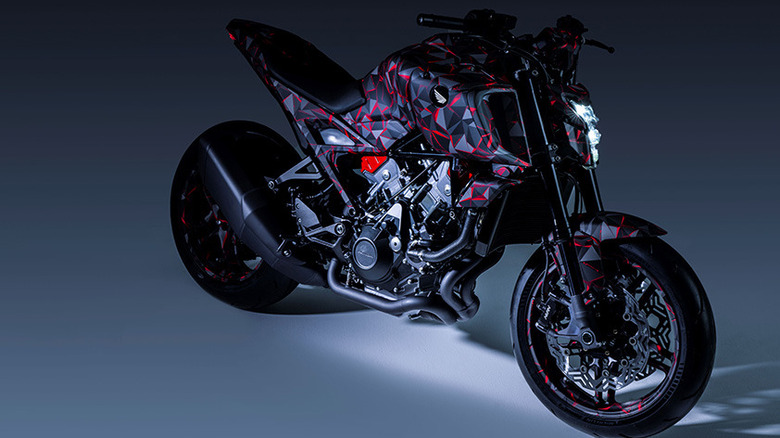
In November 2024, Honda showcased a motorcycle called the V3R 900 E-Compressor Prototype, which made headlines for having an electric compressor attached to its three-cylinder V3 engine. The e-compressor, as it was called, worked like a traditional turbo, pushing more air into the combustion chamber to improve power output. After showcasing a prototype of the V3R 900 at EICMA 2025, though, Honda has remained silent about the bike's prospects.
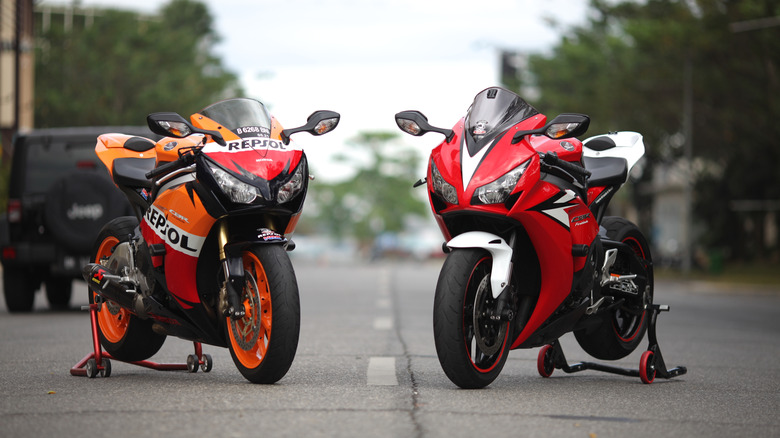
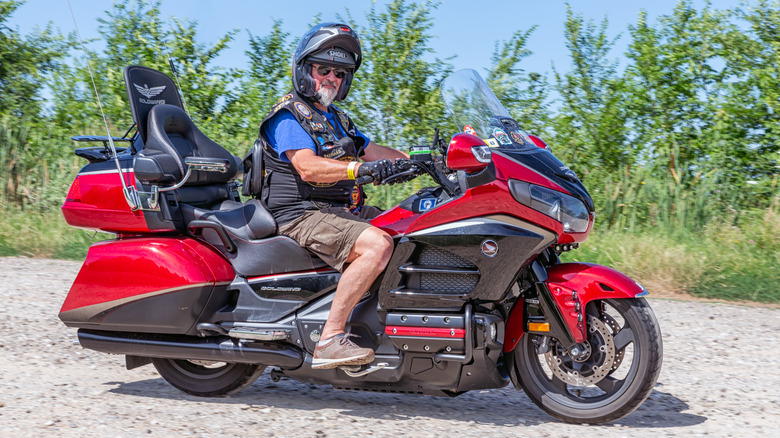
However, a series of patent documents published in 2026 (nine in total) suggests that Honda wants to adapt this technology to a much wider range of motorcycles beyond the V3R 900. These patent filings discuss how the e-compressor technology can be modified to work with multiple engine architectures. Notable engine types being considered include the horizontally opposed (flat-six) engine (used on the Gold Wing), inline-fours (used on the CBR 1000RR Fireblade), parallel twins (used on the Africa Twin), V4's (used on the VFR 800), and even Honda's entry level single cylinder engines (used on the likes of the CRF300L, and the CRF300 Rally).
More specifically, the documents center on the optimal positioning of various components of the e-compressor, such as the air cleaner, supercharger, and surge tank, instead of the tech itself. Honda's eventual goal, if the patent documents are anything to go by, appears to be a system that it can adapt to work on motorcycles with different engine and frame configurations. Most crucially, it wants to do this with as short an intake path as possible to minimize pressure losses, improve throttle response, and boost overall efficiency.
Honda's e-compressors vs superchargers: What's the difference
Traditional turbochargers, superchargers, and Honda's e-compressor are all designed to achieve the same thing: improve engine performance and throttle response by forcing more air into the combustion chamber. How they achieve this differs significantly. While turbochargers (which are rare on motorcycles) use exhaust gases to spin a turbine, superchargers — as seen on the Kawasaki Z H2 and the H2R — use a centrifugal supercharger connected directly to the engine's crankshaft. In contrast, Honda's e-compressor uses a dedicated electric motor to drive an air compressor to do the same thing.
The advantage of Honda's approach is that its functioning is not tied to engine RPM or exhaust flow. The amount of extra airflow can be controlled precisely to match actual engine requirements. This is enabled by a bypass intake that allows the engine to switch between naturally aspirated and supercharged operation, indicating that the electric compressor would only be used when additional performance is required.
Another advantage over traditional superchargers is that it can deliver air into the combustion chamber even at low engine speeds. This, at least theoretically, can improve throttle response at lower speeds and even mitigate the dreaded turbo lag effect to some extent. The sheer flexibility offered by Honda's e-compressor system makes the company's latest patent applications very promising; imagine how much fun a Gold Wing — or, better yet, a Firebird — with an electric compressor would be to ride.
What these patents could mean for Honda's future lineup
It would make a lot of sense for Honda to introduce a common e-compressor system that it can use across multiple models and engine configurations. That would be more cost-effective than developing unique solutions for individual models. This would not be new to Honda, as it took the same approach with its Dual Clutch Transmission (DCT), which are present across multiple bikes in the Honda lineup.
A key advantage of this e-compressor is that it will improve the power output of smaller engines. As an example, Honda claims that a 900cc engine augmented with its e-compressor will equal a larger 1,200 cc unit. What is more remarkable is that it should do this while also offering better efficiency and meeting increasingly stringent emissions regulations. Honda's e-compressor — at least in its current form — appears to be one of the smartest ways it can increase power output without increasing the engine's displacement.
While the tech has potential, it's important to remember that this e-compressor is still limited to pre-production prototypes and patent documents. Honda will undoubtedly put it through rigorous evaluation and testing before it even considers bringing it to production motorcycles.