

If You See A Decimal Point On A Mile Marker Sign, There's A Good Reason Why
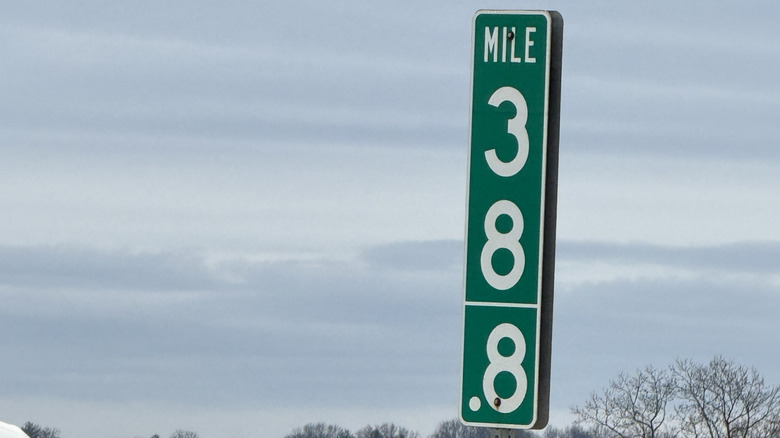
Since their inception, mile markers have been important in helping drivers understand the distance traveled or get their bearings. If you're a frequent driver, you have almost certainly encountered them, but the ones with a decimal point are rarer. It might seem like a strange thing, or even a typo to have decimals in a traffic sign, but there is a very good reason for that. Namely, the location, or rather, a pinpoint location.
Having a decimal point on a mile marker sign helps drivers or passengers get as precise a location as possible on the highway. While beneficial for navigation, that little point also helps first responders in the case of an accident or emergency. For instance, compared to a regular 70-mile marker, reporting that you're near or at a 70.3-mile marker would not only narrow your location to a few hundred feet but could also play the role of a distinct landmark, making it much easier to find you.
These types of mile markers aren't everywhere, and you'll usually find them most often on interstate highways. Additionally, mile markers are spaced at a speci fic distance on a highway, adding to the pinpoint location. For example, according to the Federal Highway Administration, a mile marker with a decimal for tenths of a mile can be posted every one‑tenth of a mile, or at some other set interval.
How to read a mile marker sign?
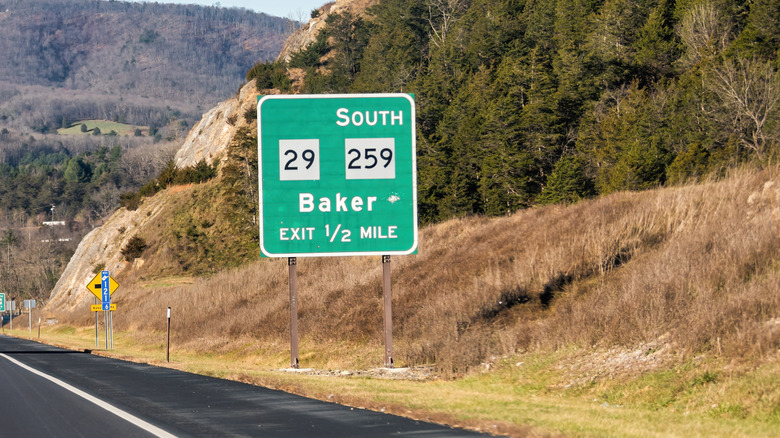
Decimal or not, it's good to know how to actually read a mile marker sign, as some do differ and have specific abbreviations. Certain highway distance signs can have a different color, too. Or, in the case of California, they can be spade-shaped. That being said, a mile marker will have a slightly different meaning depending on where you're traveling to and from. For starters, mile marker numbers increase as you travel north and east, or decrease if you travel south and west. This is handy to know because the number on a mile marker tells you how many miles you've traveled from the state border.
So, let's say that you're driving into Virginia from North Carolina on I-95. In this case, the very first mile marker you'll see is mile marker 1. Conversely, if you take I-81 into Virginia from West Virginia and head south, the first mile marker you'll see is 324. As mentioned, this number will go down the further south you drive. Also, do note that a lot of exit numbers match up with the closest mile marker, meaning exit 317 on I‑81 is right at mile 317. Another interesting tidbit that can help you get your bearings is that odd‑numbered interstate routes go north‑south, and even‑numbered ones go east‑west.