

Why Does The US Military Use Red Light At Night?
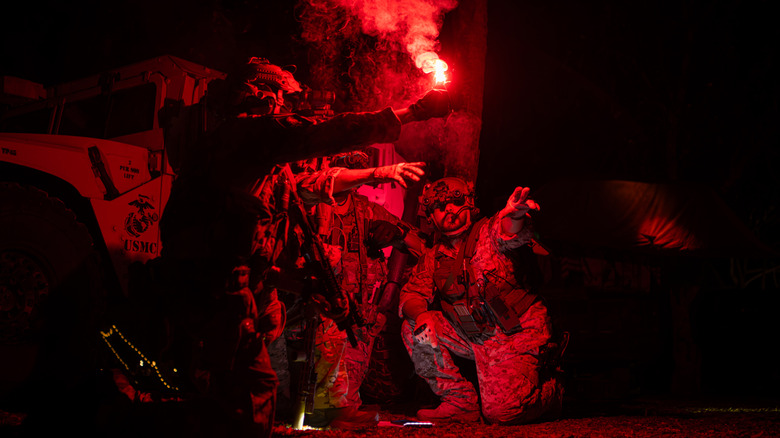
Humans don't see particularly well at night, especially compared to many animals. In fact, according to one study published by Science Daily, frogs may have the best nocturnal vision, as they can differentiate color in lighting conditions where humans would only see darkness. However, despite the limitations of the human eye, military operations aren't restricted to daytime hours. Darkness can be used as a tactical advantage, though some illumination is required. The trick is, how do you provide enough light for soldiers to operate without giving away their position?
Red lights are used by the military because it allows soldiers to see better in the dark without compromising natural night vision. Better still, red light isn't as perceptible over long distances, making it a challenge for enemy forces to spot it. This is much different than night vision goggles first used in the military as far back as the 1930's, which relied on bulky equipment.
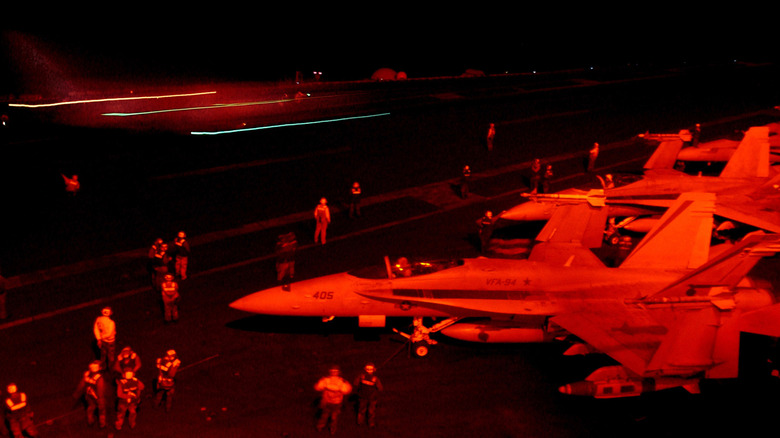
There are a variety of situations these red lights come in handy, such as when ground troops are navigating in the dark and need to verify their position. In addition, naval vessels are illuminated in red both inside and out at times. This allows the crew enough visibility to monitor their instruments and those working the flight deck can see to do their jobs without turning the vessel into a bright beacon that's easy to spot with the naked eye.
Why the color red doesn't diminish night vision
When trying to see in nighttime conditions, your eyes are working hard to provide the most information by widening your pupils, which allows as much light in as possible. The retina then takes this light and utilizing special receptors (rods and cones), converts it into signals your brain processes into sight.
Colors are measured in wavelength, and in terms of visible light, red has the longest wavelength at 700 nanometers (nm). Human eyes can usually distinguish colors between 380 to 700 nm. When exposed to a dark environment for several minutes, your body releases rhodopsin, which is a chemical that helps human eyes see better at night. The problem is, this chemical quickly vanishes when exposed to brighter light even for brief moments.
However, red light doesn't cause rhodopsin to decay, which is what allows soldiers or sailors to continue to maintain optimal night vision. In addition, red light may not just be advantageous for the military, but also could potentially have additional health benefits. According to one study, aging vision was significantly improved following daily exposure to red light.
Red lights are even used on submarines
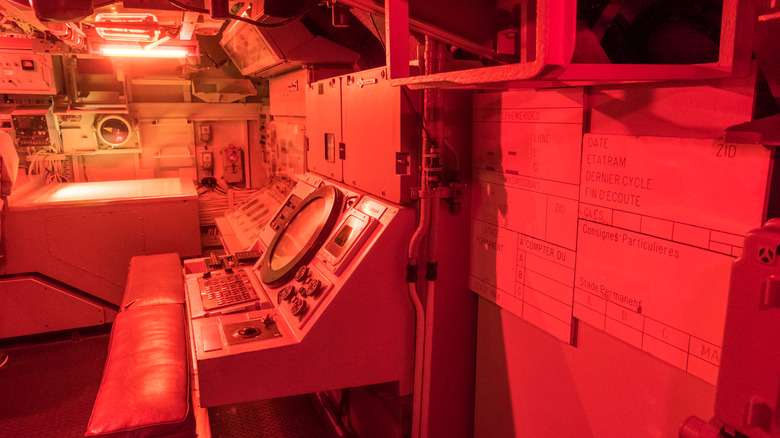
Considering one of the reasons the military uses red light is to be less perceptible to enemy forces, you might wonder why they're also utilized on a submarine. After all, these vessels are designed to travel underwater and are sealed shut, making even bright lights on the interior impossible for anyone outside the sub to see. However, red light actually helps solve a critical problem that effects the health of the entire crew: differentiating day from night. And this becomes critical when considering just how long a military submarine can stay underwater, which is months.
Your body has its own built-in clock, referred to as a circadian rhythm, to identify when it's time to be awake and asleep. With no external cues such as the sun or moon, human circadian rhythms can become disrupted, leading to sleep problems, among others. Military submarines can use brighter white lights during the day but then switch to red lights at night, helping to preserve some semblance of a natural day and night cycle.