

What's The Difference Between Harley-Davidson Evolution & Revolution Big Twin Engines?
Think of a Harley-Davidson powerplant, and chances are that some iteration of the company's big V-twin engines will come to mind. Indeed, given Harley's long association with the format, it's difficult to conceive of anything else. The marque's first 45-degree V-Twin debuted a mere six years after the company was founded, and the rest, as they say, is history.
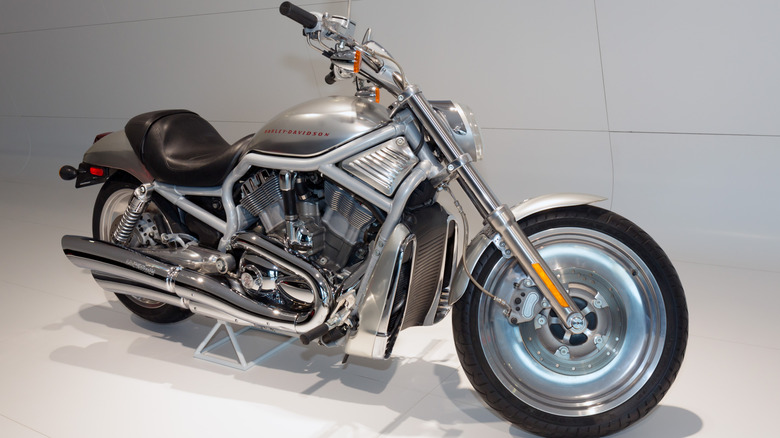
Two significant engines in Harley's V-Twin lineage are the Evolution Big Twin, introduced in the mid-1980s, and the liquid-cooled Revolution engine that powered Harley's VRSCA bikes from 2001 to 2017. The names are actually good indicators of the philosophies defining each engine. The Evolution Big Twin was an updated version of its predecessors, with improved head gasket reliability and enhanced cooling, among other enhancements.
The Revolution, on the other hand, lived up to its name by being a radical departure from H-D tradition. With help from German car manufacturer Porsche, the Revolution was a liquid-cooled, 60-degree V engine that featured a dual overhead cam and four valves per cylinder. Early versions of the Revolution displaced 1130 cc and produced 114 hp, later climbing to 1250 cc and a healthy 123 hp. Let's take a closer look at these legendary Big Twins.
The Evolution Big Twin (1984 - 1999)
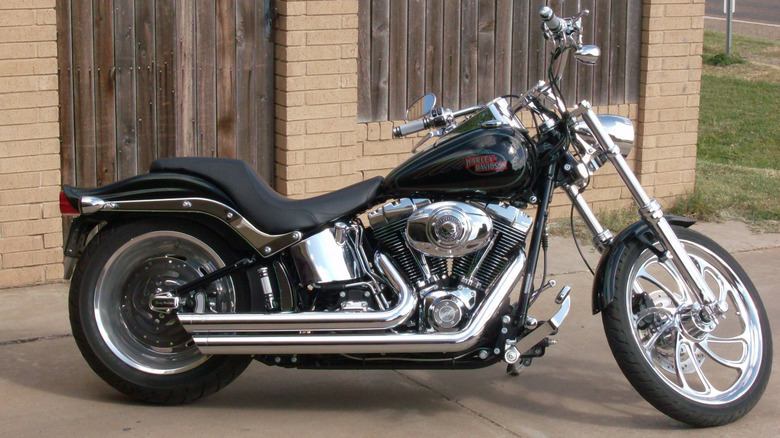
The Evolution engine arrived at a time when Harley needed a replacement for its troubled Shovelhead engine — some versions of which are often regarded as the worst engines Harley-Davidson ever used. In terms of engine architecture, the Evolution retained the Shovelhead's 45-degree layout with twin overhead push-rod-operated valves. While the basics were familiar, Harley introduced several significant changes to improve reliability, cooling, fuel efficiency, and emissions.
One of the biggest changes was the introduction of aluminum cylinders and heads. These could run at tighter tolerances than previous generations and could also shed heat more efficiently. Redesigned combustion chambers and faster combustion also helped to improve the engine's cooling. Shortened exhaust ports helped even more, reducing heat transfer into the heads.
Engine knock was also a frequent bugbear for Shovelhead owners. Low-quality fuel, common during the '70s oil crisis, could cause severe knocking. This could lead to serious engine damage, including damage to the head gasket. To address this, the Evolution used longer head studs for better reliability. The Evolution replaced an ailing engine and is often regarded as the engine that saved Harley-Davidson.
What the Revolution Big Twin brought to the table
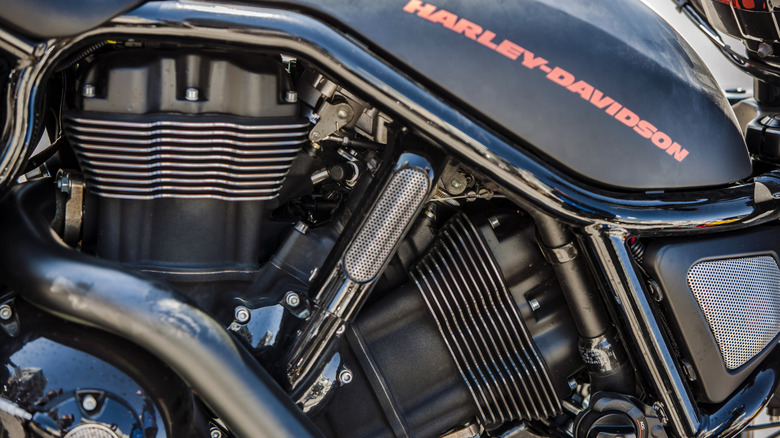
The Evolution was a refinement of Harley's long-established formula, but the Revolution was the opposite. With it, Harley threw its out the window and moved its engines into modern, high-performance territory. Introduced in 2002, the Revolution was the engine that powered Harley-Davidson's V-Rod Muscle family of motorcycles.
While it'd be going too far to say that it took Harley out of its comfort zone, it certainly was a radical departure from previous designs. Rather than Harley's traditional 45-degree layout used in the Evolution and its predecessors, the Revolution used a 60-degree layout with dual overhead camshafts and four-valve heads. It also dropped Harley's traditional air-cooled design, as used in the Evolution, for liquid cooling. The Revolution also featured electronic fuel injection, although it wasn't the first Harley engine to do so. EFI had come to the Evolution in 1995, marking the first time Harley had electric fuel injection.
The Evolution came along when H-D was struggling with aging hardware and a dwindling market share, and helped Harley turn things around. The Revolution was the next step, pushing the company away from its old low-revs-and-high-torque approach toward high-performance designs backed by modern engineering. They're both significant, just in different ways, and it's no surprise that they are considered some of the best Harley-Davidson engines ever made.