

B5 Vs. B20 Biodiesel: What's The Difference Between These Fuel Types?
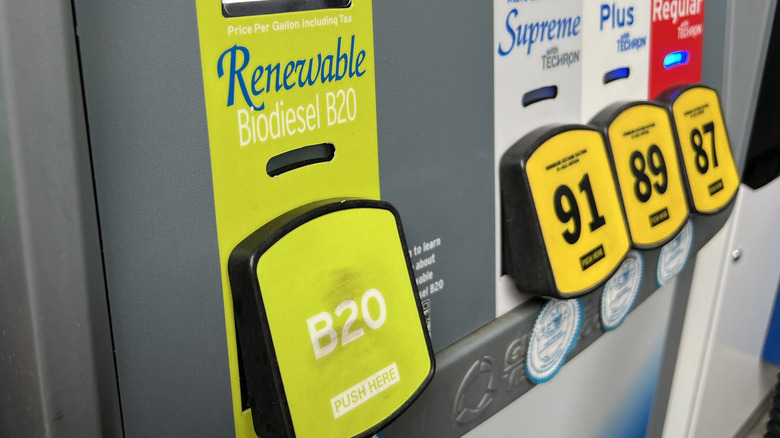
Biodiesel may have failed to live up to its early promise, but it's still available at many fuel pumps across the country. If you're filling up a diesel pickup, a tractor, or a generator, you might wonder what the deal is with the different designations such as B5 and B20. While both B5 and B20 blend biodiesel with conventional petroleum diesel, the two must meet different compatibility and regulatory standards and also come with different emissions benefits and cold-weather performance.
On a basic level, the numbers in each fuel's name tell you how much biodiesel is mixed into the finished product. B5 contains up to 5% biodiesel and at least 95% petroleum diesel. B20 contains anywhere from 6% to 20% biodiesel, with the rest being standard diesel fuel. That subtle difference directly impacts how each blend is regulated and used.
For example, because B5 falls within the limits established under diesel fuel standard ASTM D975, it can be marketed as standard diesel fuel without requiring any separate labeling at the pump. It's also cleared for safe operation in any compression-ignition engine that runs on petroleum diesel. In other words, it's safe for everything from passenger diesel vehicles and heavy-duty trucks to agricultural equipment, boats, and electrical generators.
B20 is the more common blend

What's interesting is that even though B20 contains a significantly higher percentage of biodiesel, it can still be used in most current diesel engines without any modifications. That means it has a better balance between renewable fuel content and everyday usability than B5. As such, even though B5 is technically more compatible, B20 is the most common biodiesel blend around.
It's also the more attractive choice for regulated fleets because biodiesel blends with at least 20% biodiesel can qualify for biodiesel fuel use credits under the Energy Policy Act of 1992. B20 is also slightly cheaper, offers solid cold-weather performance, and offers broad compatibility with conventional diesel engines. For example, Cummins engines can run on B20 biodiesel without issues. All things considered, it's the more common choice for commercial operators and individual diesel owners alike.
There are some minor downsides to be aware of, though. B20 offers slightly less energy than conventional diesel. That means a full-strength B20 blend might leave you with about 1% to 2% less energy per gallon on paper. It's probably not going to make a noticeable difference in real-world fuel economy or vehicle performance, but it's there nonetheless. On the flip side, since B20 contains a larger share of biodiesel than B5, it naturally has fewer emissions than lower-level blends.