

Why Is Air Conditioner Unit Capacity Measured In Tons?
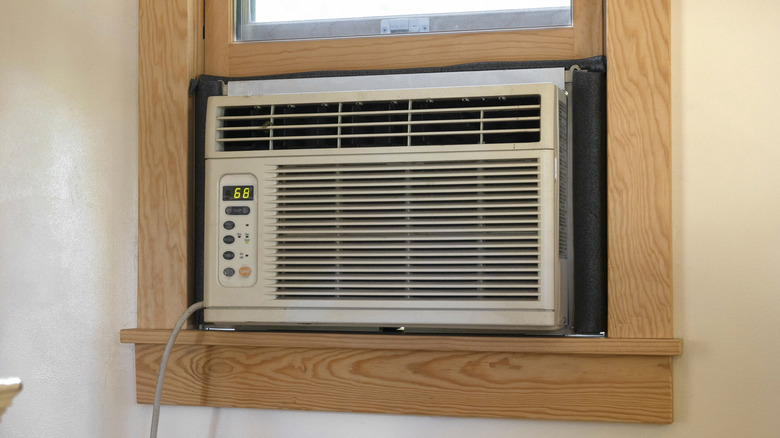
With the summer heat rolling in, finding ways to stay cool is everything. An air conditioner — particularly a unit from one of the most reliable A/C brands out there — can certainly get the job done. With that said, there are some elements of air conditioner shopping that can trip folks up. For instance, it's not uncommon to see a unit's capacity measured in tons, which, fortunately, doesn't refer to the unit's weight. Rather, this dates back to the early days of air conditioning systems, when it was necessary to use full-on blocks of ice to cool indoor spaces.
Before refrigerant became the norm for air conditioning units, large cooling systems utilized blocks of ice in the late 1800s and early 1900s. These blocks typically weighed around 1 ton, or 2,000 pounds, so it became a standard for air conditioning systems to use tons as a measure of cooling ability. In time, ton became shorthand for the amount of heat required to melt one ton of ice over 24 hours. Fast forward over a century later, and ton measurement is now used to describe the heat-removal capacity primarily for larger, whole-house air conditioning systems.
Even as the ton measurement for air conditioning systems has endured, it's not the only heat-removal measurement in use. Another has taken prominence, albeit for explaining cooling ability on a smaller scale.
How tons relate to BTUs

As mentioned previously, ton measurement for air conditioning systems is typically reserved for systems serving large indoor spaces or even entire buildings. This is because the other measure of air conditioner capacity, British Thermal Units, isn't ideal for such a large space. Long before tons became a widely used unit of measurement for air conditioner capacity, BTU was the standard for measuring the heat required to raise the temperature of one pound of water by one degree Fahrenheit. It has also become a favored measurement for explaining heat removal from an area.
In the context of air conditioners, BTU ratings indicate how much heat energy a given unit can remove from the room it's connected to in an hour. As for how BTUs relate to tons, the ton measurement is still used in cases where BTU measurement would be absurdly large. A single ton is equivalent to 12,000 BTUs per hour, so if you're looking into a 5-ton air conditioner, it's easier to call it that than a 60,000 BTU unit. Regarding it in the latter form isn't inaccurate, but it's simpler to just call it 5 tons for brevity.
No matter which unit of measurement you choose, make sure the capacity of your air conditioner is right for your space. Otherwise, you won't achieve the cooling you want.
The importance of air conditioner capacity

When selecting an air conditioning unit, determining the right capacity for your space is essential. Too low a BTU or ton measurement for a given room or building will result in lackluster cooling, no noticeable drop in humidity, and continuous running that can prematurely wear out the air conditioning system. The same goes for a too-high BTU air conditioner in a confined space, as the unit is likely to short-cycle, wear out sooner than an air conditioner's average lifespan, and fail to adequately reduce humidity. Not to mention, air conditioners are energy-hungry machines, so leaving them running with little cooling to show for it is just throwing money down the drain.
All of that is to say, finding out how much air-conditioning power your space needs is essential. Luckily, figuring out the right capacity isn't too difficult, since it's predicated largely on your space's square footage. Websites like Calculator.net provide easy ways to determine your ideal BTU or ton size based on your area's square footage, insulation level, climate type, and other key factors. Additionally, it's not a bad idea to consult an HVAC technician for their input, since they work with such appliances daily and should be able to point you in the right direction.
Air conditioners can be game-changers during the warmer months, and given how pricey they are, it's crucial to understand what exactly you need. Understanding BTU and ton measurements is an essential step to picking the right air conditioning setup for your space.