

The Twice-Failed Experiment That Killed Ford's Semi-Truck Dreams
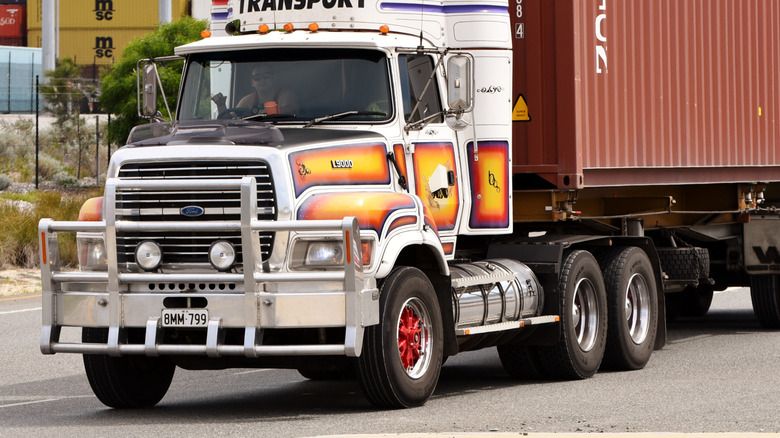
When you think semi-trucks, you probably think of Mack, International, Kenworth, maybe even a car brand that occasionally makes semis. Did you know that Ford also had a semi? The Ford AeroMax L9000 was the last time that Ford attempted to compete in the semi-truck space, which it was part of since the 1950s.
In the 1970s, during the fuel crisis, Ford's L-Series was doing pretty well — the automaker received 4,900 orders before this truck line was produced. However, the 1980s brought new challenges, as truck manufacturers started to close in at a rapid pace. To compete in this space, semi-trucks became more aerodynamic to save on fuel, hoping to get the remaining companies to buy. Ford responded with the AeroMax L9000, hoping to be among the leaders of the heavy truck industry.
It seemed like a game-changer, with a dramatically redesigned nose and integrated headlights to control air flow around the truck and reduce drag. However, independent agencies ran an SAE Fuel Economy Test that showed the AeroMax was able to get 8.27 MPG, compared to the Kenworth's contemporary model boasting 9 MPG. Since the AeroMax came out a bit later, it wasn't giving truck companies a huge reason to buy a new rig. While the AeroMax didn't live up to sales expectations, the carmaker tried once more to enter the semi-truck space.
Ford tries to make the AeroMax work one more time
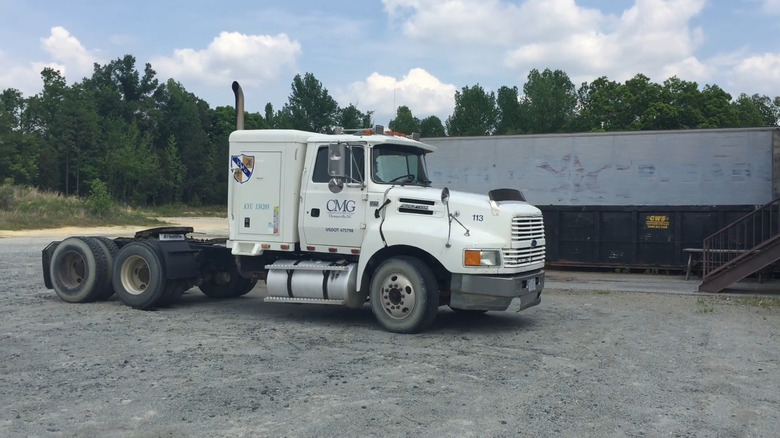
Despite the AeroMax's failed launch, Ford decided to give it another shot for model year 1996. The second-generation AeroMax's angle? Being more comfortable to drive. Ford had 5,000 truck drivers help design the interior, including its seating and gauges. The result was a semi-truck with highly adjustable seats, a clearer dashboard, larger windows for a better road view, and a quiet cab. On the outside, Ford used a ton of plastic to make this truck more aerodynamic and lighter than before.
The development of this new truck cost Ford $500 million. Unfortunately for Ford, the second-generation AeroMax had slow sales, and the brand's truck market share was dipping drastically. It was falling behind the competition again, unable to keep up.
By 1997, just a year after the new AeroMax truck came out, Ford sold its semi-truck business to Freightliner for $200 million. Ford simply could not keep up with the competition, despite the AeroMax boasting a futuristic design and prioritizing driver comfort. Its new HN80 platform was doing quite well, looking modern decades later thanks to its car-inspired interior, including cruise control switches on the steering wheel. In the end, Ford chose to focus on its lighter pickup trucks, like the F-Series, which would go on to become the best-selling truck in the United States multiple times.