

What Happens If You Max Out The Speed Limiter On A Car? Here's How The Tech Works
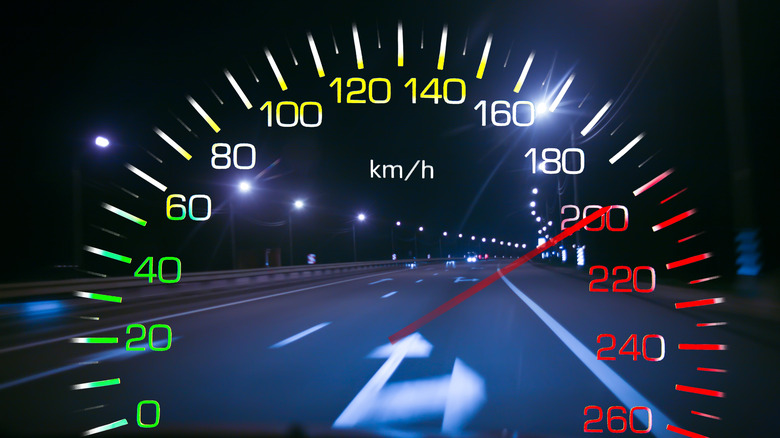
It's pretty self-explanatory: a speed limiter is a component in your car that stops it from going faster than a set number – for the sake of safety. Some of these are baked into the car at the factory itself, while many others are bolted on later by a third party. Not every car has one, especially if it's an older model. However, plenty of modern cars come with one, and in the EU, they even ship with an Intelligent Speed Assistance limiter, which is required by law.
A speed limiter isn't really a component you can yank out whenever you wish to unlock more speed. On most modern cars, it's a part of electronic sensors wired to the small embedded computer hooked up to the car's engine, also known as the ECU (electronic control unit). These sensors keep tabs on your speed, and the instant it reaches the set ceiling, they clamp down. Usually, that's done by pinching off some of the air and fuel reaching the cylinders. Moreover, since all modern cars run a throttle-by-wire system – instead of a physical cable connecting your pedal to the engine — the signal can simply be tweaked to hold the throttle.
As for what happens when you max it out, well, you can try to bury the pedal all you want, you'll simply not be able to get around it. It's a seamless process, and you won't feel a jolt or anything — the car will just refuse to climb any higher. The power gradually tapers off until you settle back to the allowed speed.
There's sometimes a way to punch through it
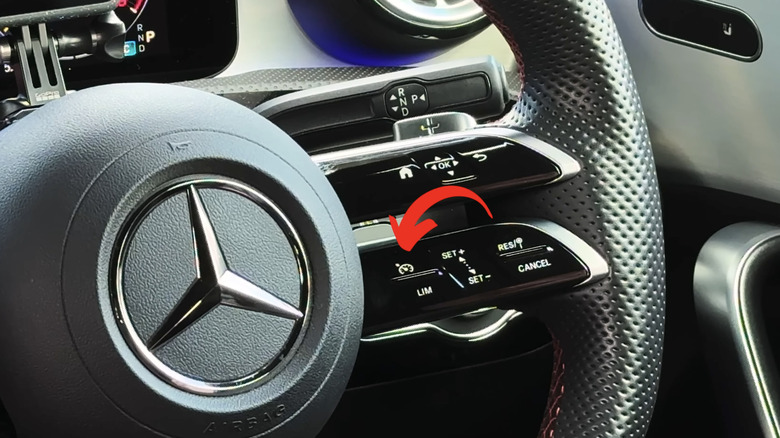
Whether you can shove past it really depends on the kind of limiter system you are dealing with. Many cars come with a limiter set up a user themselves can control – you basically set a speed you'd rather the car not cross, through buttons on the steering wheel marked LIM. The car then holds at that speed, though for safety reasons you can punch past it. All you need to do is push the gas pedal all the way down to the floor (to hit the 'kickdown' switch) — the car will then temporarily override the limiter to allow for emergency maneuvers.
However, there's also a top-speed governor installed on many cars you can't do anything about directly. It exists to protect the tires and engine, so simply flooring it would get you nowhere past it. Take the 2024 Mustang Dark Horse, the speedy, most track-focused version of the car, for example. Despite packing 500 horsepower, its top speed is electronically governed to 168 mph for the sake of safety.
But it's not just ICE cars with limiters, as EVs have them too. Since hard acceleration and high speed drain a battery fast, a lot of electric cars artificially cap their top speeds, even though they're capable of much more. That's done through the power controller. Besides safety, it also helps to protect their range. Also, it's worth mentioning is that limiters aren't just a car thing. They also turn up in commercial vehicles in everything from delivery vans to heavy trucks.
So can you actually remove it?
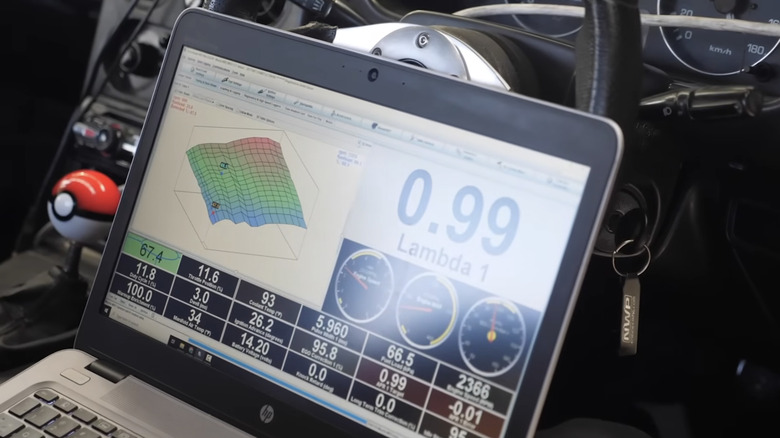
It's certainly possible to delete the speed limiter, and it's something that some people do. The usual route to pull off is ECU tuning, where a tuner reflashes the unit for performance gains – or to remove the cap. It can also be achieved using a bolt-on performance chip, an aftermarket module that piggybacks on the factory engine computer. On some older cars, you also have model-specific mechanical hacks. For instance, on the Nissan 240SX, a 90s sports coupe, you can unplug a couple of transmission sensors and the computer loses sight of the revs in the highest gears. With no reading to act on, the limiter stays dormant.
Whether you should is another matter. Most factory caps land at whatever the carmaker is comfortable with for the engine and everything attached to it. Blow past that by 20 to 30 percent, and you are rolling the dice on a mechanical failure. Moreover, on commercial vehicles like a school bus, there are legal walls, too, that you aren't supposed to tear down. Quietly modding cars also dents your insurance, so that's another factor worth keeping in mind.