

Why Do Some Motorcycles Have Inverted Forks?
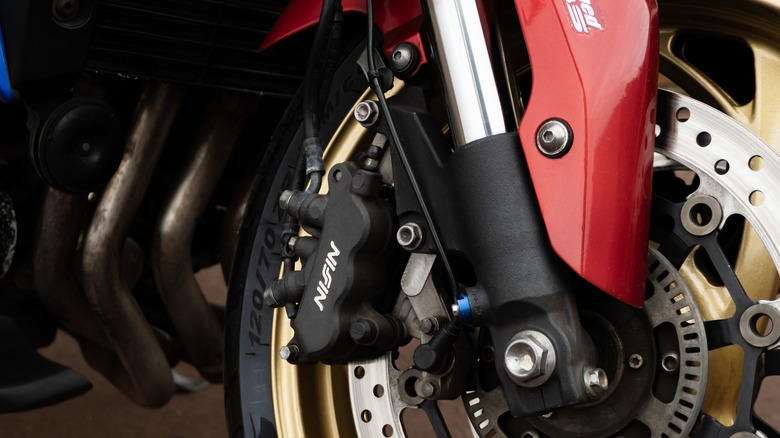
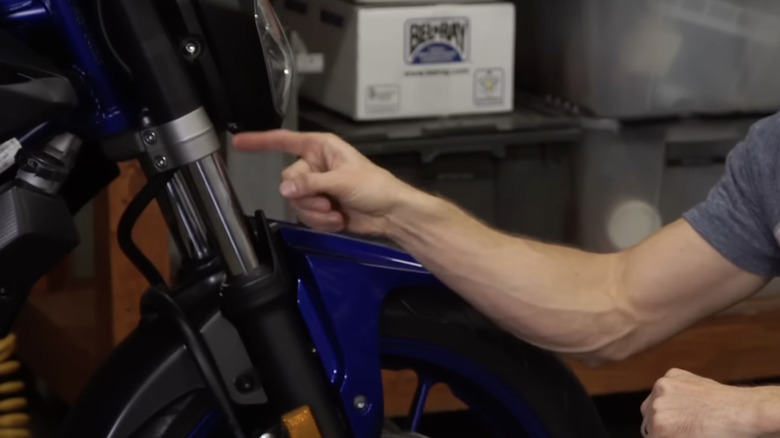
Not all telescopic suspensions are built the same on motorcycles. In fact, some of them are mounted upside down. It's easy to tell which one's which. If the fatter tubes (typically gold, black, or colored) sit up high near the bars, while the skinnier ones (usually silver) run toward the wheel, then you're looking at an inverted fork telescopic suspension. These are also referred to as upside-down forks by those who prefer to be more literal, and even abbreviated to USD. They work exactly the same way as a regular fork, just in reverse, which brings about some changes in how the suspension performs.
The main difference is the stiffness. In a regular fork, it's the skinny tubes that connect to the triple clamp, the part that joins the forks to the frame of the bike. When you flip that, the wide tubes end up sitting up top. These beefier tubes resist bending far better while at the same time also giving the clamp a firmer grip.
The benefits add up fast, especially when you are hard on the brakes — that's when a bunch of force is dumped into the forks right below the lower triple clamp, which ends up taking the brunt of the load. An inverted fork can reduce this strain by putting its fattest, stiffest section right there. This results in less flex, and in turn, more precise steering, while you also feel where the wheel is going much better.
Inherited straight from racing
To understand how the inverted telescopic fork came to be, we'll first have to take a look at the regular telescopic fork itself, which actually precedes the upside-down version. Motorcycles have been running some flavor of it since 1935, the year BMW began making the famous R12, so it's had a long run already. However, it wasn't until 1984 that the first inverted fork showed up on a production bike, thanks to Austrian brand KTM. It fitted out its 495MX dirtbike with a White Power inverted fork. So technically, it was dirt bikes that got it first.
Racing did the rest. Race teams quickly realized how much steadier those stiff front ends were, and by the end of the 80s, pretty much everybody had copied the idea. Eventually, it also started making its way to road bikes: The Kawasaki 1989 ZXR400 is usually credited as the first production model to carry them.
Another major advantage these forks offer, besides stiffness, is that because they are so much wider, there's spare room inside them for cartridge dampers. These are basically sealed valve units that control how the fork settles after a bump. On regular forks, this is handled by more basic damper rods. But cartridge dampers are simply a whole lot smoother. This is another reason why the inverted layout caught on.
So why isn't every bike running them?
As for why not every bike today features inverted forks, the main problem actually is cost. Those basic damper rods in regular forks contain fewer parts inside, making them cheaper to build, and in turn, more suitable for budget bikes. They also win out in servicing, since on inverted forks, you have to pull them right off the bike just to change the oil. Some of them even need specialized tools to get the whole job done.
There's an important safety wrinkle as well. On an inverted unit, the fork seal sits down low, close to the brake disc. If that seal ever gives up, oil can leak straight onto the brakes and tire, which can be downright dangerous, especially at high speeds or when cornering. It's an important factor to note, considering how dangerous motorcycles already are compared to cars.
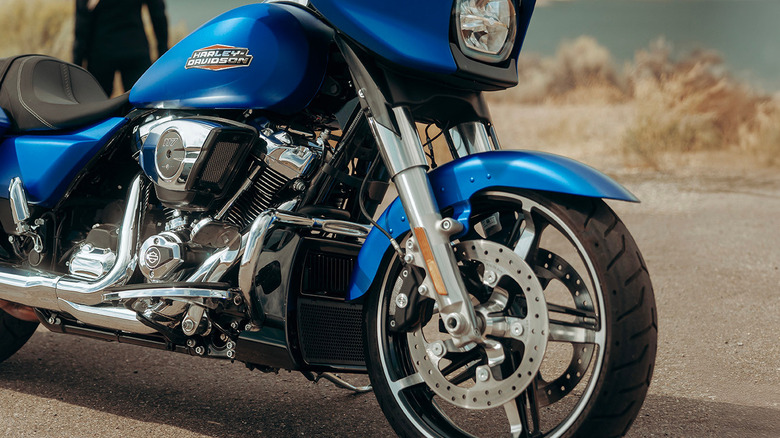
The two combined represent some serious performance trade-offs, which the average rider wouldn't notice anyway. At normal speeds, there's barely any flex in the forks in the first place, so the payoff only really counts on the track. That's exactly why bikes like the Harley-Davidson Street Glide and Triumph Bonneville happily stick with regular forks. On classics like the Bonneville, one of the more affordable retro bikes you can buy today, that kind of high-tech stuff may also look and feel out of place.