

Drivers Are Using This Free Tool To Beat Flock's AI Traffic Camera Tech
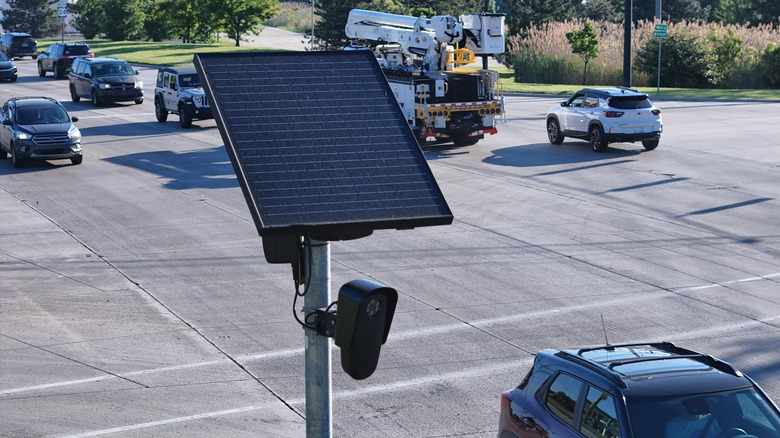
Flock traffic cameras have become an everyday part of driving on highways across the United States. But the type of data they collect and the extent to which it's used have become serious points of concern for many people. Now, a free public mapping tool is making it easier to know where these systems are installed, allowing drivers to avoid them altogether.
The tool is called DeFlock, an open-source project that maps the specific location of Automated License Plate Readers (ALPRs) across the U.S. DeFlock has identified and mapped over 100,000 such systems nationwide. Users can access the website for free to launch the map, where they can enter an address, city, or zip code to find ALPRs in their area. From there, the exact coordinates of each camera, along with other details such as the manufacturer's name, can be accessed. Users can also enter their start and end points to get routes free of ALPRs.
Because DeFlock is open-source, users can contribute information regarding ALPR locations through the organization's website. This allows the available data to be updated consistently, adding new locations and expanding the map further. Drivers can use the service on the go with the mobile app, where they can view and enter information. Flock Safety sent a cease-and-desist demand to DeFlock in early 2025, but as of this writing, the project is still online.
Flock Safety's effectiveness and public pushback
According to Flock Safety's 2025 Impact Census survey, the company's ALPR cameras assisted in solving 20% of cleared cases in areas where the technology is used. The survey consisted of input from nearly 700 law enforcement agencies across 43 states. Flock also claims that its systems assisted in finding more than 10,000 missing persons and were involved in recovering a substantial amount of stolen vehicles in the U.S.
However, cities are fighting back against Flock Safety, and DeFlock has openly challenged the company's claims, arguing that there is no independent evidence that ALPR systems reduce crime. DeFlock also asserts that much of the research used is produced, or at least influenced, by either the companies selling the tech or the agencies utilizing it. DeFlock has pointed to existing studies suggesting that the effect of ALPR systems is minimal at best. Much of DeFlock's public focus has centered on how these systems are used and how the information they gather is utilized by law enforcement agencies.
Flock Safety is facing its share of public pushback over its ALPR systems, as its cameras capture a lot more than just license plate numbers. There are legal claims that center on concerns about privacy and data handling, specifically the sharing of driver information among various agencies. Critics of the Flock systems argue that civil liberties issues are at play as well, including the scale of data collection and how vehicle location information is accessed.