

Why 155 MPH Became The Top Speed For So Many Cars
Most of us rarely see our speedometer go above 100 mph. The majority of U.S. highways have a speed limit of 70 or 75, with a few allowing 80 mph and only one state, Texas, allowing drivers on some portions of certain roads to hit 85 mph. Other parts of the world have even higher limits, including the famous Autobahn in Germany, which has sections with unrestricted speed.
German sports cars are renowned for many reasons, including precision engineering, luxury and, of course, speed. If you've ever owned a BMW or a Mercedes-Benz, you may have noticed that its speed was factory-capped at 155 mph. If you're confused as to why a country that built a highway with few speed restrictions would limit even high-end automobiles to 155 mph, well, you're not alone. The main driving forces behind the decision may not surprise you, however: cost and safety.
According to the Insurance Institute for Highway Safety, almost 30% of all crash fatalities involve a speed-related accident. In the U.S., speed accounted for almost 12,000 deaths in 2023 alone. In the 1980s, German automakers realized that standard tires simply aren't designed for speeds higher than 155 mph. Of course, other tires are made to withstand high speeds, but those are expensive and would significantly raise the price of every model. Other parts of the car would also have to be designed to withstand the forces of high speed, including brakes, suspension, and even the body.
The 155 mph limit: a gentleman's agreement
Three of Germany's biggest automakers — BMW, Mercedes-Benz and Audi — regularly compete for the same customers. Rather than rely on eventual governmental guidelines that may have restricted speed for safety concerns, these companies reached an informal "gentleman's agreement" to speed-cap their performance vehicles at 250 kph (around 155 mph) and compete in other ways. Customers can still compare these vehicles in terms of luxury, acceleration times, standard tech and equipment, and more.
Today, BMW tends to focus on performance while Mercedes-Benz offers comfort and ultra-luxurious interiors. Audi settled comfortably in the middle-ground, offering luxury while also focusing on traction and handling. There are few places in the U.S. where you can drive anywhere close to 155 mph, and we don't have any public roads like the Autobahn that allow you to really put the pedal to the metal. To legally drive at speeds this high, you have to find a closed-course track or a dedicated experience.
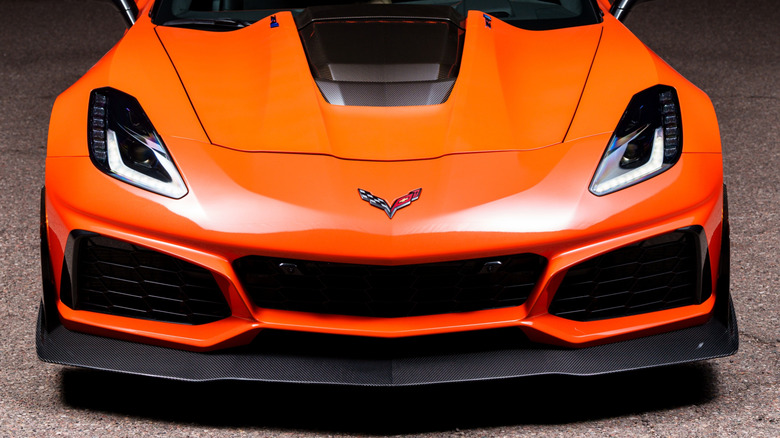
Of course, not all cars sold in the U.S. are speed-capped. If you really want those bragging rights, the most common everyman car sold in America that offers speeds over 200 mph is the Chevrolet Corvette. The ZR1 has a top speed of 233 mph and is currently sold for $185,000 as of this writing. The Bugatti Tourbillon, meanwhile, would leave the ZR1 in the dust, with a top speed of 277 mph. It's street legal but virtually impossible to buy thanks to its extremely limited run of only 250 and its $4 million price tag.