

What's The Difference Between Nitro Fuel And Regular Gas?

If you've only driven a vehicle that uses regular gasoline with either 87 or 89 octane, you may not be familiar with other fuel types and what they're made for. Something like nitro fuel might sound like a gimmicky new option at the pumps, but it's actually a special racing blend meant for use in high-performance vehicles.
Nitro fuel is made with methanol, which acts as the primary base, along with nitromethane, which gives the fuel its name and increases power output by changing how the fuel burns when under combustion. Lubricants are also added for a final mixture that is designed for performance applications like drag racing, rather than everyday driving. Regular gasoline, which is a refined blend of hydrocarbons, is instead formulated for everyday drivers. Its overall performance is limited by its octane rating, which measures just how well gas can hold up under heat and pressure. The higher the octane, the more compression an engine can handle before detonating.
Perhaps the biggest difference between the two fuels is how they burn. Regular gas needs oxygen from the air entering the engine in order to combust. However, nitro fuel already contains oxygen in its own chemical structure. This means nitro needs less oxygen per unit of fuel, which allows more fuel to burn at a time. This is how it creates the added power output necessary for high-performance racing engines.
How nitro fuel and gasoline are used
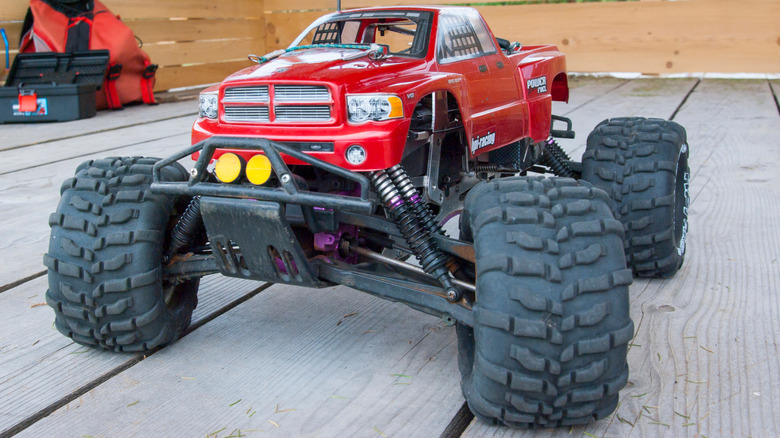
While nitro fuel is widely utilized in drag racing, it's not limited to just that application alone. Nitro is commonly used in certain types of Radio Controlled (RC) vehicles, where similar fuel principles exist. (Although they are scaled down for much smaller engines.) The chemical components of the fuel itself are the same in RC racing, but the exact blend can differ, depending on performance needs. However, some sources estimate RC nitro fuel contains between around 10% and 40% nitromethane.
Regular gasoline can be used in RC vehicles as well, but with some caveats. Because gas and nitro are designed for different types of engines, gas can only be used in certain RC models. Gas-powered RCs actually use gasoline mixed with motor oil, similar to full-size gasoline engines. But while both gas and nitro do share some crossover uses, gas is designed to support a much wider range of engines and applications.
That includes outdoor power equipment, such as chainsaws, leaf blowers, string trimmers, and some of the most reliable gas-riding mower brands. However, depending on the engine type, some equipment may use straight gasoline, while other small engines require a mix of gas and oil in order to operate properly. Exact fuel requirements for these engines vary based on design. Because of that, it's always important to check with the owner's manual to ensure you are using the right type. This will ensure proper performance, as well as engine longevity.