

Why Do Utah State Highway Signs Have A Beehive?
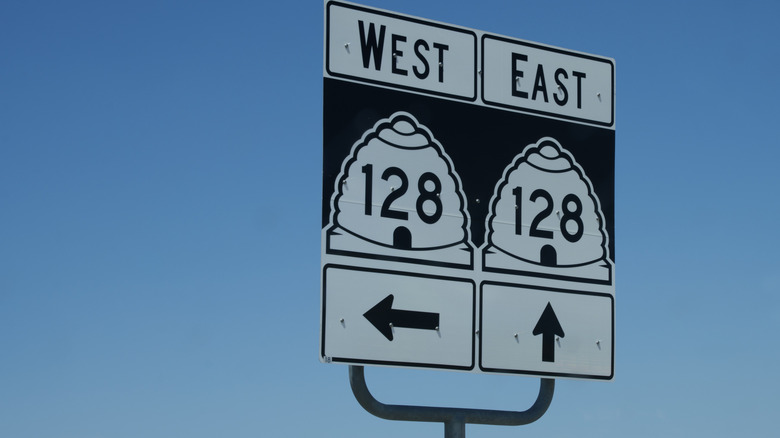
If you've ever driven through Utah, you probably noticed something a little unusual on the state highway signs: an image of a beehive where the usual shield or state silhouette might be. As it turns out, the beehive is one of Utah's most cherished symbols, almost like a visual shorthand for the state's entire identity. It goes all the way back to the earliest Mormon settlers who arrived in the Salt Lake Valley in 1847. Those settlers called their new state "Deseret," which is a word from the Book of Mormon that means "honey bee." It reflected how they saw themselves and what they were doing: taking a harsh landscape and attempting to build a successful society out of it.
The first governor of the Utah Territory and president of The Church of Jesus Christ of Latter-day Saints, Brigham Young, further embraced the beehive emblem, incorporating it throughout early Mormon architecture and public life. Beehive motifs could be seen on church buildings, homes, decorative features, and even Young's own Beehive House. The beehive remained a central feature when Utah joined the Union in 1896, appearing on both the state seal and state flag. It became the official state symbol in 1959, which helps explain why Utah started using it on state highway signs.
The beehive is central to the state's identity

Over time, the beehive has become less about religious identity and more about Utah as a whole. Even as Utah's population diversified, the emblem has continued to represent the state's belief in community-minded cooperation. So it's not surprising that when state leaders redesigned Utah's flag in 2024, the beehive remained the dominant visual element. Today, the beehive can still be found on state highway distance signs, route markers, and beyond. It also shows up on government buildings, public infrastructure, business names, and even educational institutions throughout the state.
While most states use either a shield emblem or a silhouette of the state itself on their highway signs, Utah follows in the footsteps of other western states that buck the trend. For example, New Mexico uses a sacred Zia sun symbol to honor the Indigenous Zia Pueblo community. California uses a spade-shaped sign as a tribute to the Gold Rush. Further up the winding Pacific Coast Highway, Washington (fittingly) uses a silhouette of George Washington's profile. Looking at the big picture, Utah's just having some fun with its signs like the rest of the region.