

What Is The 30% Rule For AI? Here's What It Means

AI acceleration continues apace, with humans and regulations trying to keep up. According to the 2026 AI Index Report by Stanford University HAI, generative AI adoption reached a 53% population adoption rate in 2026, with the United States leading global AI investment at $285.9 billion. While these figures demonstrate that AI isn't going anywhere, it does little to assuage the concerns that many have with AI adoption. The phenomena of AI fatigue is soaring, and the anxiety of AI-related layoffs are a real concern, as thousands of future layoffs could reveal the harsh reality of the AI revolution that continues to fuel a paradigm shift in the workplace. A Gallup survey reports that 18% of U.S. employees believe their job will be eliminated due to AI in the next 5 years –- that number rises to 23% among employees who are already working alongside AI.
Though, amidst the AI-generated upheaval, an emerging principle that is intended to strike a balance between AI and human work is the 30% rule. The 30% rule recommends a ratio of 70/30, whereby AI handles 70% of the workflow, and humans focus on the remaining 30% that requires creativity and critical thinking skills. How this looks in practice varies by industry, but the concept remains the same: let AI do the heavy lifting, while not eroding the value and importance of human interaction.
The 30% rule is a blended approach
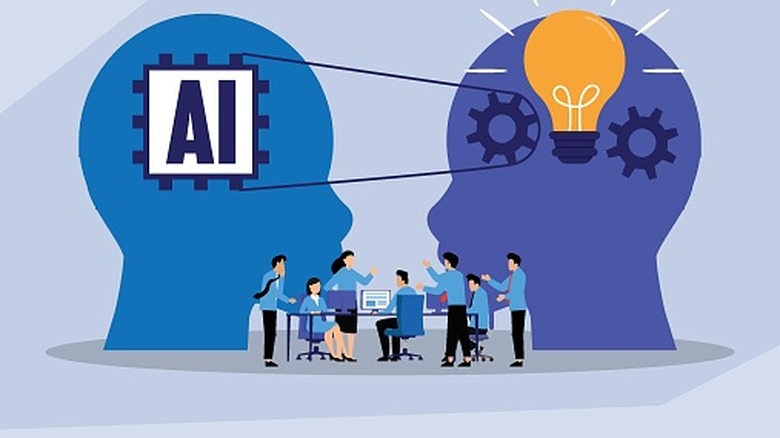
The origins of the 30% framework for AI implementation in the workplace are hard to trace, but it is a guideline that is being increasingly recommended for a modern work culture in the age of AI. It's a blended approach meant to balance the disparate strengths of human talent and machine work. Under this rule, AI can handle the mundane day-to-day tasks that various roles are inundated with, or it can be any time-intensive workload that can benefit from the speed and scale of machine learning. Humans then focus on work that requires ethical judgment, nuanced thinking, contextual awareness, or emotional intelligence.
While this model of work combines AI automation and human value, it also preserves the idea that AI needs ethical human oversight. It is meant to work in tandem with the growing regulations regarding AI, like the EU Artificial Intelligence Act or California's pioneering AI transparency and safety laws — both landmark AI laws that could very well shape future legislation around the world. The 30% rule is meant to reinforce the notion that AI is a tool, and it is meant to be complementary, not comprehensive.