

How A High-Tech Boat Rescued Downed US Troops Overseas With No Crew Onboard
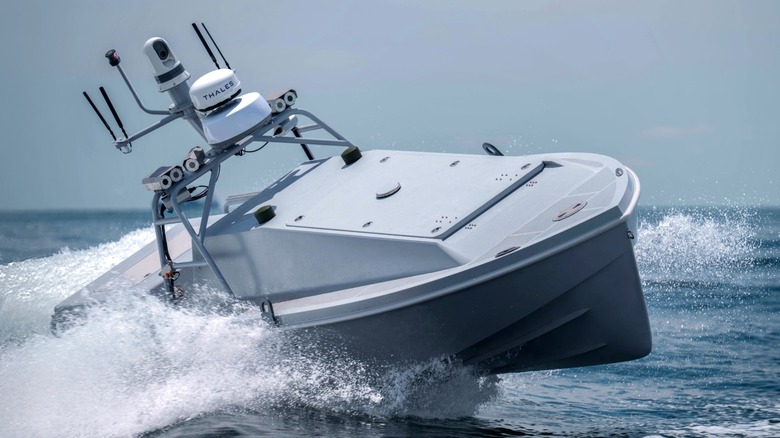
One of the most important things that every sailor knows and has had drilled into their heads from the start is what to do when someone falls overboard. Man overboard drills are commonplace on all types of ships, and the training everyone receives helps save lives when and if such an event actually occurs. As time passed, new methods for personnel retrieval included the use of helicopters and drones. Now, a new type of U.S. Navy autonomous surface vessel (ASV) is being used to find and save personnel in the water.
On June 8, 2026, an Iranian drone downed a patrolling United States Army Boeing AH-64 Apache helicopter, which splashed down near the Strait of Hormuz off the coast of Oman. In response, the Navy dispatched a Saronic Corsair powered by artificial intelligence to find and rescue the crew. The mission was a success, marking the first time an ASV carried out such a rescue. According to a press release from U.S. Central Command, both soldiers were found and rescued within two hours.
The ability to dispatch an uncrewed boat that can find and rescue personnel is an absolute game-changer in terms of maritime safety and rescue operations. As the U.S. military continues to bulk up its wide-ranging fleet of drones, it's likely that more rescues will be carried out similarly in the future. For now, the rescue marks an important milestone in demonstrating the efficacy of ASVs, which are being developed all over the world for a variety of mission types and operations.
The Saronic Corsair ASV
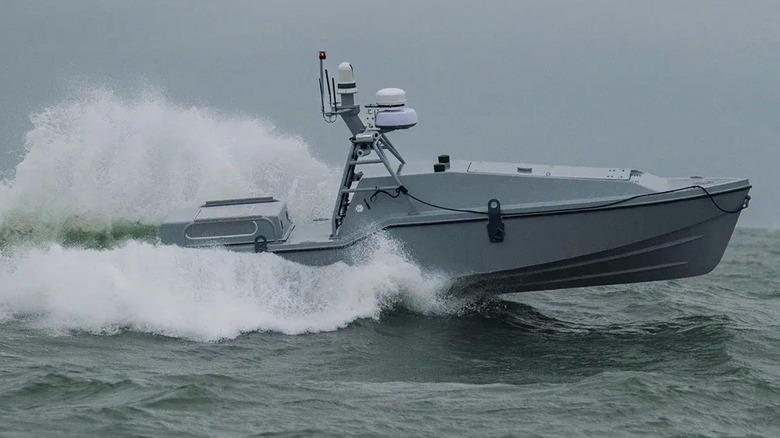
The Saronic Corsair used in the rescue is operated by U.S. 5th Fleet's Task Force 59, which began using them in March 2026. The unit is based out of Bahrain and works to integrate artificial intelligence with uncrewed maritime systems in the 5th Fleet's area of operations, so it was ready to go on a moment's notice. The Corsair is one of several ASVs produced by Saronic Technologies, which is based in Texas. The Corsair can carry over 1,000 pounds and has a range of more than 1,000 nautical miles (about 1,150 miles).
The vessel has a top speed of 35+ knots (about 40+ mph) and is capable of more than rescue missions, as it can be outfitted with all manner of sensors and equipment. The boat measures 24 feet in length and is powered by artificial intelligence that provides smart navigation through adaptive path planning. While the Corsair incorporates AI, it must still be guided by human operators who dispatched the vessel to the downed helicopter's location to find and provide a rescue platform for the two soldiers.
For its AI, Saronic developed Echelon, which integrates software and hardware to provide faster decision-making and smarter autonomous behaviors. This allows sailors to set mission objectives along a preferred route, which is all managed via a simple click-to-plan interface that anyone familiar with modern computer systems can operate. The company is working to provide over 20 additional Corsair vessels by 2027, and given the success of its latest rescue operation, the Navy is likely eager to acquire them alongside other long-range drone ships.