

What Does The CE Mean On Electronics & Other Products?
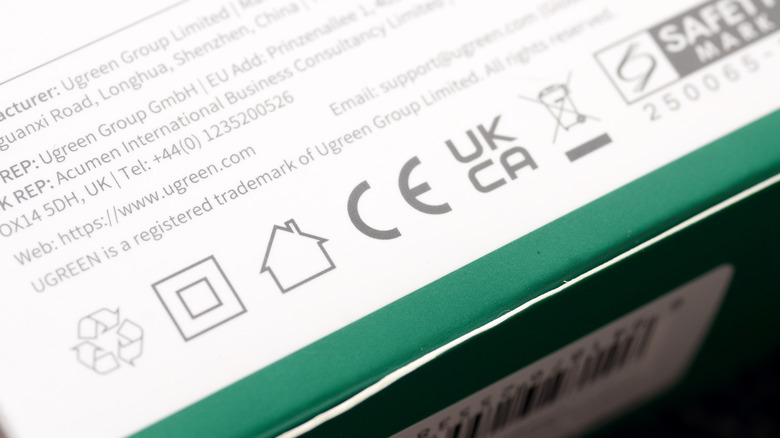
Flip over almost any gadget in your house — let's skip the washing machine for your spine's sake — and you'll spot two little letters near the power ratings: CE. Everything from the everyday, like chargers, to the less common, like drones, has them. Sometimes when something's that common, people tend to skip thinking about why it's even there. But if you're one of the few curious people who wondered, there's an answer.
CE is actually short for conformité européenne, French for European conformity. A product with that stamp means it complies with the European Union's rules on health, safety, and the environment. It came into being in 1993, when that tag was locked into EU law, though it was only in 1996 that electronics were required to carry it. The actual chain of events that led to its creation began in 1985, when the European Economic Community, the EU's earlier form, launched a plan called the New Approach. The goal was to get countries to agree on shared safety basics for the sake of simplicity, while also letting companies vouch for their own stuff.
What the mark really buys is freedom for companies and sellers to move the item across the EU and the wider European Economic Area, no matter where it was made. Even some non-EEA countries require it, like Switzerland and Turkey.
It's bigger than just Europe, and bigger than gadgets
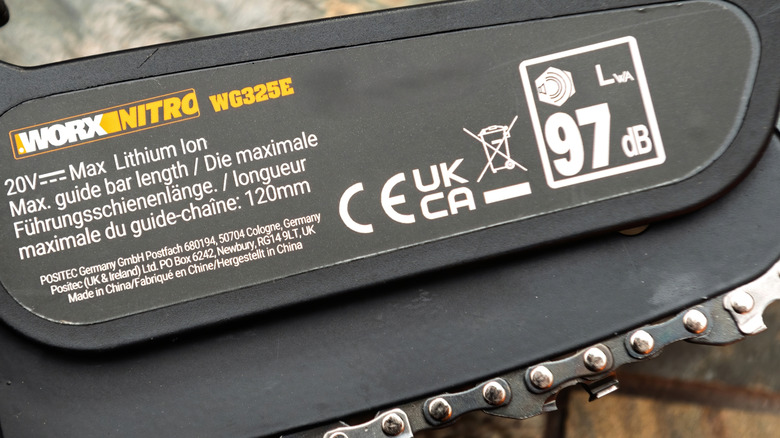
As for the USA, while many products may have CE markings on them, they aren't required in the country since American regulators don't recognize them. That's because the USA runs its own setup. But it's not like CE is banned in the US either, which is why you see it here. The thing is that makers just slap that logo on a single design and ship it across the world, rather than retooling for each market. It's also indirectly a result of the EU being a highly influential body, so any regulations it imposes ripple out worldwide, like how Apple was forced to put USB-C on every iPhone, not just its European ones, thanks to Europe's new USB-C law.
It's also worth mentioning that CE is not just for electronics. You'll find it on toys, medical devices, protective gear, and industrial machinery. And that list only grows ever longer because the EU keeps stretching it. The one catch is that the mark only applies when a specific rule calls for it. So if there's no rule that covers your product, it's illegal to stick those letters on it.
There are also certain gadgets that must meet a few additional directives before they earn the CE badge, whichever applies to them. For instance, there's the Radio Equipment Directive, or RED, which governs anything that uses radio waves to talk or locate. Similarly, you also have the Low Voltage Directive, covering power supplies.
But does anyone really check it?
It may well seem that if a gadget says CE, it means that somewhere there's a central EU office that's handing out permissions for specific items. Or perhaps an outside lab poking at the thing before signing it off. But that isn't the case. The truth is that CE is more of a self-declared mark, so for most lower-risk products, the maker basically checks its own work, writes up a Declaration of Conformity, and adds the letters itself. A good example of this is some of the best portable phone chargers, since it's usually the company that assesses it all in-house.
However, for higher-risk gear — like medical devices or industrial machinery — it must go through a notified body. This body is just an outside organization, typically one that an EU member state has cleared to vet products. One of the big ones is Germany's TÜV SÜD. You can tell when a body like that has signed off on a product, thanks to a four-digit ID code, which you will find stamped beside the mark.
Contrary to what many people think, CE was never meant to be a quality badge. The whole thing is really built on trust, so if makers want, they can put the label on without actually testing. And this is something that many makers do as well, making CE one of the most forged marks out there today – in fact, it's frequently found on fake Apple chargers, making them harder to spot. That's why many countries choose to run their own tests — like Germany, which has its GS mark, short for Geprüfte Sicherheit. It only goes on after an accredited German lab properly checks the product.