

What Are Those Spiral Hoses On Semi Trucks For?
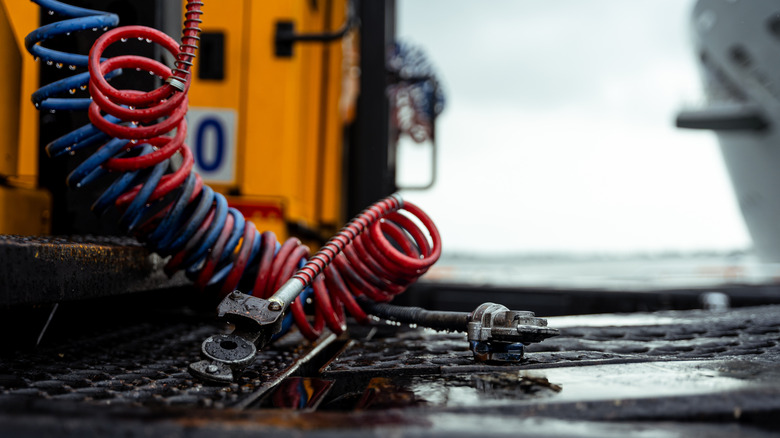
If you've ever been driving along the freeway or parked at a rest stop along the highway, you've probably seen more semi-trucks than you can count. And if you're the mechanically curious type, or you just haven't grown out of that big rig fascination many of us had as kids, you've probably wondered about all the different things that set these huge vehicles apart from everything else on the road. Perhaps you're curious about which company the semi truck is made by, or you've noticed those distinct hoses that connect the tractor to the trailer it's towing and wonder what exactly they do.
The hoses in question are usually spiraled and colored both blue and red. Often, they're joined by a similar-looking spiraled green cord. The purpose of the blue and red hoses is to provide air from the tractor to the trailer's brake system, while the green line is actually not an air hose but an electrical connector.
And there's a specific reason why those hoses are coiled that way — it's to reduce overhang and eliminate possible safety risks. Some setups will have all the hoses running independently of each other, and others integrate all three lines for a more streamlined setup.
The power of air
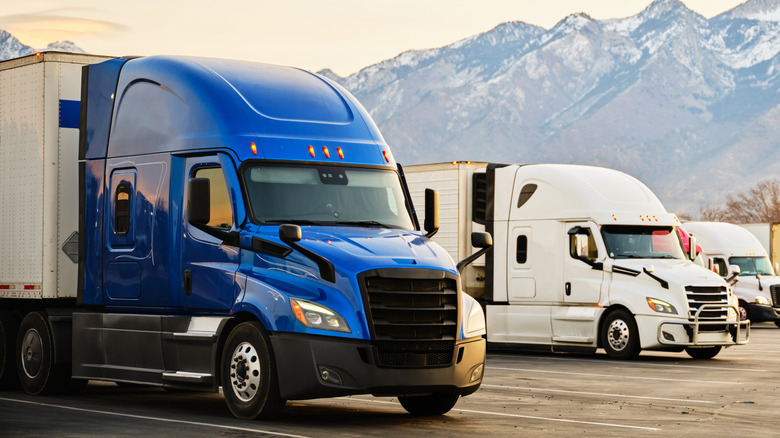
Before we get into the hoses themselves, it's important to have a basic understanding of how semi-truck brake systems actually work. With their massive weight and size, semi-trucks and their trailers can't use normal hydraulic brakes the way cars do. Instead, they use pneumatic air brakes.
To put it simply, a compressor near the tractor's engine sends compressed air to tanks in the trailer, which in turn uses the air to engage the brakes themselves. The hoses you see on the outside are used to supply air through the system between the tractor and the trailer. The air brake system isn't just used for its stopping power; it's also cleaner and easier than trying to connect and disconnect hydraulic fluid-filled brake lines between a semi-truck and the various trailers it pulls.
As for the lines themselves, the blue hose is usually for the service line, through which pressure and brake application are modulated, depending on how hard the brakes are pushed. The red hose is usually used for the emergency air line, both supplying the air tanks and applying the emergency brakes in situations where pressure is lost from a mechanical fault, line damage, or from the trailer getting disconnected from the truck.
Serious stopping force
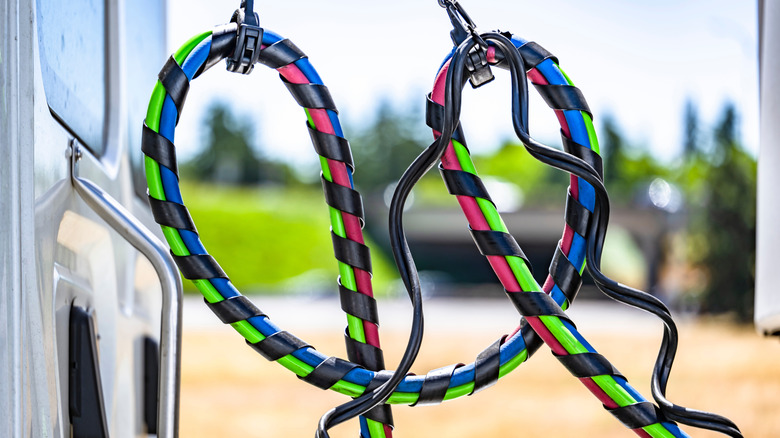
The air lines themselves are connected to both the trailer and tractor with hose connectors called glad hands. These connectors can be hooked up quickly, and the glad hands have rubber seals to keep air from getting out of the system. Meanwhile, despite looking like another air hose, the green line is actually an electrical connector used to provide power to things like the trailer's brake lights and turning signals.
The full lengths of the hoses can vary, but the red and blue air hoses typically come in either 12-foot or 15-foot lengths. As you'd imagine, the lines need to be long enough to work during ride turns, so the familiar coiled design is often used to keep the long lines from dragging on the road, getting caught on something, or being severed by road debris.
Notably, some companies offer more streamlined solutions that tie all three of the lines together in an integrated setup to reduce entanglements and the risk of the lines coming undone. All in all, the colored lines are part of a fascinating and time-proven method of bringing these massive, big rigs to a stop, and something to take a peek at the next time you're on highway — just make sure you aren't passing the semi truck on the right as you do so.