

Wi-Fi 8 Is More Than Just Another Internet Speed Boost
Over the years, Wi-Fi standards have increasingly become about dialing up the peak throughput ceiling, and in most cases, represents an upper limit that devices and users will never achieve outside of a lab or intra-network. When Wi-Fi 7 was announced, it came with a theoretical peak data rate of 46 Gbps –- the defining difference when compared to Wi-Fi 6. Wi-Fi 8 is expected to retain that same 46 Gbps peak, with the goal post moving to improve reliability, rather than focusing on speed.
Wi-Fi 8 will live under the IEEE 802.11bn standard, which is further designated as Ultra High Reliability (UHR). Clearly, the focus on reliability is a central theme here. By shifting away from the speed race, Wi-Fi 8 will make improvements under the hood to bring some sense of parity between peak throughput and effective throughput achieved in real-world conditions –- making it much more than just another internet speed boost to be advertised.
Wi-Fi 8 and the goal of 25%
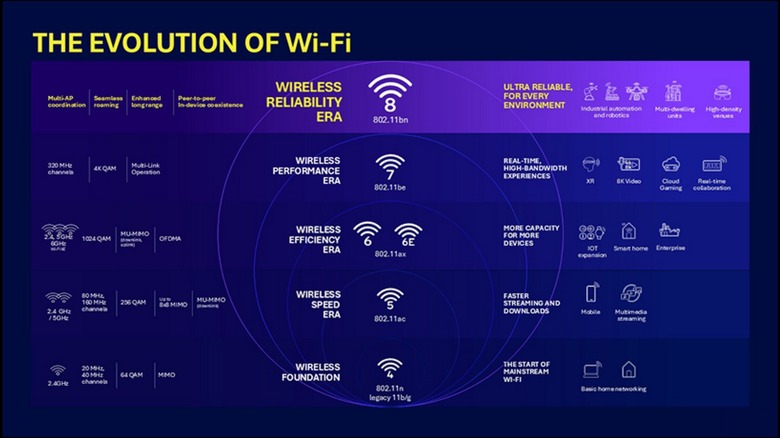
As outlined in IEEE scope document for 802.11bn, Wi-Fi 8 will focus on introducing the following: a 25% increase in throughput under poor signal conditions, a 25% reduction in latency in the 95th percentile of the latency distribution, and 25% less packet loss. This is aimed at addressing the most persistent problems that have emerged not just since Wi-Fi 7 was introduced, but also as Wi-Fi has evolved over the years. Common network issues that Wi-Fi 8 is addressing include dead zones in coverage, congestion due to connected device density, improved signal in challenging environments (apartment buildings, offices, venues, etc.), and latency spikes.
To achieve this, Wi-Fi 8 will bring with it several technologies like Distributed Resource Unit (DRU), Enhanced Long Range (ELR), Multi-AP Coordination (MAPC), and Interference Mitigation (IM), among others. The aforementioned tech improvements should allow for enhanced signal stability, minimize signal degradation, better room-to-room roaming speed, and improved mesh coverage. Wi-Fi 8 will also change how spectrum and airspace is used to increase bandwidth, channel access, and lessen lag.
Wi-Fi 8 is still in active development; The IEEE is expected to finalize and ratify the standard by 2027, with broad consumer device availability slated for 2028.