

Why Do Some Speed Limit Signs Have Such Odd Numbers?
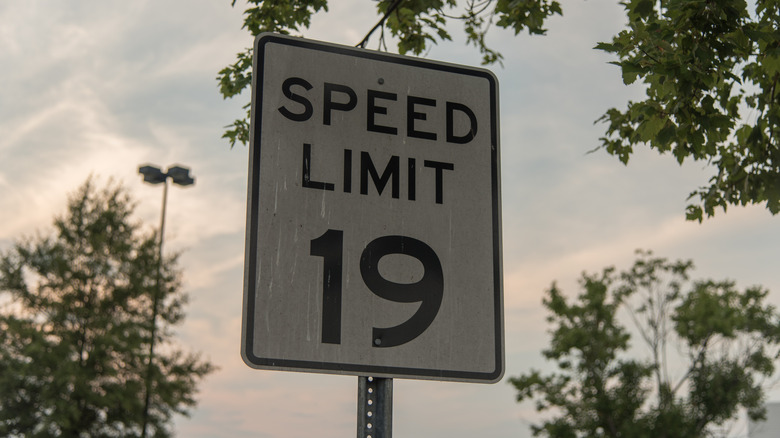
Drivers in the U.S. are very familiar with typical speed limits, from 25 mph in neighborhoods to 65 mph and above for interstates. While there are different sign types, including maximum and minimum speed limit signs, these numbers are often measured in increments of five. However, that's not always the case, and the reason for that has to do with guidelines set by the Federal Highway Administration (FHWA).
Speed limits are the direct result of engineering speed studies conducted by State Departments of Transportation. These studies evaluate various factors, including road design, traffic volume, and crash history, as well as the speeds that drivers just naturally use. However, federal rules require these study results to be rounded to the nearest multiple of five on public roads. This means that when you see an odd number like 19 on a speed limit sign, it's usually on private property, placed there as a psychological trick to catch your attention rather than as the unrounded result of a roadway study.
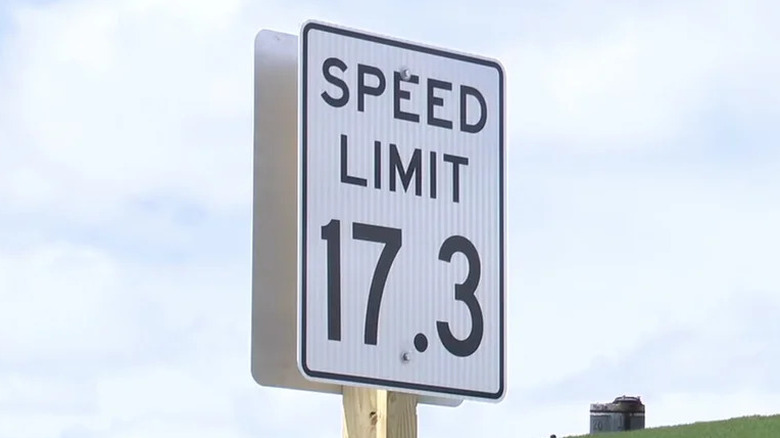
But there are times when odd speed limits, including those signs with a decimal point, are used for reasons outside of standard roadway engineering studies. For example, the Outagamie County Recycling & Solid Waste complex in Appleton, Wisconsin, posted a limit of 17.3 mph. This was done to draw attention to the speed limit and slow drivers down in a high-activity area that requires increased awareness.
The FHWA's role in speed limits and road signs
The FHWA, as a government organization, does not set or enforce speed limits. This responsibility lies with state and local agencies that have jurisdiction over public roads. Instead, the FHWA provides guidance, standards, and tools to support those agencies in making decisions about speed limits. As a result, the federal government is not responsible for evaluating road conditions across the country.
Much of the FHWA's work involves the Manual on Uniform Traffic Control Devices (MUTCD). The MUTCD sets national standards for how traffic signs, signals, and road markings are designed and used across the U.S. As a result, states must follow these guidelines to ensure consistency and safety in how speed limits are displayed to drivers. So, in cases where a state wants to use a traffic sign that falls outside MUTCD standards, it may need to obtain FHWA approval before the sign can be installed.
This means that when you see speed limit signs that are different than what is usually posted, the FHWA may still be involved in some way. For example, the red-bordered speed limit signs in Texas were put there by the state to notify drivers of speed changes on certain roads. While the FHWA did not set those limits, it granted experimental authorization for the state's request to use the new signs, which are non-standard in design.