

This Navy Fighter Jet Had The Weirdest Ejection System Ever
Ever since the dawn of aviation warfare, the need to eject from a doomed aircraft has been vital in keeping aviators alive. Modern military jet ejection seats are highly engineered and impressive pieces of technology, but they took a long time to develop. In the early days, planes flew slowly enough that a pilot could simply jump out with a parachute and eject safely, but jets made that impossible. The aircraft's speed made ejecting calamitous, and even today, it's not entirely safe.
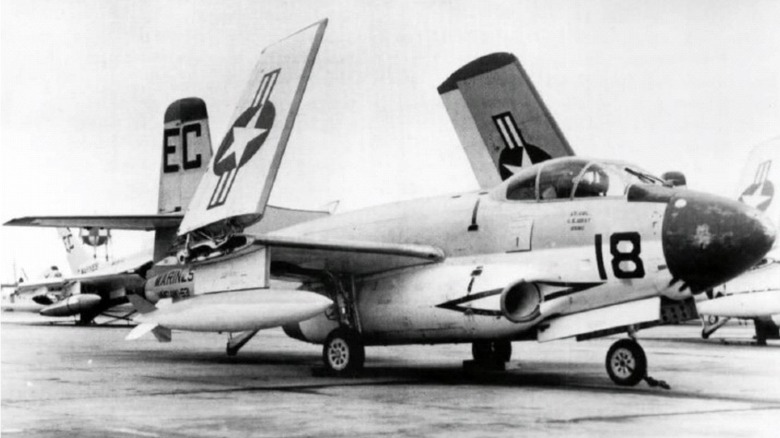
Still, what we have in modern jets is far superior to early methods. One aircraft from the early days of jet engines, the Douglas F3D Skyknight, had one of the most unique ejection methods ever devised. The aircraft was unusual, as it was built to house highly advanced radar, or at least as advanced as was in in the 1940s and early '50s. It was also massive, requiring a great deal of space within the fuselage. Because of this, the pilot and radar operator had to sit side by side, which created a problem when it came time to eject.
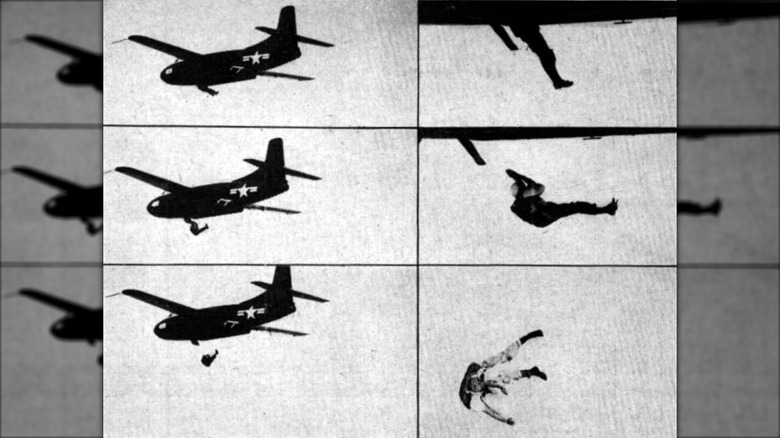
To overcome the issue, the aircraft was outfitted with a metal chute that allowed its pilot and radar operator to slide down, exiting from the belly of the aircraft. The chute ran between the fighter jet's twin engines, and the personnel literally fell through the moving plane and out the bottom, where they could safely deploy their parachutes and fall to the ground. It may have been unusual, but the chute did the one thing it was designed to do: It worked.
The Douglas F3D Skyknight's unique ejection method
The F3D Skyknight isn't a well-known fighter these days, but it holds an important distinction in aviation combat history. A Skyknight was the first fighter jet to shoot down another aircraft in jet-on-jet aerial combat at night. The Navy and Marine Corps operated the aircraft during the Korean War, where it sought enemy fighters under the cover of darkness. Skyknights continuously operated over enemy territory, engaging Russian-built MiGs. If they ran into trouble, the pilot and radar operator would have ejected behind enemy lines.
Modern ejection seats are built with a literal rocket that blasts their occupant (and the seat) safely out of the aircraft. This is typical these days, but when the Skyknight began operating in 1948, that wasn't a possibility due largely to the seating configuration. The aircraft was unusually proportioned to accommodate its radar equipment, resulting in the aforementioned crew configuration. Blasting out of the cockpit simultaneously would have been too dangerous, so the chute was designed in lieu of more traditional means of ejection.
The escape slide was located behind the seats, aft (back end or rear) from the cockpit. According to former Air Force F-15 pilot Paul Woodford, the cabin would first be depressurized, and the seats would pivot toward one another. The first crewmember would kick open the chute covering, grasp a horizontal bar, and swing down through the chute to exit from the belly of the jet. This was safe even at high speeds, making the Skyknight's unique means of escape both innovative and effective, albeit certainly unusual.