

The USS Gerald R. Ford's Next Mission Is As A Floating Nuclear Power Plant
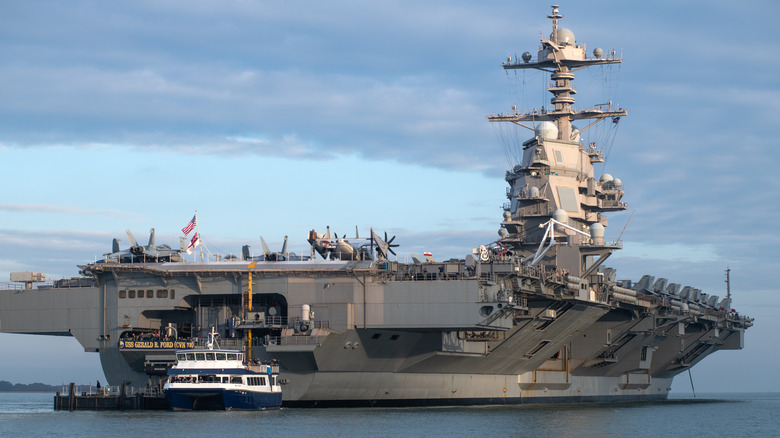
The USS Gerald R. Ford, first deployed in late 2022, is a truly remarkable ship. It already earned the distinction of being the world's largest aircraft carrier and, as of May 2026, is on track to earn another impressive distinction. The over 1,100-foot-long supercarrier is being fitted to serve as a floating nuclear power plant for an on-land naval installation. The test is slated to take place at Naval Station Norfolk, located in Norfolk, Virginia, sometime in summer 2026.
The carrier and its twin A1B nuclear reactors — which were developed specifically for the Gerald R. Ford — will power the entire base. While the United States military has kept many specifics of the A1B under wraps, estimates suggest that a single A1B produces about 700 MWt; two of them, then, would generate 1,400 MWt. This is approximately 25% more power than the A4W reactors that powered Nimitz-class vessels. Of course, it's not just a matter of plugging it into the grid, and the U.S. Navy will conduct extensive research and testing to safely and effectively move power from the ship to land.
While this is a fascinating feat on paper, what exactly is the point of running a naval base off of a supercarrier's nuclear reactors? According to those involved with the effort, this project is all about preparedness.
Why the Navy is testing an aircraft carrier as a power source
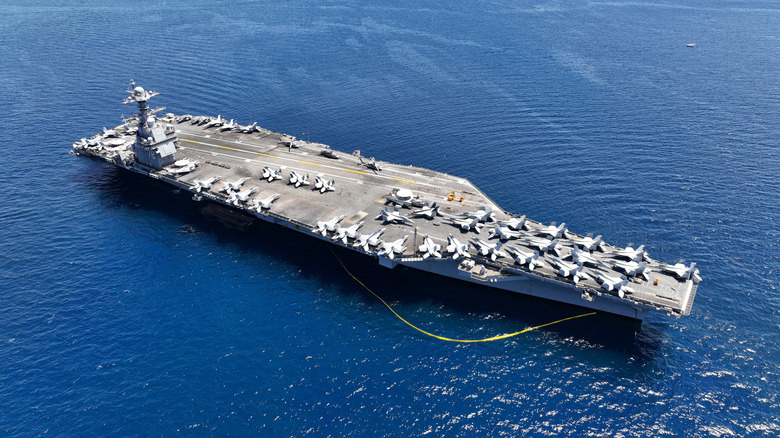
Naturally, there is a point behind a test of this magnitude. The idea behind running a naval base off the USS Gerald R. Ford's nuclear reactors is to enhance the U.S. military's disaster response capabilities. Should a natural disaster or an enemy attack take out a region's power grid, these carriers could act as floating generators until the affected areas get back on their feet. As more Ford-class carriers — like the USS John F. Kennedy, set for arrival in 2027 – come online, the Navy could have a fleet of floating power stations ready to respond to multiple worst-case scenarios across the country.
The Navy is confident that this capability can help in military and civilian capacities alike. During a May 2026 House Armed Services Committee hearing, Acting Secretary of the Navy Hung Cao suggested that these vessels could also help provide electricity to repair military bases and supply fresh water to drought-stricken areas (via Nuclear Newswire). Of course, whether the USS Gerald R. Ford can actually do any of this depends on the results of this test.
The USS Gerald R. Ford might not be the most decorated U.S. Navy aircraft carrier in history, but there's no denying its place in the history books. In addition to being notably enormous, it could very well be the saving grace for disaster-stricken areas in need of electricity.