

Why Do Jets Use Generators Instead Of Alternators?
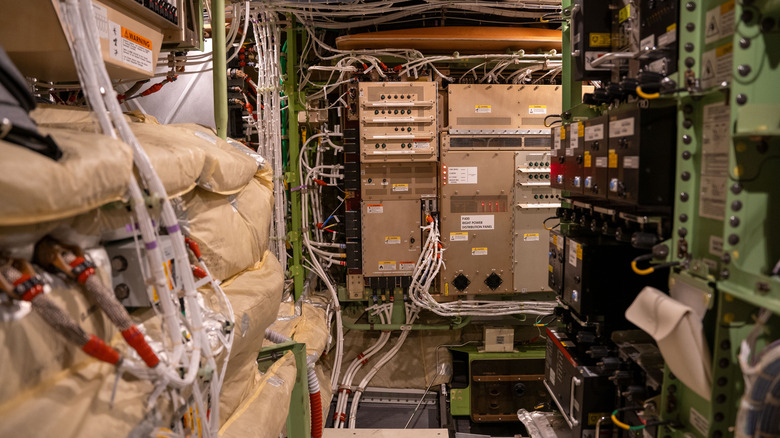
A modern jet is an engineering marvel that's very easy to take for granted. Consider the uniquely engineered Boeing 787 Dreamliner, for instance. Step aboard this jet, and one of the things that's often just accepted without a second thought is the sheer quantity of electronics on show. First there are the visible devices like lighting, entertainment systems, and galleys to consider. Dig just below the surface, and you have the fly-by-wire systems, sensors, and the cockpit controls & instruments, each of which needs to be reliably powered. All in all, a Boeing 787 is threaded with about 57 miles of electric cabling.
All these electronics require a lot of power, the vast majority of which is supplied by the engines. However, the eagle-eyed among you will notice a big problem here — jet engines produce mechanical energy, not electrical, and something is needed to convert an engine's output into usable electrical energy.
There are several ways of converting mechanical energy into electrical power, but step aboard any modern jet, and it's going to be a generator that lets you watch the in-flight movie. While alternators are still used in smaller piston-engined aircraft, and the car in your driveway, the electrical demands of a modern jet are a different beast altogether.
Going back to the Boeing 787 and its 57 miles of wiring, the wiring schematic of this plane includes six generators, which supply power to 17 electrical substations. Modern aviation alternators are efficient, reliable, and lightweight. This begs the question, if alternators are so good, why don't jets use them? The short answer is scale. Electrically speaking, modern jets are ravenous machines — avionics, engines, climate control systems, and flight controls are all needed to keep the plane in the air and the passengers and crew comfortable. This requires far more power than a compact alternator can supply.
Why jets use generators

Jet engines spin at incredibly high speeds, while the front fans spin within a range of 2,500 to 4,000 rpm, which is why jet engines often have spirals painted in the center of their fan. However, as fast as this is, it's in the inner high-pressure chamber that things start to get interesting. In here, the high-pressure core spins at far greater speeds; 10,000 rpm is typical in Rolls-Royce engines. It's this part of the engine that drives the generator through a clever bit of engineering called the accessory gearbox (AGB).
This is the crux of the matter. While strapping a compact alternator onto this setup would certainly be an interesting experiment, it would also be a short-lasting one. Aircraft generators are built for these extreme conditions. They're large, heavily cooled, and engineered to turn all that blistering power into the electricity that lets us charge our phones at 37,000 feet, and keep us up there, of course. Put simply, a generator takes the extreme RPM of a jet engine and converts it into steady, high-voltage AC power that's then distributed over tens of miles of copper wire.
The generators that power a jet

Flying is still the safest form of transport, by a long shot, and the data from the International Air Transport Association backs this up. This can largely be attributed to the engineering of the jets we fly in, where most critical systems have backups ready to kick in the moment they're needed. This also applies to the electrical systems and is why modern jets don't rely on a single type of generator — rather, they're designed with failsafe systems ready to take the reins should the worst happen.
At the core of this ecosystem are the engine-driven generators. These are the workhorses of the system, and they are the generators that strap to the AGB and produce the bulk of the aircraft's electrical power when in flight. On the ground, or in the case of failure, a generator called the auxiliary power unit, or APU takes over. An APU is like a scaled-down jet engine, that drives its own generator. As well as emergency power, this is sometimes used to start the aircraft's engines. Finally, there's the ram-air turbine; in extreme emergencies, this can be dropped into the aircraft's airstream to provide emergency electricity to vital systems.
Regardless of the type of generator, they all have one thing in common — the type of electricity they produce. Unlike the 50 or 60 Hz AC found in American homes, aircraft systems run on 115-volt, 400 Hz AC power. This is important, as the higher frequency allows aircraft designers to use lighter transformers, smaller motors, and generators — all of which reduce the weight of the aircraft, which is something of a Holy Grail for aircraft manufacturers.