

We Now Have Scientific Proof That Expensive Audio Cables Are A Waste Of Money
We may receive a commission on purchases made from links.
The audiophile is a rare specimen of tech enthusiast, a person dedicated to experiencing music and other audio with the highest possible fidelity. But there's an upper bound to fidelity that binds audiophiles and average listeners alike, no matter how many must-have Hi-Fi gadgets one owns. The human ear is a limited instrument, able to hear only a portion of the audio spectrum between 20Hz and 20kHz — far less than many other animals, such as elephants and pigeons. To be reproduced at the highest quality humans can hear, audio needs only to reach at most 44.1kHz and 24 bits of depth, and even that is overkill according to some experts. Yet many audiophile-grade products advertise much higher resolutions.
Among the worst offenders are audio cables — if you ever want to start a Shakespearean feud with an audiophile, tell them their cables are garbage. Cable companies have put a lot of work into justifying eye-watering prices. The average person might balk at an auxiliary cord that costs more than, say, $20, but some audiophiles will eagerly fork over hundreds of dollars per cable, or even tens of thousands. But within the audiophile community, you will find voices of reason who insist that you don't need to spend the price of a new car on your cables. They are often met with derision and told to get their ears examined, but it turns out they were probably right all along.
One audio expert who runs the YouTube channel Audio Science Review had what seems like an obvious idea in retrospect: testing multi-thousand-dollar audio cables alongside bargain-bin cables using scientific equipment to compare the results. What he found confirmed that you don't need to make it rain to get audiophile-grade cables.
Amazon Basics audio cables hold their own against $4,000 boutique cables
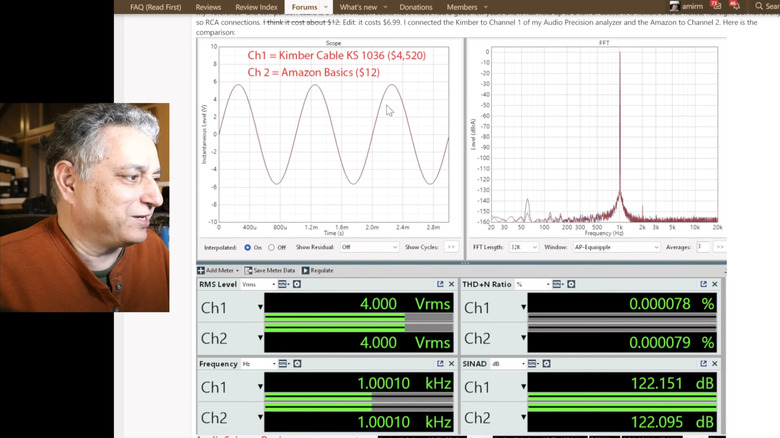
Most audiophiles wouldn't touch Amazon Basics RCA cables with a ten-foot pole, but when those $7 cables were compared to Kimber Kable KS1036 in a rigorous test conducted by Audio Science Review, they performed just as well. The Kimber Kable product costs $4,100 for just 3 meters of cord, and can surge as high as $17,060 for the maximum 5-meter variant. For that kind of money, you might expect them to sound like you're sitting front row for the philharmonic, perhaps while being luxuriously massaged by a host of heavenly angels. Kimber certainly doesn't dispel that notion. The product listing for the KS1036 cable boasts that they're made with "solid silver conductors drawn in diamond coated dies and insulated with virgin FEP dielectric under the most exacting tolerances which offer the purest transfers of the most demanding, highest resolution signals." In reality, though, the difference is minimal.
Audio Science Review tested the Kimber Kable and Amazon Basics cables using an Audio Precision analyzer, which pushes pure reference signals through the connected gear and delivers data readouts that quantify performance. The tester, Amir, actually found slightly more electronic interference noise in the expensive cables, though both brands showed extremely minimal levels. As for actual sound quality, both cables displayed identical performance across a frequency response test.
Frequency response doesn't tell the whole story, says the audiophile, sweating as they look toward the multi-thousand-dollar cables protruding from their Hi-Fi system. And they're right, but that's no saving grace for the Kimber Kable, which also performed identically to the Amazon Basics substitute in measurements of total harmonic distortion plus noise (THD+N) and signal-to-noise and distortion (SINAD) ratio. That's unsurprising, given that audiophiles couldn't tell copper wires from a banana in another experiment.
Don't waste money on expensive cables
If you're looking to spend the wealth of a small nation on your Hi-Fi system, get your audio cables from the bargain bin and put the savings toward better gear. What matters far more than your cables are your audio sources, amplifier, digital-to-analog converter (DAC), and speakers. These are the parts of a home audio system that can truly make a difference, and if you were planning to spend multiple thousands of dollars on cables, there's a good chance you were making compromises elsewhere to afford it.
There's likely no need to explain the importance of high-quality speakers and subwoofers in a high-end audio setup. They are the only part of the system that actually converts an audio signal into wiggly air that vibrates your eardrum. Every speaker sounds slightly different, so finding the ones you like best is paramount. Some audiophiles recommend spending up to 50% of your Hi-Fi budget on speakers alone, since it's much easier to find a decent amplifier or DAC on the cheap than a good pair of speakers. Any amount you spend on speakers is better than spending it on cables.
Moreover, many audio enthusiasts spend exorbitantly on gear, but neglect to shell out for room treatment. Even if you assemble a fully transparent Hi-Fi system, it can still sound terrible if it's installed in an untreated room. Getting a room professionally analyzed can be costly, and then you'll need to buy bass traps, absorption panels, and so on. Those foam pads you've seen coating the walls in music studios are only the exterior layer of treatment, and will not suffice on their own. Wherever you spend your extra coin, don't blow it on audiophile-bait products that don't hold up under scrutiny.