

Audiophiles Can't Hear The Difference Between Copper Wires And A Banana

Ever felt like you couldn't tell the difference between audio tech like speaker wires, despite everyone else claiming the opposite? According to a fun amateur experiment from the diyAudio community spotted by Headphonesty, you might have actually been right all along. When comparing three audio files, forum users had to guess whether the recording was made with regular copper wire, a banana, or a tin tray full of wet mud. As it turns out, almost everyone who took part couldn't tell the recordings apart at all, for the most part.
To get these results, diyAudio moderator Pano shared a set of audio files with forum members, who would then attempt to guess how each track was recorded. The audio files ranged from songs by known acts like Etta Jones and Nirvana, to piano instrumentals. Each audio track was presented four times: In the original CD format, and three times as re-recordings. They weren't just normal audio re-recordings, though. They were actually captured using some interesting apparatus assembled at home, including a banana, a tray of mud, and lengths of copper wire.
It's reasonable to expect that throwing a banana into the mix when laying out your audio setup would mess up the mix, or make things sound a little muddy. Surprisingly, though, that barely seemed to be the case — at least, not as far as most participants could tell. Correct answers generally seemed to be a fluke. This doesn't necessarily mean that there weren't any audio quality differences between the three files at all, but it does mean that they weren't easily audible.
Why can't we hear the difference between a banana, mud, and copper wire?

There are a couple of reasons why any differences between the audio files aren't easily audible to the human ear. One reason is that the setup, quirky though it appears, likely works as resistors in series — meaning that for the most part, roughly the same amount of current flows through all of them. That means that the unusual resistors are unlikely to create any obvious audio artefacts like electronic interference or other eccentricities that are clear enough for most to notice.
To tell the difference between one track or another, you're probably going to be consciously or unconsciously scanning for different noise levels that make a track sound fuzzy, or other issues with fidelity or quality. That's how you might be able to tell the difference between audio formats like vinyl and CD, for example, but if everything works about the same on a technical level, you might not be able to notice it.
Being able to tell one recording apart from another doesn't just rely on the hallmarks of an audio file, or the sound signature of the gear used to create or play it. It also relies heavily on your own perception. Auditory perception is how we make sense of sound using complex psychological and biological processes. We aren't always as good at perceiving sounds as you might expect, though. As a matter of fact, our brains can often fill in the blanks when it comes to the senses, making it easy to miss small differences between tracks, especially when they're tracks we might already know and have a strong idea of what they should sound like. Looking at you, Nirvana.
Are there any differences between the audio files?
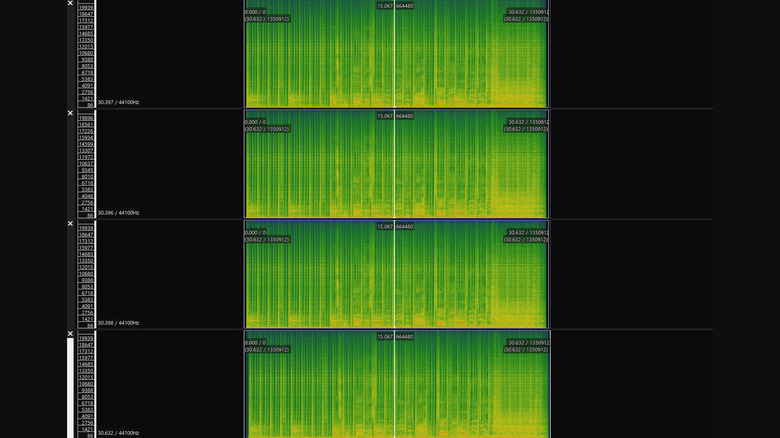
Of course, just because it's hard to hear the difference between tracks used in the experiment doesn't mean that differences don't exist. To get a better understanding of what was going on underneath the surface, we took a look at each track with audio analysis software Sonic Visualiser. This meant we could compare tracks recorded with different equipment to look for differences that were tough to find by ear alone.
Although you might expect the tracks to look rather different, considering how they were recorded, there weren't any noticeable visual differences between them. We compared each of the four Nirvana tracks provided as part of the experiment by taking a look at their spectrograms and waveforms. Spectrograms are a way of turning audio into visuals, so you can see which frequencies are in a sound.
Meanwhile, in the context of audio, waveforms show amplification, or how loud a sound is at a certain time. Besides some small differences between the tracks, with one appearing to be mono, and another being slightly off-set from the others, there weren't any massive giveaways that one track was secretly recorded with a banana.
Spectrograms and waveforms can only tell us so much about a sound. In this case, they can only represent differences in loudness or which frequencies are in the recording. So, that's to say that the experiment's audio could still be hiding other secrets as a result of its rather tropical (or wet) recording setup. But, whatever secrets they hold, they sure aren't easy to hear by ear alone.