

This 1950s Concept Car Featured A Backup Camera & Was Way Ahead Of Its Time
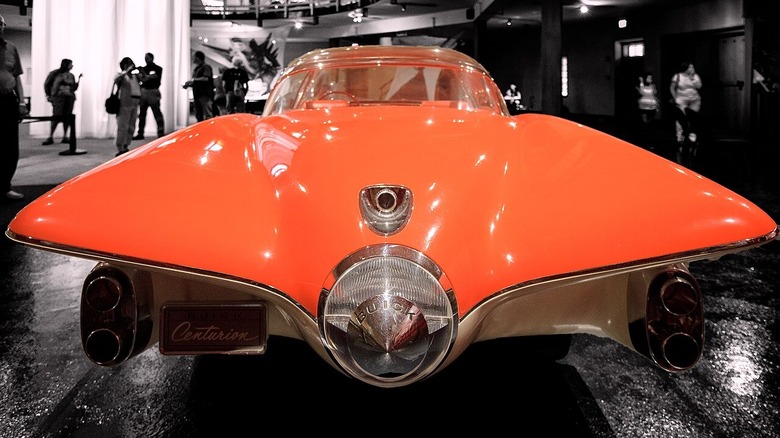
Backup cameras are one of those now-ubiquitous automobile features that seem quite modern, having become mandatory in the U.S. in 2018. Modern backup cameras date back to the early 2000s, debuting on the 2002 Infiniti Q45, but the technology's roots go back even further to the mid-1950s and the Buick Centurion XP-301 concept. The XP-301 was the first major passenger vehicle designed by legendary GM stylist Charles M. Jordan, and it debuted at General Motors' 1956 Motorama.
Of all the "dream car" styling features on the prototype, including a batwing rear deck, a clear acrylic bubble canopy that echoed the bubble canopies found on jet fighters, a cantilevered steering wheel and column, bucket seats with retractable headrests, and even a digital clock, the most fanciful was likely a backup/rearview camera. The Centurion had no side or rearview mirrors, opting instead for a fully functional TV camera installed in the back where a normal car's trunk would be.
To compensate for the lack of mirrors, a 4x6-inch CRT monitor built into the dashboard showed a low-resolution live feed from the camera. University Broadcasting System, Inc. supplied the shock-resistant, monochrome camera, which came equipped with a wide-angle lens. and weighed in at a hefty six pounds. This Centurion never entered production, but Buick later used the name for another vehicle built between 1971 and 1973.
This 1956 Centurion had an all-seeing eye in back
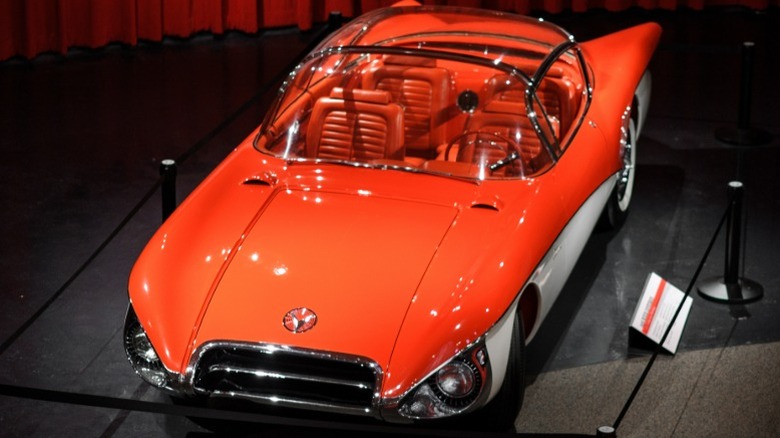
Alongside other 1950s concepts such as Ford's Nucleon, the '56 Centurion's futuristic lines were echoed by the flying cars in Joseph Barbera and William Hanna's 1962 hit cartoon, "The Jetsons." The Centurion also had a fiberglass body, like those other concepts, because it was cheaper and easier to make. Unlike other one-off concepts, though, which were often referred to as "pushers" because they lacked an engine, the '56 Centurion had a 322-CI Nailhead V8 with a four-barrel Carter YF side-draft carburetor under the hood. This engine reportedly made 325 hp and was mostly finished in dazzling chrome.
While neither the backup camera nor the bubble canopy caught on, the "Sweep-spear" — the chrome-plated strip that bounced its way along either side of the car – did become a Buick styling staple. However, many of the Centurion's other features eventually made their way into later production automobiles. At the time, it was GM's standard operating procedure to dismantle unwanted vehicles (especially one-offs displayed at Motorama shows) and have the remains carted off to a local scrapyard. But a funny thing happened to this particular concept car on the way to its untimely demise.
The Centurion should have ended up in pieces at Warhoops Auto and Truck Parts in Sterling Heights, Michigan, but it didn't. Instead, the fiberglass-bodied, futuristic-looking car was saved, possibly because there wasn't enough scrap metal to warrant Warhoops' time. Whatever the case, it survived, and today, the Buick Centurion XP-301 can be seen at the Sloan Museum of Discovery in Flint, Michigan.