

No AC, No Problem: This Cooling Prototype Works Cheaper With No Electricity

As the temperature heats up outside, many people across the U.S. are using their air conditioning unit more often. While keeping your air conditioner running even during a heat wave can make everyone comfortable, it comes with a price. But thanks to a recent innovation in cooling technology, the reliance on traditional electricity-powered AC could change at some point in the future.
Researchers at King Abdullah University of Science and Technology (KAUST) in Saudi Arabia have developed a passive cooling system called NESCOD (No Electricity and Sustainable Cooling On-Demand). A study published by the Royal Society of Chemistry explains that this system works by dissolving ammonium nitrate in water, which triggers an endothermic reaction that absorbs heat from the surrounding environment, quickly lowering the temperature. Once the cooling cycle completes, the system can be reset using solar energy, which evaporates the water and allows the salt to recrystallize so it can then be reused.
Since the cooling and recharging steps happen in different places and at different times, the system is able to store cooling energy and use it when needed. This allows for energy storage and use of cool air on demand. In tests, this new system produced up to 191 watts per square meter of cooling under direct sunlight, showing that solar energy can be stored and used for cooling without electricity.
Future cooling vs modern air conditioning
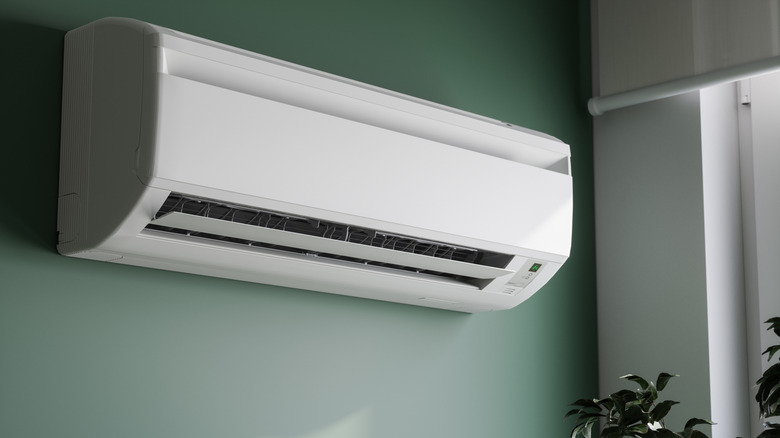
While the NESCOD passive cooling system looks like a promising alternative to electricity-powered AC, it's still just a proof of concept as of this writing. It's in the early stages, with testing taking place in a controlled setting, and has not yet been adopted for real-world use. This means that there is more work to be done moving forward, as researchers will focus on improving the system and scaling the technology for future use as well.
Today's modern air conditioning systems, including HVAC and traditional window AC units, which have to be mounted to a window to work, rely on a vapor-compression cycle to produce cool air. This process uses an electrically powered compressor to circulate refrigerant between indoor and outdoor coils. As the refrigerant moves through the system, it absorbs heat from indoor air at the evaporator coil, then releases that heat outside at the condenser coil. Because of this process, cooler air is circulated back into the home, and keeps your central air conditioning working.
Though this process is effective for cooling down a home and maintaining a comfortable temperature in the summer, it does require continuous electricity to operate. According to the U.S. Department of Energy, AC accounts for about 12% of household electricity use in the country. This makes a significant impact on energy demand overall, as utility costs can ramp up quickly during hot weather.