

Japan Hopes This Hypersonic Engine Can Make 2 Hour Flights To The US A Reality
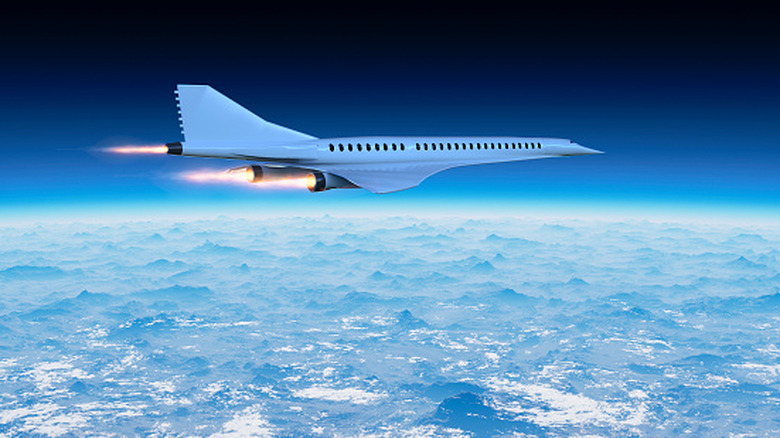
Technology often feels like it's evolving at breakneck speed, but in many ways, commercial aviation has been stuck in the slow lane since the supersonic Concorde was retired in 2003. This iconic plane, with its unmistakable delta-wing design, traveled at 1,350 mph, or more than twice the speed of sound. It could fly from New York to London in less than three and a half hours. While there are no supersonic passenger jets currently flying, several are in development, and even faster flight is already on the horizon.
It turns out that shattering the sound barrier was just the beginning. Hypersonic flight is defined as traveling at five times the speed of sound, or about 3,836 mph. These are speeds most commonly associated with missiles or space flight. Artemis II, which recently took humans around the moon, reached speeds of more than 17,000 mph at launch, and the space shuttle reached hypersonic speeds during re-entry. In the 1960s, NASA's X-15 proved that hypersonic, manned flights were possible, reaching speeds of 4,520 mph. But that was an experimental aircraft. Are hypersonic passenger flights a reality?
A research team in Japan recently performed a successful test of a Mach 5 engine inside a Japan Aerospace Exploration Agency (JAXA) testing facility. Researchers from JAXA, Waseda University, the University of Tokyo, and Keio University hope to commercialize the technology in the 2040s. If it comes to fruition, passengers will be able to travel from Japan to the U.S. in only two hours. Though the test was successful, you may not want to pack those bags just yet.
Does hypersonic flight have a real commercial future?
Hypersonic flight requires aircraft capable of withstanding extreme conditions, including shock waves and temperatures up to 1,832 degrees Fahrenheit. Hypersonic planes are designed differently because the extreme speed affects both airflow and propulsion in ways that don't affect your typical Boeing or Airbus.
The test at Kakuda Space Center is an important step in the development of this hypersonic aircraft, which has been in the design stages since 2013. The test simulated conditions at an altitude of approximately 15 miles, or nearly 80,000 feet. To put that into perspective, most large commercial jets fly at an altitude between 35,000 and 41,000 feet! Researchers put the aircraft's thermal protection system, control surfaces, and ramjet combustion performance to the test. Not only could this aircraft cover the distance between the U.S. and Japan in two hours, but if it's equipped with a rocket engine, it could also reach space. In fact, the next phase of testing may involve mounting the aircraft to a sounding rocket for a real-world demonstration; however, full development of the aircraft may take up to 20 years.
The U.S. is also at work on its own hypersonic technology, including hypersonic weapons. In addition to military initiatives, private companies are also working hand in hand with the government to advance domestic hypersonic capabilities. In 2025, Stratolaunch completed two successful test flights of its Talon-A2 hypersonic aircraft. This reusable vehicle reached hypersonic speeds and landed safely, but the aircraft is not designed for commercial use.