

This Scientist's New Invention Could Save A Building In The Event Of An Earthquake
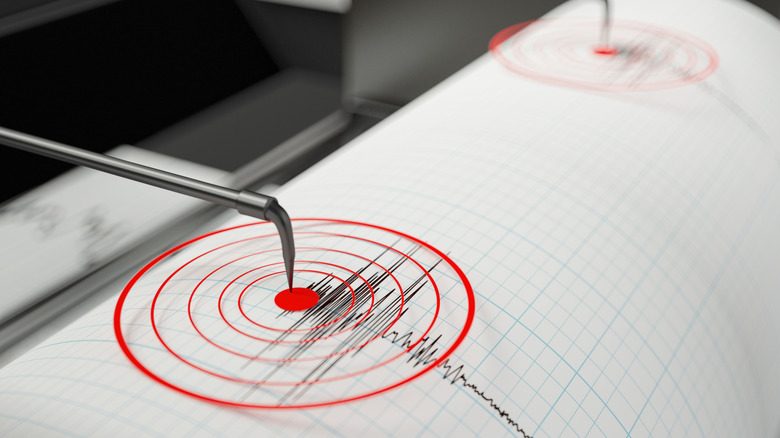
Earthquakes can pose a serious threat to cities and human life. Some scientists have tried to pre-empt these events by using technology like fiber optics to detect earthquakes and tides, while others have sought ways to mitigate the damage they can cause. Civil engineering professor Moussa Leblouba from the University of Sharjah, UAE, has developed a possible solution for the latter that is both simple and effective — and doesn't use any electricity. It takes the form of a cylinder with a rod running through the center and extending out the ends. The portion of the rod inside the cylinder has smaller rods branching outward, and the whole cylinder is filled with steel balls. The idea is that this device will absorb and dissipate an earthquake's impact.
This doesn't sound all that complicated, and that's because it really isn't. Speaking to EurekAlert!, Leblouba explained that the device only needs the power of physics to do its job. "When the attached structure vibrates, the shaft moves back and forth inside the cylinder, and the rods push through the densely packed balls. The friction generated between the balls and the rods absorbs and dissipates the vibration energy," he said. He added that the device achieved a damping ratio of around 14% in tests, which shows that it does its job to a reasonable degree.
Leblouba received a patent for this anti-earthquake device in 2025, though there's still much more work to be done before it can be widely implemented. As great as it looks currently, it still needs more testing to prove itself.
There's still a long way to go
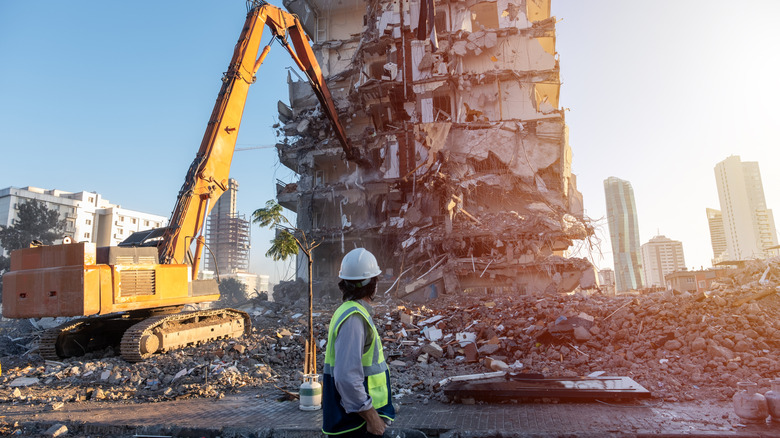
There are numerous benefits to Moussa Leblouba's device. Aside from not needing power, which makes it easy to retrofit to older buildings, it's also modular. This means that engineers can take it apart and replace components as needed, ensuring it remains in working condition. On top of that, its simplicity reduces manufacturing and maintenance costs. That simplicity also means engineers can tweak the device to suit the size, weight, and specific needs of a structure.
With that said, there are still roadblocks to get past. Most notably, the team has so far only subjected the device to small movements of 1 to 5 millimeters (0.04 to 0.2 inches). While the device has performed well, managing a stiffness of 5 kilonewtons per millimeter, it needs to be tested in real-world conditions outside the lab before it can be widely deployed. Professor Leblouba has stated that the research team plans to develop larger versions of the device and subject the design to more realistic simulations of seismic activity, including scenarios involving scale models of buildings.
Earthquakes aren't going anywhere, and all we can do is prepare for them as best we can. Earthquake emergency supplies from Harbor Freight can help, but it's inventions like this that will truly help make getting through earthquakes just a bit easier and safer.