

What Is The 20% Rule For Solar Panels?
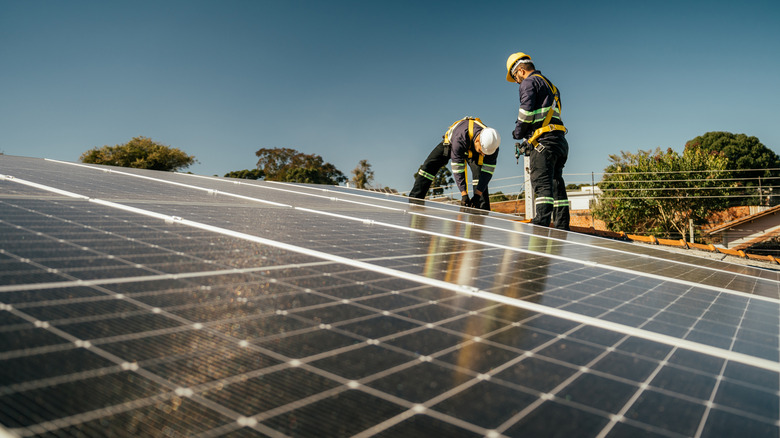
Installing solar panels has increasingly become a popular thing to do in recent years to power your home, work, or other establishment. There are many pros and cons to consider before actually pulling the trigger on installing them, but once you've decided that solar panels are right for you, there's one unwritten rule that you should definitely consider for that installation. That would be the 20% rule.
If you look at your monthly electric bill, it's going to roughly be the same month after month, barring any extreme conditions. Those extreme conditions do occur though, and if you're using solar panels for power, it's up to you to be prepared for those conditions, rather than relying on your local power grid. That's why so many energy companies working in solar — including OUPES, EcoFlow, LiPower Group, Bluetti, and more — recommend installing enough solar panels to account for 20% more power usage than your typical average.
Figuring out how much power you need to account for this extra 20% is quite simple. Take a look at the last year of your power bills. Find how many kWh your home or other building uses per month and calculate the average over those 12 months. Then, just add on the additional 20% of whatever that average is. If you average 850 kWh a month, you need a solar panel setup to handle 1,020 kWh. This extra 20% doesn't necessarily mean more solar panels on your roof, particularly if you don't have a lot of space. It could just mean panels that give more energy. The professional doing the installation should be able to figure out the setup that's best for your needs.
When the extra 20% comes in handy

There are a number of reasons why having a solar panel setup that accounts for 20% more than your average power usage is a good idea. The most obvious reason is above average power usage. Most obviously, this happens with an overused air conditioner in the summer or an overused heater in the winter, but there are other factors too. For instance, you could have a houseguest for a month using their own daily power in addition to your normal average, or you may have installed more inefficient light bulbs. Yes, some devices can help decrease your power usage, but having that buffer is very nice.
The 20% doesn't just help with your power usage though. It can also help with times when your panels are not in the best condition to collect energy. If installed correctly, your solar panels should be in the prime position to capture the sun's energy. However, that can be difficult thanks to bad weather, an overabundance of clouds, or even just an overgrown tree covering a panel that needs pruning. In these times, having an extra 20% of capable energy storage can make up for these losses that would affect your average daily power consumption.
Having this extra buffer also helps you out in case your average power usage changes in the future. You could decide to switch from a gas-powered vehicle to an EV, requiring an electric charger. Maybe you buy a second refrigerator or decide to switch your gas grill to an electric one. It's always good to be over-prepared, and the 20% rule certainly helps you do that.