

Is A Traffic Light At A Roundabout Pointless? This Florida County Doesn't Think So
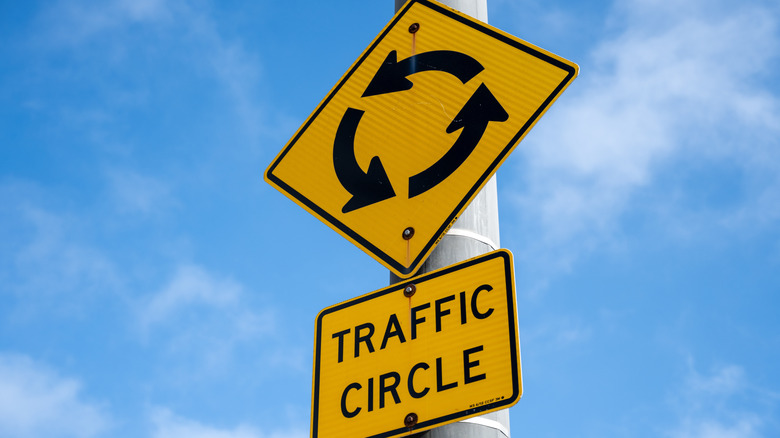
There's a county in Florida that recently added a traffic light to a roundabout, with the intention of reducing the gridlock during times when traffic is the heaviest. This traffic light-protected roundabout is in Sarasota County, at the eastbound Apex Road and Lakewood Ranch Boulevard roundabout.
The rationale for adding the traffic light, which will control the flow of eastbound traffic into the roundabout, is to prevent the traffic from backing up into the roundabout. This will be the first roundabout in Sarasota County to have a traffic light added. According to Sarasota County, the traffic light will serve as "...an operational tool designed to help mitigate potential gridlock." Drivers are instructed to stop when the light is red and continue through the roundabout when it is green.
This move by Sarasota County is likely a response to the level of traffic exceeding the capacity of the roundabout to permit it to flow through smoothly. By adding a traffic light during peak times, the normal flow of the roundabout traffic can be restored, even though motorists who must wait at the red light may disagree. But the real reason for the traffic congestion at this roundabout, according to a Sarasota Reddit community, may be due to its location not far from a very busy intersection with a long wait for the green light.
How roundabouts work
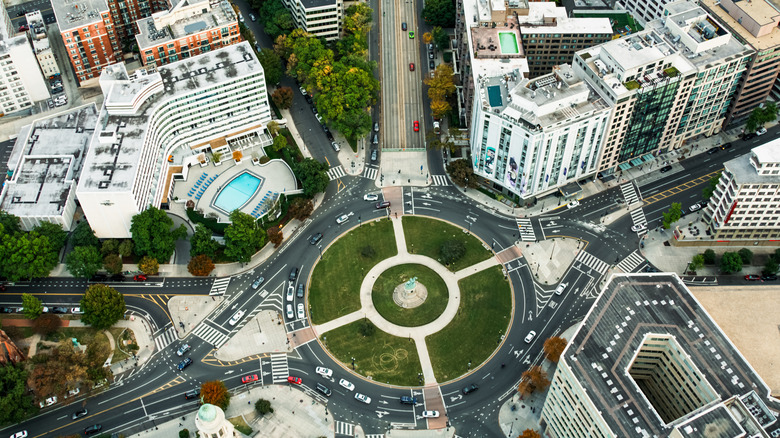
Modern roundabouts are a traffic-calming feature, originally created in the UK in the 1960s when the law first required motorists to yield to the traffic inside them. Roundabouts reduce vehicle speeds, making travel through them safer for all types of road users, including pedestrians and bicyclists. A roundabout is an intersection that takes the form of a circle and typically does not use any traffic signals. In it, traffic flows in a counterclockwise direction around an island placed in the middle of the roundabout. After yielding to any cars making their way through, motorists enter it and then exit when they reach their selected street. But not all roundabouts work perfectly — there's a North Carolina traffic circle that causes so many accidents, it's getting a makeover.
Roundabouts, or traffic circles, can be large, like Washington, D.C.'s Thomas Circle above, or they may be much smaller, like your neighborhood's mini-traffic circles. Regardless of their actual size, they all provide the same benefits by largely eliminating the types of accidents that hurt the most people in conventional intersections — those that result from turning left, hitting someone head-on, and getting T-boned at a right angle. And by slowing down the flow of traffic going through a roundabout, overall safety is improved as well. This also makes them safer for pedestrians passing through.
There are also environmental benefits to using roundabouts instead of conventional right-angle intersections. Your engine spends much less time idling since there are no traffic lights, which results in improved fuel economy and lower emissions overall.