

The 'Maverick Act' Could Lead To The US Flying F-14D Tomcat Fighter Jets Again
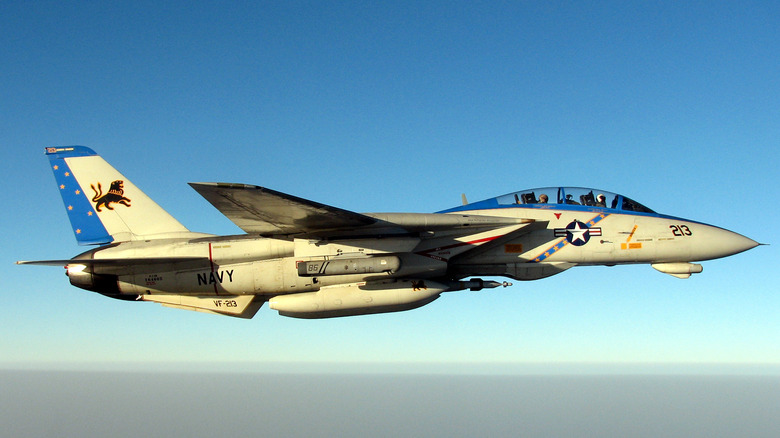
The F-14D Tomcat may not have the modern-day prestige of fifth-generation fighter jets like the F-35 Lightning, the world's most advanced fighter jet — but it does have its own claims to fame. Not least of which, the fighter can claim to have starred alongside Hollywood greats in a blockbuster movie.
Of course, it also had a long and illustrious career as the US Navy's primary carrier-borne fighter. From its first operational deployment in 1975 until its retirement in 2006, the Tomcat repeatedly proved itself to be more than just a movie star.
Now, an act currently moving through Congress could see the old warhorse shake off the cobwebs and return to the sky. This doesn't mean we're going to get to see the sight of an aircraft carrier flight deck full of F-14s again, but the appropriately named "Maverick Act" could see at least one Tomcat restored to grace the skies again.
The Bill, which passed the Senate on April 28, 2026, proposes the transfer of three surplus F-14Ds from Navy ownership to the US Space and Rocket Center (USSRC) in Huntsville, Alabama. While the Maverick Act doesn't expressly say that all three jets will be made airworthy, it does have provisions that could allow one of the retired fighters to be restored to flying condition for airshows and commemorative events.
So, while it isn't going to return to its glory days, the film star of the fighter jet world may yet have a final curtain call or two to perform in American skies.
Why bringing back the F-14D Tomcat is a big deal
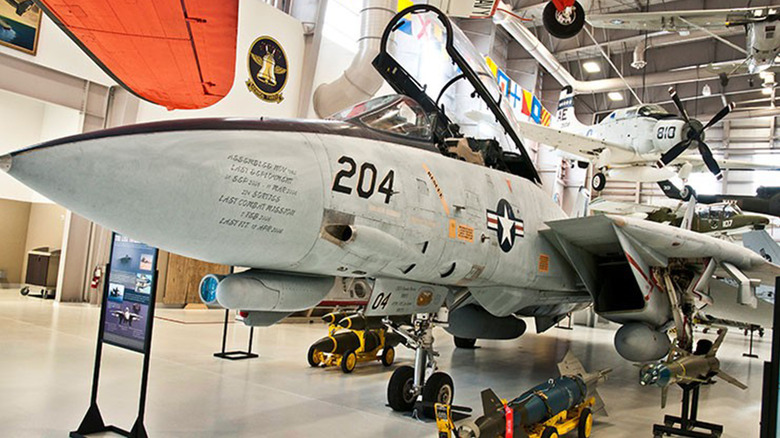
There is more than a touch of irony about the fact that, as of May 2026, Iran remains the only country left flying the F-14. While this fact might seem trivial, the history of Iran and the F-14 Tomcat can at least partially explain why bringing back the Tomcat is a big deal.
After the fighter was retired by the US Navy, the service went to great lengths to ensure that retired Tomcats never returned to service elsewhere. Many aircraft were dismantled or even entirely shredded to prevent spare parts from making their way to Iran and therefore helping to keep the country's F-14s airborne. It's worth noting that these jets were sold to Iran before the 1979 Iranian revolution, with the country ultimately receiving 79 out of a planned 80 fighter jets.
Even now, the Maverick Act is quite explicit in stipulating that the three F-14Ds earmarked for the project are fully demilitarized. If the Maverick Act passes, the jets in question (Bureau numbers 159437, 164341, and 164602) will be transferred to the Center at no cost to the federal government. However, any costs associated with the transfer, operations, and maintenance of the craft will be borne by the Center's governing Commission.
The Act also stipulates that any maintenance and operations manuals that the Navy has the right to share are provided with the aircraft. While the F-14D Tomcat's active career is certainly over, the Maverick Act aims to ensure an aviation legend is always remembered as more than just a movie star.