

Are RFID-Blocking Wallets Still Needed Or Useful In 2026?
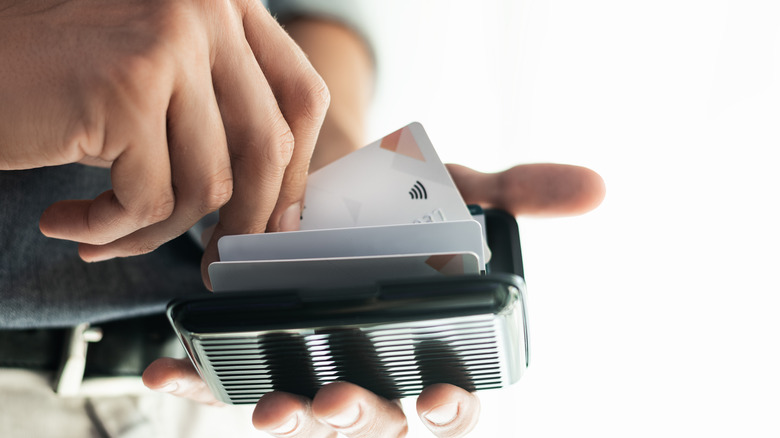
The switch to cashless payment methods like debit and credit cards has, fortunately, eased the burden of carrying around cash for many people. Most credit cards feature contactless payments, too. You simply tap your card against a payment terminal, and the transaction is completed. This is all thanks to near-field communication (NFC), a short-range form of RFID technology. RFID stands for radio-frequency identification — a technology that uses electromagnetic fields to transfer data between two devices. This eliminates the need for you to swipe your card or insert it into a reader, making transactions way quicker. If this raises concerns, though, you are not alone.
Theoretically, anyone with an RFID reader could get close enough to you to try to steal data from your contactless card without it ever leaving your pocket. This is where the market for RFID-blocking wallets comes into play. Manufacturers line these wallets with conductive materials like copper or aluminum that act as a shield against RFID signals. To make a payment, you have to intentionally pull your card out of your wallet. RFID skimming is a legitimate concern in theory, but in practice, it's a relatively rare method of financial fraud.
There's no harm in opting for wallets with RFID shielding, but you likely don't need the extra protection. There aren't many real-world stories of RFID skimming being successfully carried out. American Express highlights that contactless payments are encrypted, which makes hacking very difficult. Even in the worst hypothetical, reaching out to your bank is usually enough to reverse fraudulent charges.
How to keep your cards safe
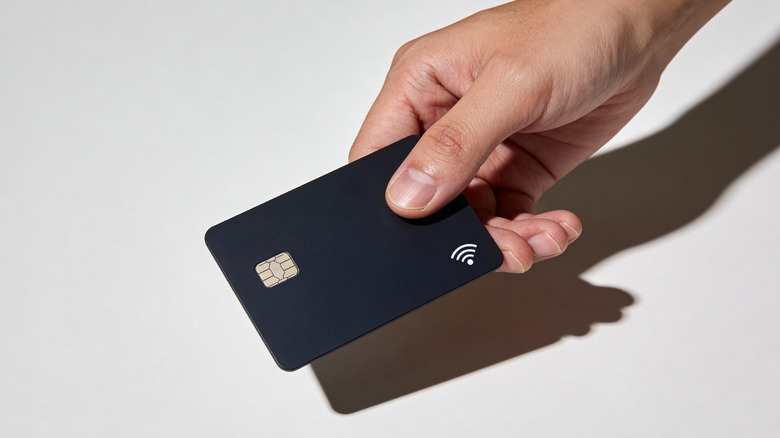
As we've mentioned, there's no downside to using a wallet with RFID-blocking. Before you pick one up, though, it's better to confirm whether your payment card even supports contactless payments. This is usually indicated by a small symbol that looks like a sideways Wi-Fi icon. Furthermore, tap-to-pay transactions are kept safe through a process called tokenization, where your card details are exchanged as random one-time identifiers, which are issued by your card's network. This makes it extremely difficult for bad actors to intercept and gain your card's actual details.
If you've decided not to pay extra for an RFID-blocking wallet, there are other ways that can help keep your digital payment methods safe. For starters, if you primarily use your phone for contactless payments, you might not even need to carry your physical credit card around. Furthermore, most banking apps let you set transaction limits for contactless payments. You can bring this down to a less scary number. That way, larger payments will require you to go old school and insert or swipe your card through a card reader.
Contactless card skimming not only requires very close proximity to your card but also takes a couple of seconds to initiate a transaction. In fact, you are more likely to fall victim to phishing or other social engineering attacks. Put simply, you likely don't need an RFID wallet because it's not a popular means of fraud in the real world.