

5 Harbor Freight Tools That Are More Powerful Than Makita

If you're shopping for some high-quality tools on a tight budget, one of the first places you might look is Harbor Freight. Whether you're looking for a fancy new power accessory, a no-frills hand tool, or a smart storage solution for any of your kit, this hardware store is a great place to spend your hard-earned cash.
The store primarily sells its own in-house brands, but a few stand out as the best you can buy at Harbor Freight. If you're specifically searching for cheap Harbor Freight alternatives to pricey Makita products, the best, most comparable brand is Hercules, though Bauer also has a few products that match well against Makita models.
After searching through Harbor Freight's current stock, we found five power tools that are not only significantly cheaper than a lookalike Makita model but also more powerful. Shopping at Harbor Freight already tends to save DIY enthusiasts and homeowners a fair amount of money, but these power tool finds will help you get the absolute best bang for your buck.
Hercules 20V Brushless Cordless 16 Gauge Nibbler
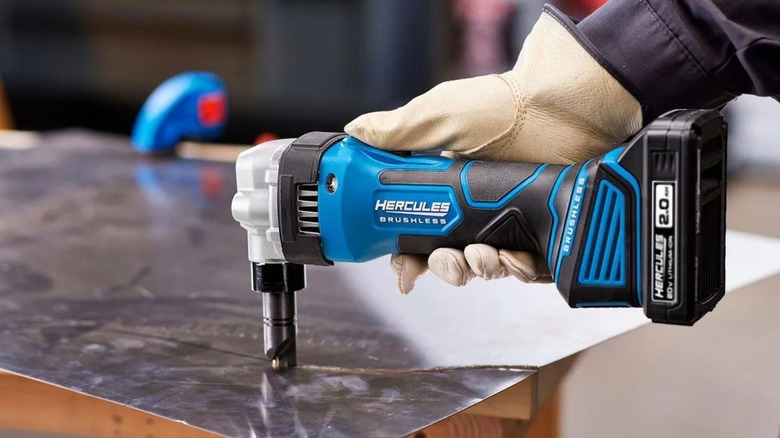
The $123 Hercules 20V 16 Gauge Nibbler makes cutting through metal a breeze. As its title implies, it can quickly cut through 16-gauge sheet metal, but it can also effectively deal with 18-gauge stainless steel, corrugated steel, roofing panels, and other metals.
With a 20-volt, 5-amp battery and a brushless motor promising speeds up to 2,200 SPM, this cordless Hercules power tool can cut up to 118 feet of 16-gauge sheet metal on a single charge. Beyond its power features, Hercules' 16 Gauge Nibbler has a 2-inch minimum outer-edge cutting radius, a die holder that rotates 360 degrees, a rubberized nonskid pad, and a slide switch to lock the tool in the on position for long cutting sessions.
Harbor Freight compares this Hercules tool to the Makita XNJ01Z 18V 16 Gauge Nibbler, a similar yet slightly less powerful find with a staggering $489 price tag. Like the Hercules cutter, this Makita tool can slice through 16-gauge sheet metal, corrugated metal roof decking, and stainless steel, and it features a lock-on sliding switch, a 360-degree rotating die holder, and a 2-inch outer-edge cutting radius. The big difference between these two tools is that the pricier Makita model's brushless motor, paired with an 18-volt battery, can only deliver speeds up to 1,900 SPM.
Hercules 20V Cordless 280 Lumen Stick Light
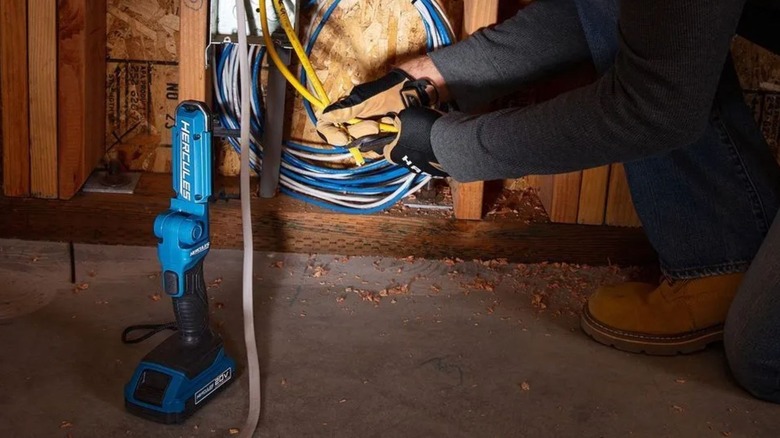
The best work lights for mechanics don't have to cost a fortune. The Hercules 280 Lumen Stick Light is available at Harbor Freight, and right now, it's only $25. It has 12 built-in LEDs, capable of producing up to 280 lumens of focused light at full brightness. If you need less light, you can use it in low (half) brightness mode, which can last up to 48 hours with a fully charged 20-volt, 5-amp Hercules battery (sold separately).
If you accidentally drop this light, no worries. There's impact-resistant housing all around to prevent major damage. Hercules' Stick Light can stand on its own, or there's an integrated hook if you need overhead light, and there's a convenient spot to hang it. Likewise, the $79 Makita DML801 Flashlight can stand or hang, though its hang hook is metal and swivels 360 degrees, so it can fold away completely. The flashlight head on Makita's tool can also rotate left to right and fold up and down with seven positive stops, giving you more flexible angle options than the Hercules model.
However, Makita's light stick isn't as powerful as Harbor Freight's Hercules model. Both light sticks have 12 built-in LED lights and two brightness modes to quickly switch between, but Makita's light is fueled by a slightly smaller 18-volt battery (sold separately). At half brightness, the DML801 Flashlight by Makita is rated to last only 22 hours.
Hercules 15-Amp Abrasive Cut-Off Saw
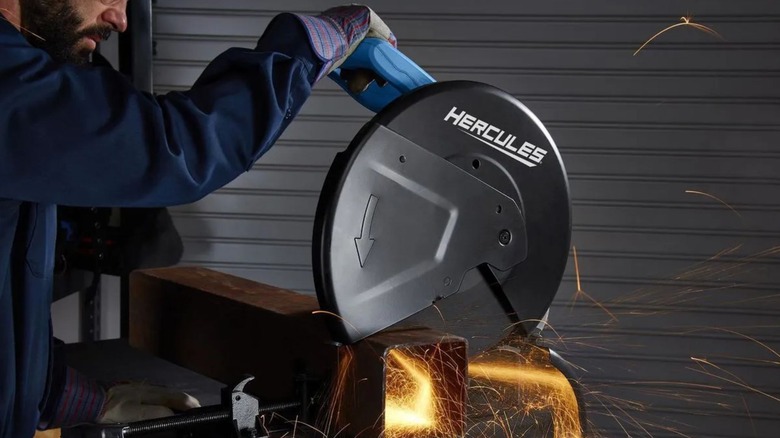
With a 15-amp, 4.3 HP motor, the $190 Hercules Abrasive Cut-Off Saw delivers up to 4,100 RPM and glides through metal, drywall track, angle iron, pipe channels, and even rebar up to 5 inches thick. To help guide cuts, there's a quick-adjust vise clamp, an adjustable fence, a hefty steel base with grippy rubber feet, and an adjustable depth stop. It has a max cut capacity of 5 inches, a power cord that extends over 10 feet, built-in storage to stash extra blades, and a spindle lock for quick, easy blade changes.
The $334 Makita LW1400 Cut-Off Saw is also equipped with a 15-amp motor capable of cutting through metal and other materials, but only at speeds up to 3,800 RPM. Then, Makita specifies that this saw can specifically cut up to 5-inch rounds and rectangular materials measuring about 4 x 7.6 inches. Beyond these power limits, it features tool-less flange removal, fence and vice adjustments, a weighted base, and an extra-large spark guard for safety.
Among customer reviews of the Hercules Abrasive Cut-Off Saw, the consensus seems to be that the tool is relatively easy to use and delivers strong overall power. An in-depth Pro Tool Reviews look at the Makita LW1400 Cut-Off Saw points out that the tool delivers decent power, though not quite up to the Hercules' speed standard.
Bauer 14-Inch Portable Concrete Pull Saw
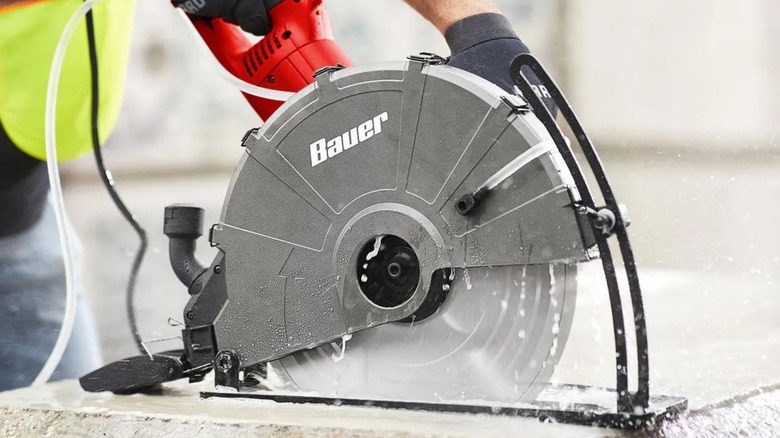
This $300 Bauer 14-Inch Portable Concrete Saw is significantly less expensive than the Makita model Harbor Freight has it stacked up against: the $959 Makita 14-Inch 4114 Electric Angle Cutter. That said, the Makita model comes with a 14-inch diamond blade, whereas the Bauer model requires you to purchase a blade separately, which can cost an extra $50 to $130. Both models are decked out with 15-amp motors, but the Bauer variant can reach up to 4,300 RPM, while the Makita option is limited to 3,500 RPM.
Because both saws are corded electric tools, neither produces gas fumes or requires fuel, oil, or engine maintenance, making either option safe for indoor and outdoor use. Makita's saw has a max cutting depth of up to 5 inches, just barely higher than the Bauer saw's max cutting depth of 4 and 9/16 inches. Each tool boasts a built-in vacuum attachment port to greatly decrease the amount of dust stirred up in the air, a durable internal design, and variable depth control along the tool's base. Reviews of the Makita 4114 model are generally positive; it's simply less powerful than the Bauer equivalent.
Hercules 20V 2.5-Inch Brushless Cordless Compact Band Saw
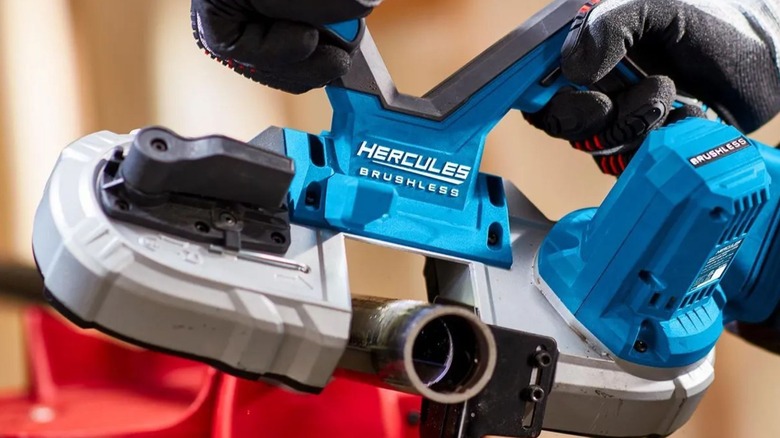
When one Redditor spotted the $100 Hercules 20V Compact Band Saw make its debut at Harbor Freight, other tool enthusiasts hopped in to say they'd definitely be adding one to their collection, including multiple professional electricians. This band saw is fitted with a brushless motor, compatible with Hercules' 20-volt batteries and chargers (sold separately), and has a conveniently compact and lightweight design, meaning it's easy to maneuver and control in tight spaces, even if you only have one hand to manage it with.
Similarly, the Makita 18V XBP04Z Portable Band Saw features a brushless motor and is convenient to use in small areas, thanks to a compact, cordless design that works with Makita's 18-volt batteries and chargers (sold separately). However, this pricier $399 Makita tool delivers an estimated maximum blade speed of up to 630 feet per minute, whereas the Hercules model can reach up to 635 feet per minute. Makita's XBP04Z model has a slight edge in cutting capacity, offering roughly 2.6 by 2.6 inches compared to the Hercules Compact Band Saw's 2.5 x 2.5 inches.
Methodology
To find Harbor Freight tools that are more powerful than similar Makita models, we first had to identify which Harbor Freight tools were designed to be dupes of more expensive Makita models. Luckily, Harbor Freight makes this easy. For each tool on the hardware store's website, there's info under the price that compares it to a specific model from another brand. We looked through nearly all the Harbor Freight-branded tools available to find ones that directly compared to Makita models.
From there, we analyzed the Harbor Freight listing to gather information on the tool's power source, design, and overall capabilities and specs. We examined the same information for the Makita tool that most closely resembled the Harbor Freight tool we were looking at. Then we highlighted Harbor Freight tool versions that advertised more power or higher operating speeds than the Makita alternative. With these items in mind, we dove deeper into customers' anecdotal experiences and, when available, professional reviews for each Harbor Freight tool to identify which features people loved most and whether the tool's specs on paper matched real-world results.