

Why Do Most Truckers Choose Snow Chains Over Winter Tires?
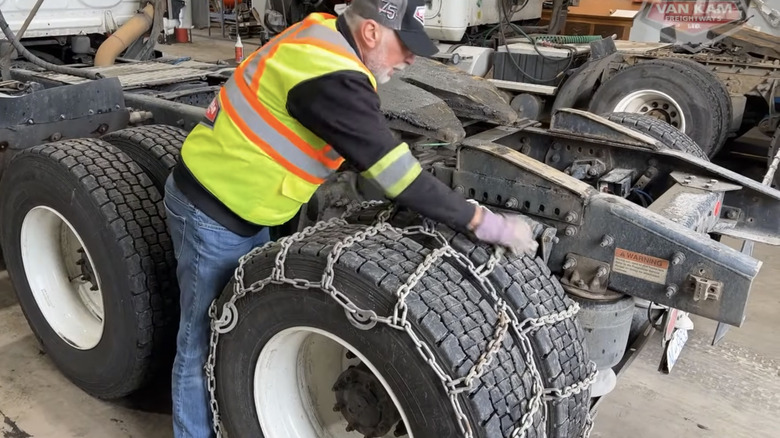
Truckers who roll through snowbound mountain passes typically make a very conscious choice, which is to strap snow chains onto the tires. That may seem odd, considering snow tires already exist — you just slip them on, and leave them there all season. You don't have to deal with the more tedious process of wrestling with metal links.
There are a number of reasons why truckers prefer this. Part of it has to do with how heavy these trucks are. A fully loaded semi runs around 80,000 pounds, which is then spread across 18 wheels — which is actually why semi-trucks are called 18-wheelers in the first place. That much weight spread across such a large surface area ends up doing funny things to physics.
The bigger reason, though, is the law. While plenty of exemptions exist for passenger cars with the right rubber, heavy commercial vehicles almost never qualify for those. In fact, state agency Caltrans even runs "truck screening" checkpoints during bad weather. In those, heavy-duty trucks have to physically show officers that chains are on board before proceeding. If they have no chains, they're asked to turn back.
Rules pretty much make chains a non-choice
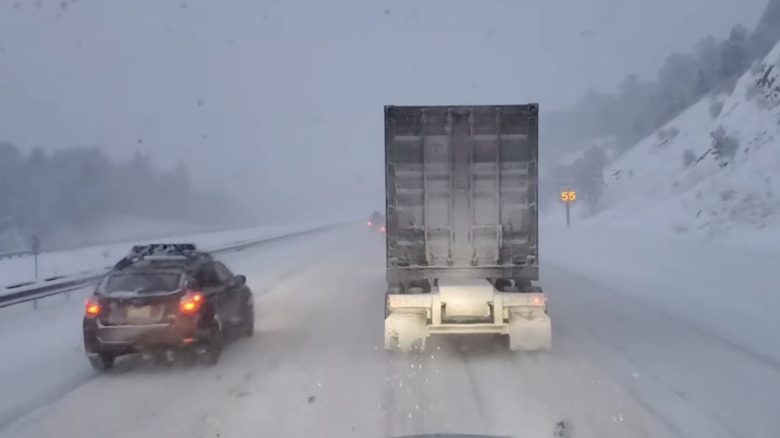
The wider laws in California get even more specific based on the conditions. Caltrans actually runs a tiered chain control system that scales with how bad conditions get. Things start off with R-1, the mildest, which requires chains on most vehicles except passenger vehicles and light trucks. That basically means every heavy truck has to wear chains. The stricter R-2 kicks in when things get worse, and it only exempts 4WD vehicles wearing snow rubber on all four wheels. Finally, R-3 requires chains on all vehicles. The key detail here, though, is that regardless of which level is active, any commercial vehicle over 6,500 pounds gets no exemption at all.
Of course, this is just California; not every state experiences the same winters, so laws are different. Washington, which sees consistently colder winters, enforces stricter rules where from November 1 through April 1, any vehicle over 10,000 pounds has to carry chains at all times on specific routes. They also have to carry at least two spare chains, just in case something breaks mid-haul.
Several states also fine truckers for violating rules around chains. Colorado enforces chain carrying for vehicles over 16,001 pounds from September 1 through May 1. Skip that, and you're looking at $500 plus a $79 surcharge. Block traffic while failing to chain up, and the bill climbs to $1,000 plus $156.
The physics and math behind chains
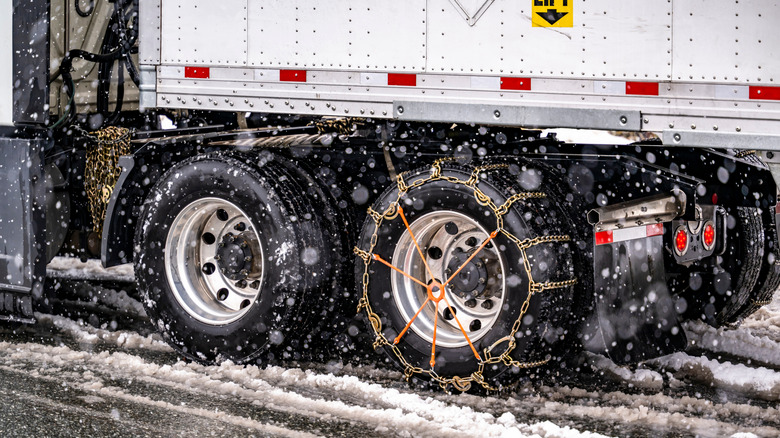
Beyond following the law, there are actual benefits for truckers using chains too. Winter tires rely on specialized rubber compounds and tread patterns to generate friction against the road, which are some of the features that make a snow tire good in the first place. But they are far less effective in more extreme conditions like glare ice and polished snow, where the surface is just too smooth for rubber to grip onto. Tire chains fix this shortcoming. They have a metal cross-link design that physically bites into ice and compresses snow under the wheels, creating mechanical grip regardless of how slick the surface is.
Then, there's the cost. New winter tires for a semi run $300 to $600 each, and many semis carry 18 wheels. Add installation fees of $20 to $50 per tire, and a full swap easily climbs past $10,000. Used or retreaded options run cheaper, dropping to $150 to $300 per tire, but they wear faster. Chains, meanwhile, are a fraction of that outlay.
Then there's the fleet math, which makes seasonal tire swaps look absurd at scale. Tire expenses sit around $0.46 per mile for fleets, with owners spending an average of $3,687 per truck per year on tires. Multiply that across a fleet of even a few dozen trucks and doubling up with dedicated winter sets of gets painful fast.
That said, there's a downside to chains too. You can only drive at a max speed of 25-30 mph with them on. They're also designed for highly specific conditions, and if you run them on bare pavement, they'll chew through tires and road surface alike.