

The Ford Mustang Dark Horse's Purported 500 HP Might Not Be What It Seems
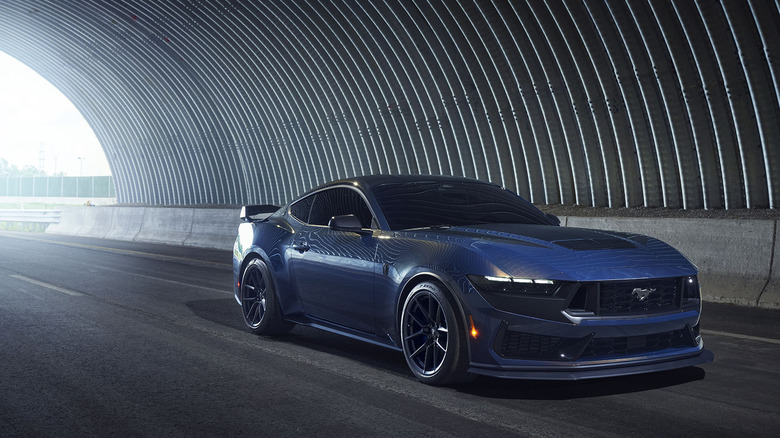
While it may not be the most powerful or most exotic of the various modern Mustang performance variants, the Ford Mustang Dark Horse is a special kind of modern enthusiast car. With Chevrolet discontinuing the Camaro and Dodge getting rid of the Challenger in recent years, the Mustang GT has already established itself as the remaining V8-powered American pony car — and the Dark Horse takes everything that makes the GT special and amps it all up a bit.
This includes the engine bay, where the Dark Horse is powered by the same basic 5.0-liter Coyote V8 that comes in the GT, but with a few performance tweaks that bump output from 480 horsepower in the base GT to 500 horsepower in the Dark Horse. This is big, not just because 500 horsepower is an impressive power figure on its own, but because it means the Dark Horse's 5.0 makes 100 horsepower per liter — helping it join a distinguished list of naturally aspirated performance engines.
However, there can sometimes be large variations between a car's on-paper horsepower rating and its real-world power as delivered to the rear wheels — and not just due to the typical and expected drivetrain loss. For an example of this, look no further than Road & Track's recent experiment putting the same Mustang Dark Horse on four different chassis dynos and getting four substantially different readings, which could be seen as either impressive or disappointing compared to the car's 500-horsepower rating.
When is 500 horsepower actually 500 horsepower?
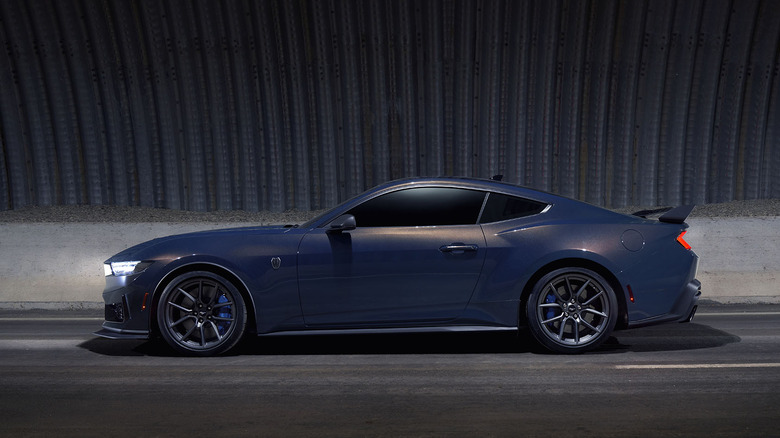
There are a lot of ways to look at an engine's performance capabilities, but peak engine horsepower has long been one of the standard measurements for both car enthusiasts and automakers looking to one-up each other on spec sheets and in marketing materials. But to show just how much real-world chassis dyno readings can vary, Road & Track took the same 500-horsepower Mustang Dark Horse and ran it on four different dynamometers at different shops in Southern California — all with the same fuel and with the SAE correction factor on the settings.
For a car rated at 500 crank horsepower, the expected reading should have been around 440 wheel horsepower after drivetrain losses. The actual results, though, varied wildly, with the lowest reading coming at 420.8 horsepower on an older SuperFlow dyno setup. The highest reading, meanwhile, was on a Mustang-brand AWD dyno, which showed an impressive 465-horsepower figure. The other two dynos sat in the middle, with readings of 427.5 and 430.9 horsepower.
That's a swing of almost 45 horsepower between the different shops and dyno types — and when viewed in isolation, those two outlying figures could paint a picture of the Mustang Dark Horse being either noticeably underrated or noticeably overrated from the factory. So what this shows, more than anything, is that when comparing dyno figures, context and consistency are much more important than the individual numbers on their own.
Four different dynos, four different numbers
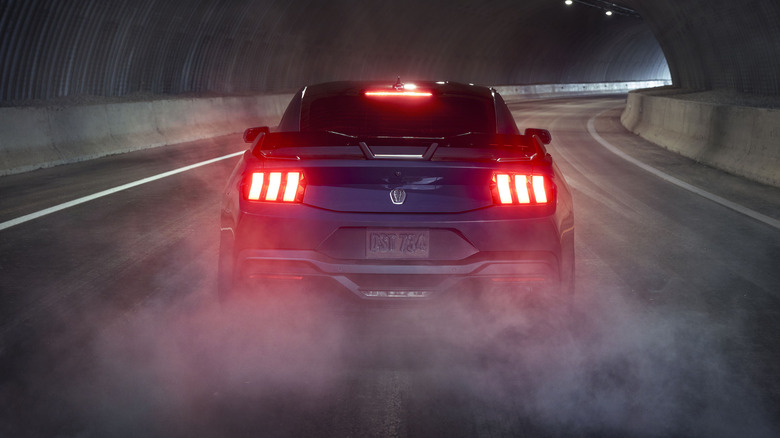
Ultimately, the lesson learned is not about the Mustang Dark Horse or its factory horsepower rating. While each of the four readings was different, when you consider all of them together, the numbers roughly average out where you'd expect for a car with a 500-horsepower rating at the crank. It's also important to understand the typical differences between crank horsepower and wheel horsepower – but that's not the big lesson here either.
The most important finding is just how much variation there can be from dyno to dyno, even when efforts are made to maintain a consistent testing environment. Even minor differences in a dyno type or its settings can make for drastically different horsepower readings — to say nothing of atmospheric conditions that can vary from day to day.
Comparing dyno numbers, whether from one car to another or on the same car before and after modifications, is only useful if the readings come from the same dyno at the same time. Otherwise, even minor differences between dyno types and calibrations can easily erase or amplify what could otherwise be noticeable horsepower differences between different cars or after different types of tuning and modifications. As with so many things in the automotive world, when it comes to dyno figures, there's usually more to the story than just the top-line numbers.