

If You Played Pokémon Go, Your Activity Was Used For Way More Than You Think
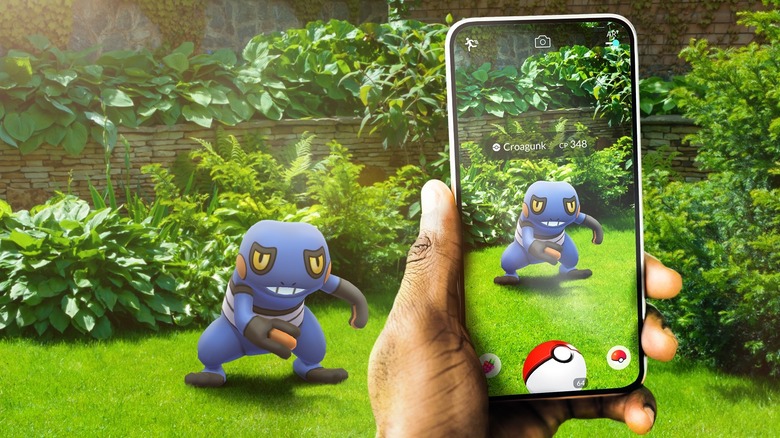
Let's rewind to the good old summer of 2016, when Snapchat dog filters and the Mannequin Challenge dominated social media. And out in the real world, it was Pokémon Go that was the real sensation. People were wandering around every gas station parking lot and weird alleyway in the hopes of capturing a legendary cartoon monster. That was Niantic's viral AR game at its peak. But now, a decade later, it's turned out that a lot of that was actually helping the company capture location data, visually, to help delivery robots find their way along sidewalks.
The thing is, in May 2025, Niantic spun off a separate AI company called Niantic Spatial. Data is gold to AI companies, and the outfit has been using its stash — a huge pile of 30 billion images from all those cameras pointed at statues, storefronts, and random little landmarks — to build a database of the real world. That database is what's now a visual positioning system (VPS). Niantic Spatial says its version can pinpoint a location to within a few centimeters.
In fact, the company has already scored a client. Coco Robotics is a startup that builds small wheeled robots you might have recently spotted running amok on college campuses and city sidewalks. These bots are roughly the size of a large cooler and are built for food deliveries, rated to carry a maximum of about eight extra-large pizzas. The company is already operating them in Miami, Chicago, Helsinki, Los Angeles, and Jersey City. Across the entire fleet, they've already completed over half a million deliveries.
How Niantic pulled it off
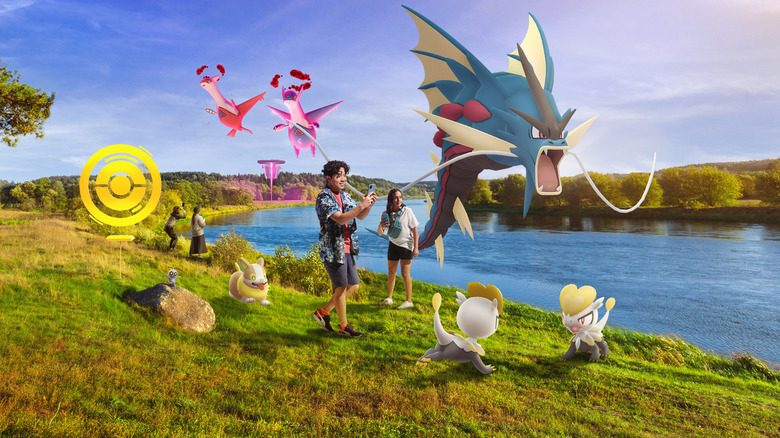
A lot of why this works comes down to how Niantic nudged its players to behave over the years. Back in 2020, the game rolled out a feature called AR Mapping. It gave out in-game rewards to players willing to record short 360-degree videos of their local PokéStops (designated real-world landmarks). Those scans captured every angle and height of the area you can imagine, creating 3D snapshots of it. And because hundreds of millions of players kept visiting these same hotspots, they indirectly provided Niantic with photographs of each location under a range of lighting conditions.
Niantic was able to use this extensive data to refine its VPS system. VPS works differently, because unlike GPS, which triangulates your location from satellites far above you, it tracks by looking at the buildings and landmarks around you, making it far more granular. GPS, on the other hand, tends to struggle when working alone in cities because radio signals bounce off tall buildings and interfere with each other. Its best-case accuracy is still off by a few meters, which is nowhere near enough to find your way around a sidewalk no wider than a few feet. That's exactly the challenge Coco's bots face. Each unit now carries four hip-height cameras that constantly scan what's around as they go. Coco CEO Zach Rash says the partnership should help the bots pull right up at a customer's door autonomously.
All of this is a pretty good reminder that data collected for one reason rarely stays in its original lane. One example is CAPTCHA tests, which have long been suspected of training AI vision models on the side. But for what it's worth, Niantic has said its scanning features have been strictly opt-in since 2019, and that it's transparent about how player data gets used.