

Why Do Slow Cars Always Seem To Catch Back Up To You? A Mathematician Explains
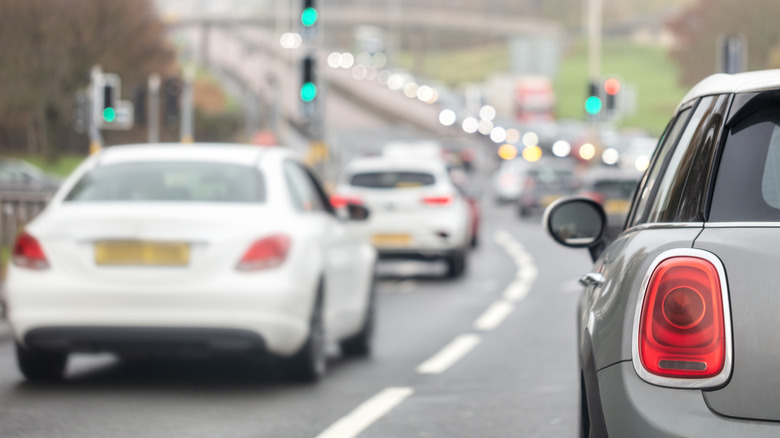
Every driver has been there: you've either been the person in a rush, speeding through intersections on the way to your destination just to feel like you've not gotten anywhere, or you've been the person who's chuckled to themselves as you catch up to someone who'd sped past you at the next red light. Why does this always seem to happen?
A researcher at Dublin City University, Ireland, Dr. Conor S. Boland, has been investigating this phenomenon and, in a paper published by Royal Society Open Science, dubbed it the "Voorhees Law of Traffic." The name was inspired by the villain from the "Friday the 13th" movies, Jason Vorhees, who always seems to catch his victims even though he moves at a walking pace.
According to Boland, this all boils down to traffic lights. If two cars are traveling at different speeds after leaving a traffic light, the spacing between them can change significantly depending on how the traffic lights in question work, the color and duration of the lights the cars encounter, and the time it takes each set of lights to complete their full cycle. In some cases, traffic lights can totally erase the distance between two cars, stopping even the speediest driver from getting too far ahead.
Can you actually catch up to a speeding car? That depends
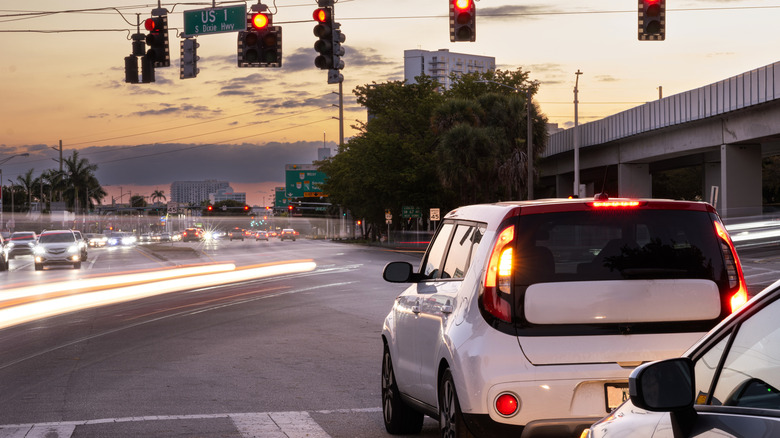
Do slow cars eventually catch up with faster cars? The research suggests that it depends on the type of traffic lights involved in the scenario. If the traffic lights are on set cycles (or if the cars hit a so-called "Green Wave"), the cars will catch up and drift apart at the same pace, and the car that's ahead will usually remain ahead.
However, if the cars encounter independent traffic lights that aren't in sync, Conor Boland's calculations suggest that the slower car is almost guaranteed to catch up to the faster one. According to the math, just one independent light results in a 42% chance that a slower car will catch up to a faster one. This increases to 78% after three lights, and exceeds 98% after eight lights. The nature of city driving, with its short blocks, means a faster car is more likely to be "caught" by a slower one than in rural environments.
Of course, these calculations and findings assume that both cars travel at consistent speeds throughout. Most cars don't do that, especially since they speed up at green lights and slow down at red ones. But Boland's research still gives drivers a bit of insight into why it can sometimes feel like another driver keeps catching up to you — or that you keep finding yourself catching up to the same car.