

Why Discount Tire Might Refuse To Fill Up Your Flat
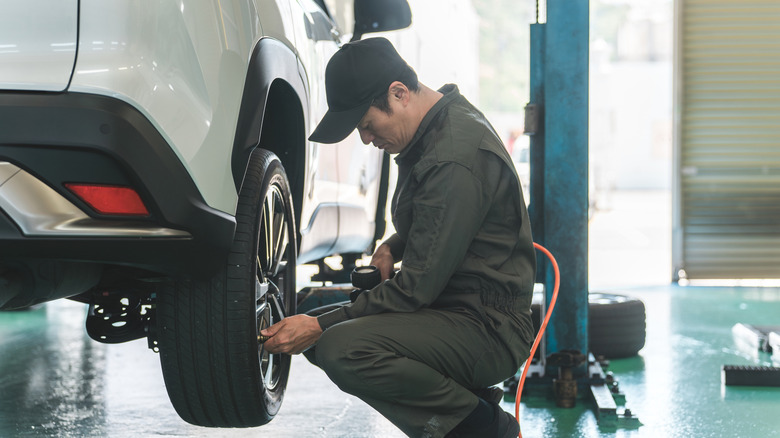
If you have to think of one of the easiest things to do to a car, you'd probably say putting air in the tires. However, sometimes a seemingly straightforward trip to Discount Tire can turn out to be more complex and expensive than you initially planned for. There's a chance that Discount Tire won't fill up your tire at all.
Getting your tire pressure checked at Discount Tire is free — and so is getting your tire filled. However, not every tire can be filled. We spoke to Assistant Manager Gio Garcia at America's Tire (the name Discount Tire uses in parts of California), who told us that some locations may not fill your tire if it's over 10 years old and considered flat.
"We can still take it into service and see what's wrong," Garcia stated to SlashGear. "We can fix it free of charge, if it's something like a broken valve stem that can be replaced. We can check what's wrong, but we won't fill it up."
What does Discount Tire consider a flat tire?
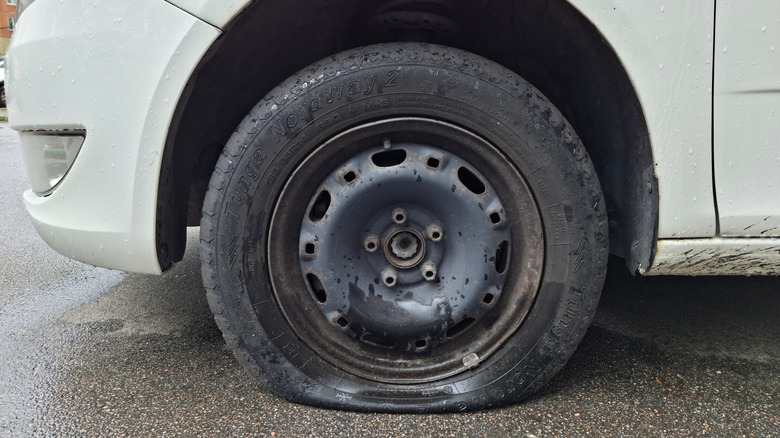
Every vehicle has its own recommended tire PSI, which is determined by fuel efficiency, safety, and performance. This number can be found in the owner's manual — but the average is between 28 and 36 PSI. According to Garcia, Discount Tire considers a tire flat if it's 10 PSI or below, which means some locations may refuse to fill it back up.
Flat tires are dangerous to drive on. Tires with extremely low pressure can no longer support your vehicle's weight properly, causing the wheels to make contact with the road. This can cause them to bend, crack, and break. A tire with low PSI will also reduce traction, making it a lot easier for your vehicle to lose control.
Oftentimes, the tire itself is also not fixable with air or a patch once you drive on it. Discount Tire can't repair every tire — if some are too damaged, employees will recommend replacing the tires instead. This is a lot more money than the free fill-up. This is why it's important to periodically check your tire pressure rather than wait until you get a warning that the PSI is too low. Using a gauge is the easiest way to get a proper measurement.