

What Are The Banjo Bolts On Motorcycles For?
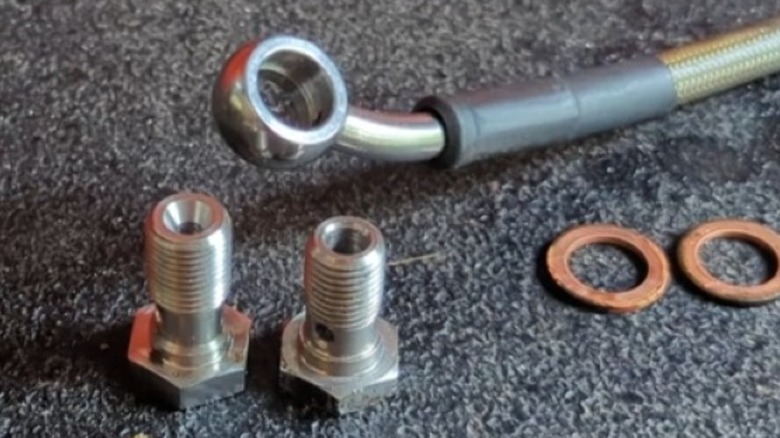
If you've heard the term "banjo bolt" when talking about motorcycles, you've probably already encountered a fair share of puns relating to musical instruments. However, the bolts themselves have nothing in common with the stringed instrument. Instead, the fittings these bolts secure earn the banjo moniker due to their shape consisting of a round opening with a straight, or sometimes curved, neck, as seen in the image above.
On motorcycles, banjo bolts are used to secure the banjo fittings often found at either end of lines, or hoses, if you prefer, that carry fluids from one component to another. These fluids can sometimes include fuel and engine oil, but banjo fittings and bolts are most often used for hydraulic line terminations.
Hydraulic lines transfer pressure from motorcycle brake and clutch actuators to brake calipers and clutch slave cylinders. Motorcycles that feature electronic linked braking systems, a modern motorcycle feature you might not even know you needed, could have banjo fittings and banjo bolts on brake lines entering and exiting a central combining brake module.
Oil line banjo fittings are often found connecting oil coolers to engine crankcases and oil sumps. Fuel lines benefit from banjo fittings when fuel pumps, petcocks, carburetors, and injection systems require lightweight, low-profile connections. One key benefit to banjo fittings is the ability to tighten the fitting in a desired position without twisting.
What you need to know about banjo bolts
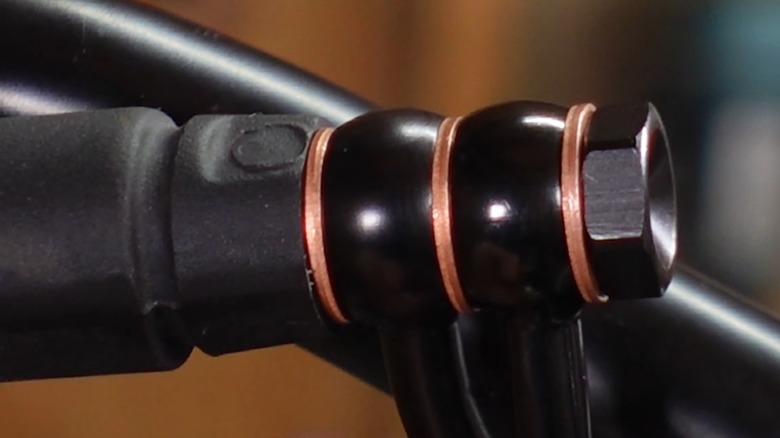
When you look at a banjo bolt, you'll notice it has some holes in it. There are one or more holes around the shank in a recessed area between the threads and bolt head that allow fluid to flow through the bolt's hollow threaded end.
The material removed from the bolts to facilitate fluid transfer makes them more susceptible to breakage than a standard bolt made of the same material. It's important to keep that in mind when installing them to prevent twisting the heads off of them.
Banjo fitting assemblies typically include crush washers made of soft metal, often copper but sometimes aluminum, intended to act as seals between one or more fittings, their mating components, and under the banjo bolt head. Some experienced mechanics might get away with tightening banjo bolts with a simple wrench, even employing techniques like whacking the banjo bolt head with a hammer during the tightening sequence to further crush and seat the soft washers.
The safest method to install banjo bolts on a motorcycle requires using an inch-pound torque wrench. Finding the proper torque specs for your project often involves consulting the appropriate service manual or information provided by the manufacturer of the component you're installing.