

Can You Plug Semi-Truck Tires?
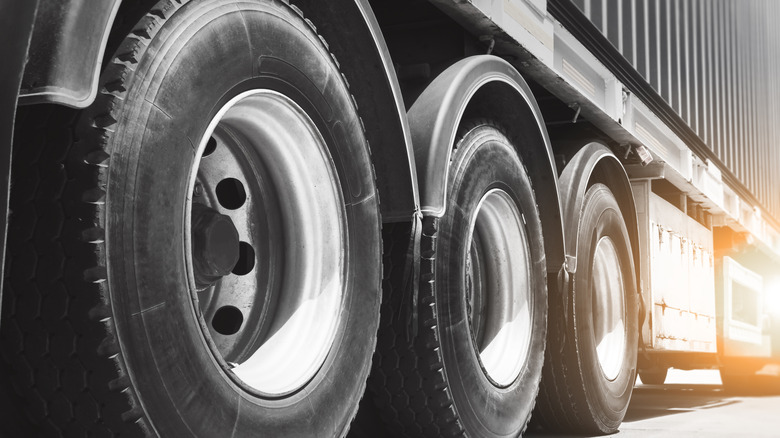
A flat tire can make you late for work, and if you have a flat at home, you may be stuck there until you can get some help. But if you drive a semi-truck, just waiting around may not be an option. After all, time is money, and you've got deadlines. According to Firestone, when a truck driver has a flat, a plug can be used on the tire. But it must be paired with a patch inside the tire. Using just a plug isn't safe.
That's because a plug on its own likely won't be able to keep the tire from losing air pressure after it's been refilled. Whereas the plug-and-patch combo can keep outside elements like water from getting inside and compromising the tire's integrity. Firestone also recommends that the flat be removed from the hub and inspected by a technician before any repair work takes place.
AAA supports this position and also notes that a plug should only be a temporary solution. The plug itself isn't forming a permanent bond to the tire, as it's only being held in place by air pressure. Because of this, it could potentially fail at any time. For truck drivers, this is especially dangerous because of the heavy loads being hauled. So rather than risk it, truckers are better off going for the more permanent solution.
The truth about fast tire fixes for semi-trucks

Though tire plugging alone isn't recommended for semi-truck drivers, what about another fast method like Fix-a-Flat? This product is sprayed inside vehicle tires to seal small punctures quickly so drivers can get to their destination. But Fix-a-Flat doesn't market to commercial truck drivers, so it's likely not an ideal solution. Additionally, the Rubber Manufacturing Association cautions against spraying aerosols into tires, because they could be flammable.
But while changing a semi-truck tire is a lot harder than you'd think, it's sometimes the best thing to do. It is safe, reliable, and can be handled by roadside service instead of the driver. The process requires lifting the trailer with a hydraulic jack and removing the tire and wheel assembly. Then, you break the bead, or the area where the tire meets the wheel rim. The damaged tire is then removed, and a new one is securely mounted in its place.
Truck drivers can monitor their tires with an automatic tire inflation system. Though not necessarily designed to take on unexpected punctures or damage, these systems consistently monitor the pressure of every tire. When a tire needs some air, it's automatically added, and whenever a tire drops below a certain level, it's topped off. The goal is to keep every tire operating safely and reduce slow leaks, which could lead to major problems down the road.