

Why Is The V-22 Osprey Called 'The Widowmaker'?
The Merriam-Webster dictionary defines "widow maker" (or widowmaker) as "something having the potential to cause sudden loss of life." This slang term implies that someone's hobby or profession (like driving a race car at over 200 mph) or genetic predisposition to something like arterial blockage that causes a fatal heart attack can make them a widow. A "widow" is normally a term associated with a wife losing her husband, and typically has not remarried.
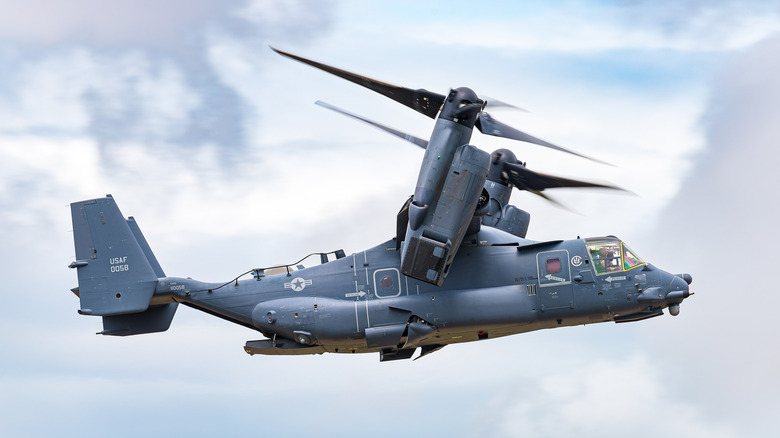
The V-22 Osprey is incredibly versatile and mightily impressive thanks to its ability to operate as both a helicopter and an airplane. By tilting its propellers vertically, the Osprey can take off and land just like a helicopter, giving it the maneuverability to land anywhere the mission requires. Once airborne, the rotors can rotate horizontally, transforming it into a fixed-wing airplane. However, it's this very flexibility that also makes it more difficult to fly.
Believe it or not, the Osprey was in development for a quarter of a century — 26 years, to be exact – and wasn't put into service until 2007. During that development and testing phase, primarily between 1991 and 2000, the V-22 was involved in crashes that caused a total of 30 fatalities. Since 2007, another 35 fatalities have been reported. Between 1992 and 2022, Ospreys were involved in a dozen fatal accidents, most of which happened during training exercises and not active operations. Sadly, this unique aircraft has killed more U.S. military personnel and civilians than enemies, thus earning its nickname among military spouses as the "Widow Maker."
Fatal Osprey crashes continued to accumulate
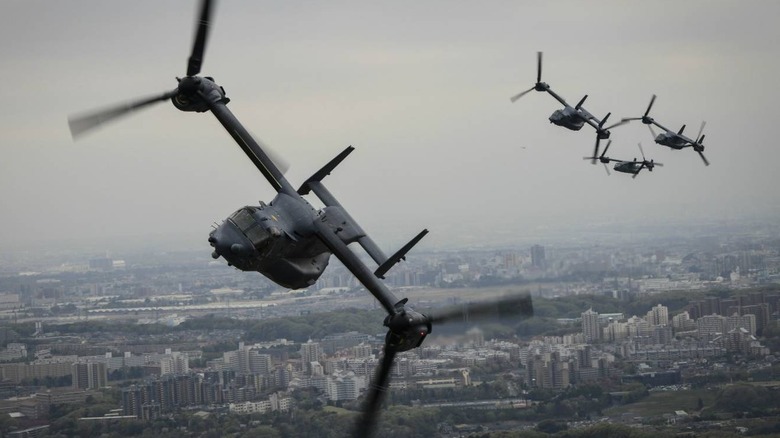
The Osprey, which has many strengths and weaknesses, had its first training accident in July 1992, when seven service members were killed in a crash in Virginia. It took another eight years for the next crash to occur, but then two took place in 2000. The one in April took the lives of 19 Marines during a training exercise in Arizona. The crash was ultimately deemed pilot error, after the pilot tried landing too fast at too steep an angle, causing the V-22 to lose lift. The second happened in December, when another four Marines were killed in North Carolina, with faulty hydraulics and a software anomaly in the computer system being to blame.
The next accident didn't happen for another decade, when in 2010 an Osprey went down in southern Afghanistan and killed three U.S. service members and a civilian employee. From there, it seemed like the V-22s were involved in some sort of mishap that either injured or killed those aboard every few years. However, 2022 seemed to be a turning point.
In March of that year, four soldiers were killed during NATO training exercises in Norway, and five more Marines died in another training mission in June near Glamis, California. The very next year (2023), two more accidents took place in quick succession. Three service members died in August (found to be operator error) when an Osprey crashed during training exercises on Melville Island in Australia; eight more airmen died in November after a crash off the coast of Yakushima Island, Japan, while participating in yet another training exercise.
Riskier uses put the Osprey in more danger
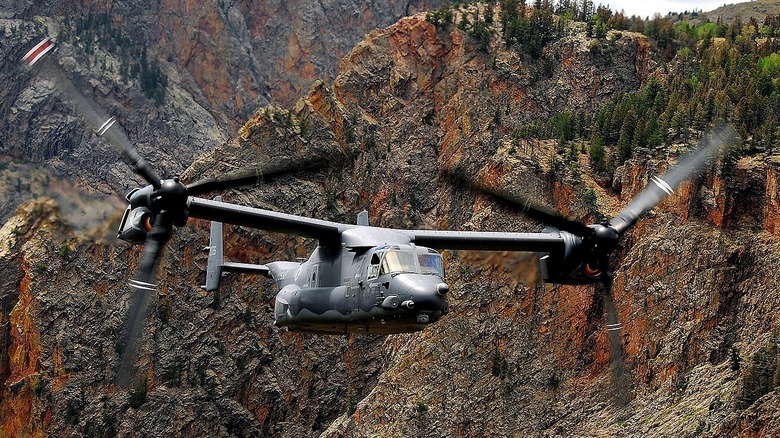
The House Committee on Government Oversight began digging into the Osprey program in December 2023 and found that, while V-22 incident numbers seemed high, one must take into account that it can easily carry 32 people. Plus, it's usually involved in high-risk missions that require it to fly fast and low — while doing so in the dark. The Class A mishap rate for the Marine Corps' version (MV-22B) was 2.56 mishaps per 100,000 flight hours (between 2015 and 2024).
By comparison, all other Marine aircraft during that same period logged 2.67 mishaps per 100,000 flight hours. However, the Air Force's version (CV-22) had a Class A rate of 11.55, while the rest of its fleet had a rate of just 1.65 mishaps. Meanwhile, the Navy CMV-22 experienced no incidents. Additional independent research found that the Osprey (developed through a partnership between Bell Helicopter and Boeing) is nowhere close to the "most lethal" aircraft in the sky. For instance, the F-15 Eagle has accumulated 125 aircraft losses (none in air-to-air combat).
In 2023, Major Jorge Hernandez, spokesman for Marine Corps Aviation at the time, stated the V-22 had a lower death rate than the Harrier, the F/A-18 Super Hornet, the F-35B, or the Sikorsky CH-53E Super Stallion, reports Alex Hollings of Sandboxx. And the UH-60 Black Hawk helicopter has been involved in over 390 incidents resulting in more than 970 deaths, most of which were during training exercises. Yet, it's still regarded as "the safest helicopter" in U.S. military history. Ultimately, the V-22 (with 67 total incidents to date) has a safety record that is in line with other military aircraft.