

Kawasaki's Z1100 Trails Rivals On Specs, But That's Not The Biggest Problem
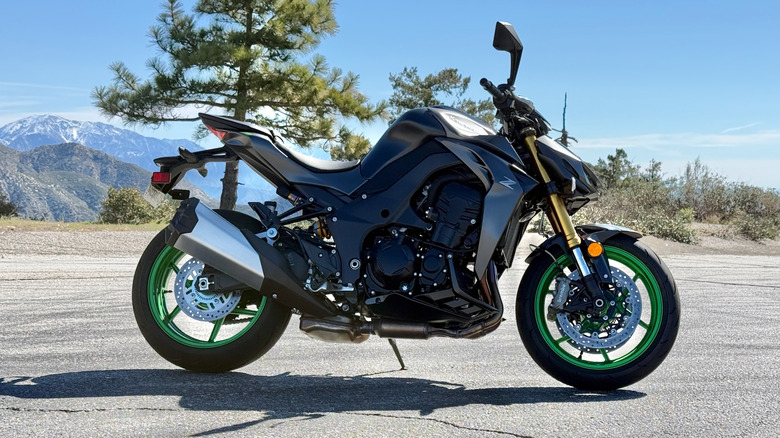
The Z1100 is at the top of Kawasaki's Supernaked category. It takes the spot that was once held by the old Z1000, and–with the exception of the supercharged Z H2–the Z1100 is the most powerful naked sportbike that the green-coded manufacturer makes. While it doesn't quite offer superbike levels of performance, the Z1100 is a menacing street machine with serious speed, and Kawasaki let me borrow one for a few weeks to see what it's all about.
Aesthetically, the Z1100 is styled with Kawasaki's aggressive "Sugomi" design language, characterized by sharp angles and steeply raked body lines. As far as curb appeal goes, it's about as streetfighter as it gets. Before I even rode the Z1100, I was a fan of the way it looked. On top of having the right looks for the class, the Z1100 is also extremely fun to ride, comfortable, and it comes with all sorts of modern equipment.
Early on in my test of the Z1100, I discovered that it could easily live its life as a spicy commuter bike, a canyon carver, or the sort of machine you take on long weekend trips — it's extremely versatile. It's pricey, though, and there are a number of competitors ready to take it on, from rivals like Honda, Yamaha, and Suzuki, and even a few from inside Kawasaki's own lineup. So where does the Z1100 fit in the pecking order of modern 1000-cc-plus naked streetfighters?
Is the juice worth the squeeze?
There's only one trim level of the Z1100, the SE: it comes packed with features and equipment, but at a hefty price. The SE will set you back $15,839 (including an $840 destination fee); that's high enough to put the Z1100 in competition with class-leading rivals like the Yamaha MT-10 at $15,774 which makes over 160 hp.
There are a few other bikes in the category, though, that offer similarly impressive performance for significantly less money. The Honda CB1000 Hornet SP starts at $11,774, and it's pushing out over 150 hp, while the Suzuki GSX-S1000 has an MSRP of $12,689 and it puts out around 150 hp as well.
Thankfully, the Kawasaki's high price includes things like anti-lock brakes (ABS), a quickshifter, assist and slipper clutch, a compact IMU, big front Brembo brakes, a 5-inch TFT rider display, adjustable front and rear suspension (with an Öhlins rear shock and adjustable preload), cruise control, multiple rider and power modes, a USB-C port, and smartphone connectivity via the Rideology app. The features are there, but for the price to be justified, the riding experience needs to hold up, too.
An appropriate amount of gusto
Powering the Z1100 is a 1,099cc inline four-cylinder engine that produces 134 horsepower and 83.3 lb-ft of torque. That's not quite enough power to match the Honda, Suzuki, or Yamaha, but it's not so anemic that it puts the Kawasaki way behind. It's the same engine as in a few other products in the Kawasaki family, including the Ninja 1100SX SE that I took on an ill-fated road trip last year. For a road-trip touring/sport bike, the 134 horses provided by the 1,099cc engine is plenty, and on an even-lighter naked street bike, it's the sort of power that's well beyond adequate.
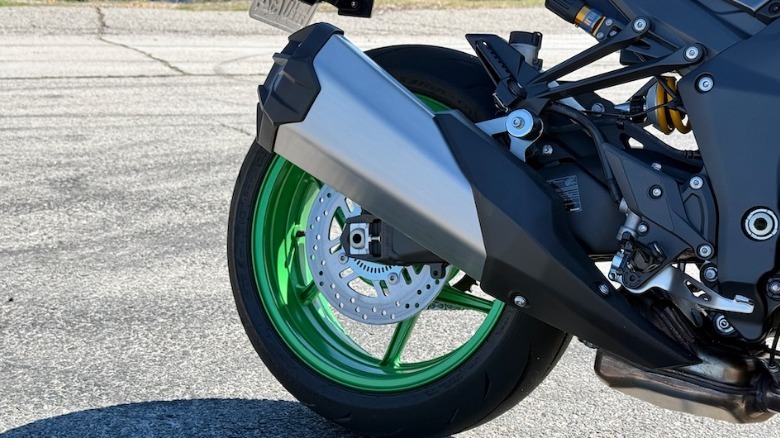
Even in the most aggressive riding modes, the Z1100 isn't snappy, which is just how I like it. Power comes on in a predictable and linear fashion. The engine and exhaust don't exactly scream on their way to redline, but there's a nice resonance from the exhaust that makes every twist of the throttle thoroughly enjoyable.
 Travis Langness/SlashGear
The Z1100 has an estimated curb weight from Kawasaki of 487.3 lbs, which doesn't make it an ultra-light, but it's still relatively svelte when you consider all the power you get. Moving up through the gears, the quick-shifter performed excellently. Just the slightest pressure from my left toe and a satisfying click, up or down, would be instantly performed by the Kawi. The clutch lever was also relatively light and easy to squeeze when needed.
Handling, steering, and braking are a strong package
Along with its big-bike power and somewhat upright riding stature, the Z1100 comes with serious stability. Around corners, it feels extremely solid. Look through a curve, push down on the handlebars, and it glides through with confidence, shrugging off small imperfections in the road surface. The ride is firm, but I never found it uncomfortable. The Z1100's size, however, does translate to some characteristics that make it a bit less sporty than its smaller siblings.
According to Kawasaki, the Z1100 is only about 16 pounds heavier than the Z900 I tested a few months back, but the extra weight makes the Z1100 feel larger. Instead of a light and somewhat flickable nature, it requires some extra input ahead of turns. It's not a giant difference in characteristics, but it's worth noting.
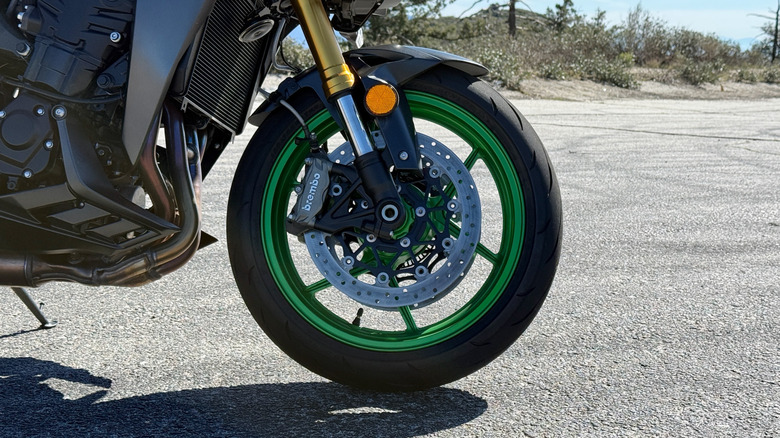
Like the Z900, the Z1100 uses 300mm front brake discs and 250mm rears, with 4-piston Brembo monobloc calipers doing the squeezing upfront and single-piston calipers in the rear. With the added weight of the Z1100, there's a bit of extra pedal squeeze required to bring it to a complete stop, but the clamping power is all there when you need it.
Living with the size and riding position
From side to side, the Z1100 feels wide at first–the same way any motorcycle with big four-cylinder displacement feels–but it's narrow enough to live with it as a city bike. On the highway, it feels slim enough to move between traffic-trapped four-wheeled vehicles, and in the canyons, the tank feels narrow enough that I can slide around it, shifting my body position with ease.
This was not a trick that I felt like the Honda CB1000 Hornet SP pulled off, at least not from my initial impressions of that bike. So, while it takes some doing to get it set up for a corner, the Z1100 is functionally well-designed for taking curves at speed.
 Travis Langness/SlashGear
Handlebar height on the Z1100 was pretty much perfect for me. At 5-foot-9, I could easily reach the bars without bending over, and I could flat-foot at a stop light thanks to the average seat height of 32.1 inches. The foot pegs are well placed, too. They're not so high that my knees felt cramped on long rides. Speaking of long rides, there's a tiny bugscreen above the Z1100's headlights, and it's enough to keep bugs off the lower half of my torso, but if you're the sort of person who does 200-mile summer days in the saddle, you'll also want to invest in some Windex and microfiber cloths for cleaning your helmet (this shouldn't be news to any seasoned naked-bike riders).
Tech and rider aids make the streetfighter experience modern
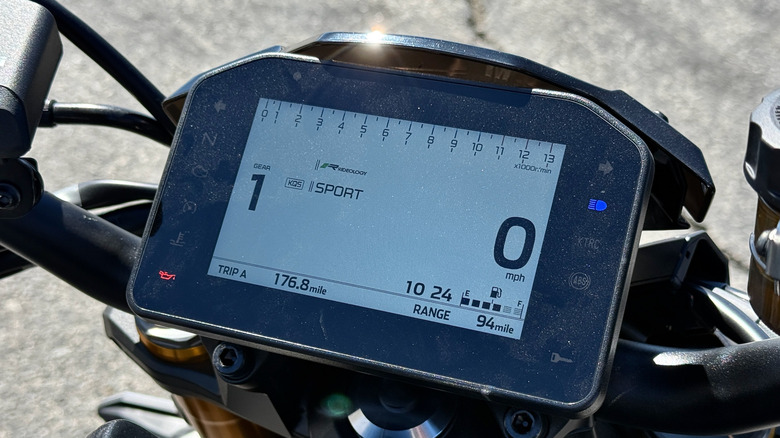
While most of the work is done in the background with stuff like the IMU, the Z1100 is loaded with all sorts of rider aids and tech that increase the quality of the riding experience on the surface, too. Various power modes and rider modes are available for different conditions, including a customizable rider mode to unleash the Z1100's full power. You can also connect to Kawasaki's Rideology app to access data about your motorcycle from your phone and configure the 5-inch TFT display.
The rider display is high-contrast and has impressive graphics, and it's pretty easy to read as a result — even in direct sunlight. There's also a handlebar-mounted USB-C charge port for riders that want to keep their phones charged on long days, though you'll need to buy an accessory mount of your own to keep the phone in place.
 Travis Langness/SlashGear
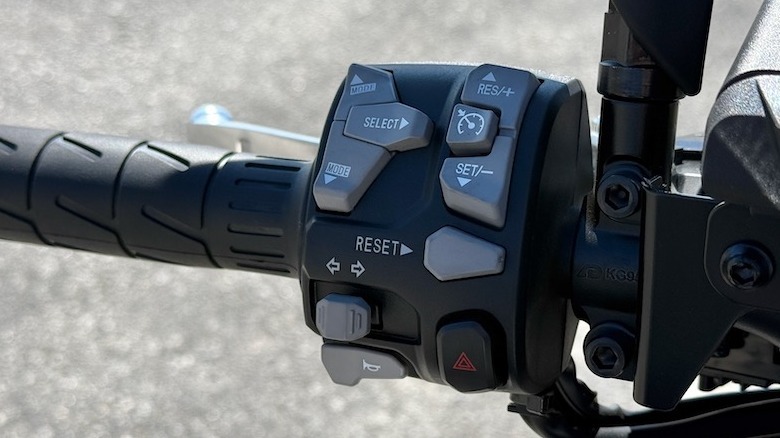
Then, of course, there's standard cruise control. The cruise control on the Z1100 is extremely easy to operate and the buttons to set the speed were easily within reach of my left thumb; there's no need to let go of the bar to set the cruise. It's the sort of thing that elevates the Z1100 experience over less-expensive bikes like the Honda CB1000 Hornet SP, which doesn't have cruise control.
2026 Kawasaki Z1100 verdict
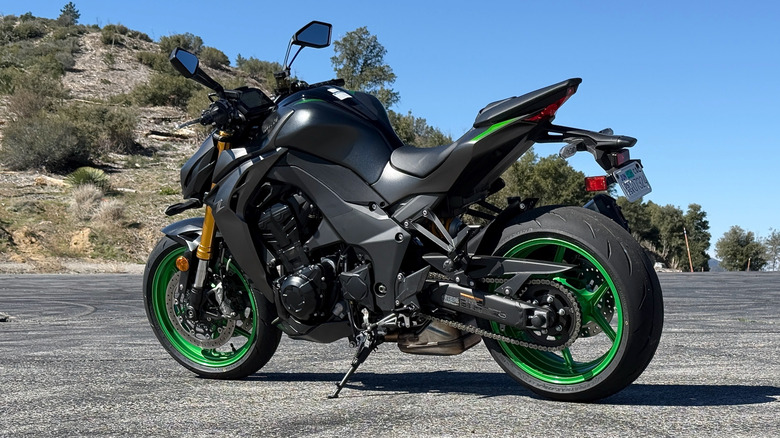
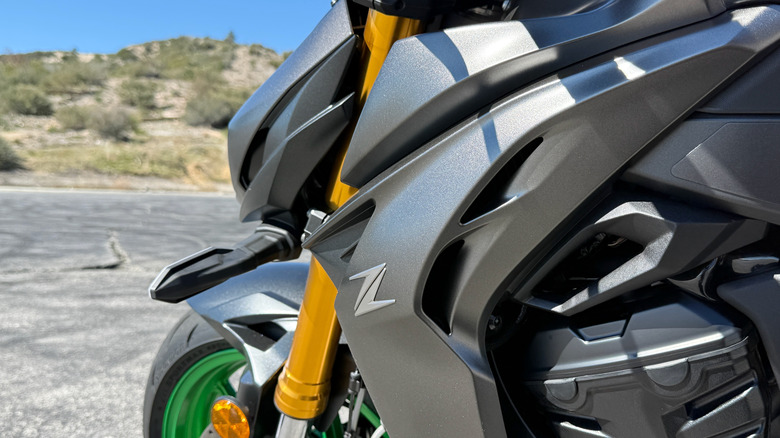
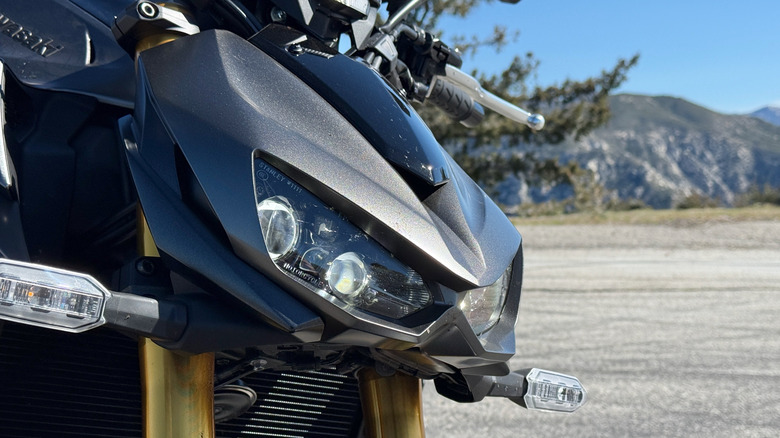
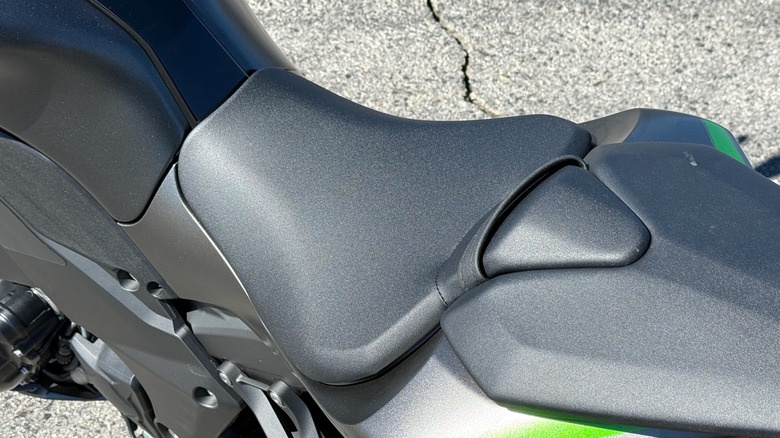
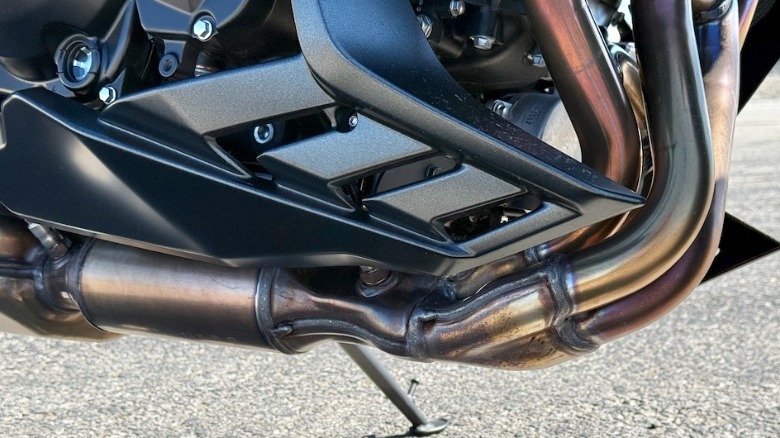
There aren't any major flaws with the 2026 Kawasaki Z1100. While it's a bit less powerful than rivals, it has more than enough grunt to make it entertaining. It looks good too, with lots of tiny details shining through the longer you ride it (I find the louvered fairings on the lower half of the bike and the four-bulb headlights particularly appealing). The ride is a little stiff, but the Z1100 has a well-padded seat that helps make it broadly livable. Even with cheaper options out there from Honda and Suzuki, the Kawasaki still makes a strong case for itself in the segment.
 Travis Langness/SlashGear
For me, though, the Z1100's biggest problem is the strength of the other bikes around it inside the Kawasaki lineup. On the street, there's not much real extra usable speed that you can get out of the Z1100 that the Z900 won't provide. Yes, their respective power ratings and riding experiences are a little different, but I'd personally have a hard time paying several thousand dollars more for the Z1100 when the Z900 was so impressive to ride.
If I were taking long-distance road trips, or commuting long distances, the Z1100 is the bike I'd choose between the two. Even then, I'd probably consider the less-expensive Ninja 1100SX, too. What Kawasaki has done here is give every tiny niche of rider something to look for, and that's a blessing and a curse.