

Russia's Allegedly Beefing Up Its Navy With Impressive New Ships
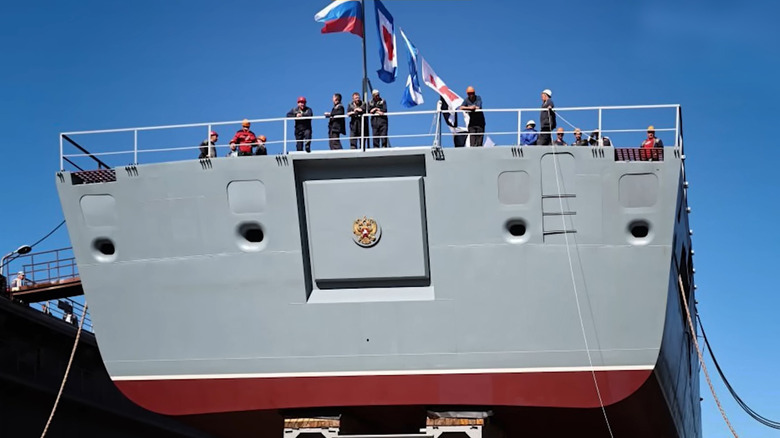
Reports that Russia has been strengthening its navy have been circulating for some time. In recent months, one verifiable sign of activity has been the launch of the Admiral Amelko frigate.
This is the fifth and latest ship in the Gorshkov-class of frigates, or if they're referred to by their rather dry official designnation – Project 22350. This class of ship represents a key part of Russia's post-Soviet naval strategy. Indeed, it's the only class of ocean-going surface warship developed by the Russians since the demise of the Soviet Union. The ships are designed to be multi-role platforms capable of handling a range of missions, from air defense to anti-submarine warfare. Currently, there are three of them in active service, with a fourth, the Admiral Isakov, and the aforementioned Admiral Amelko both set to join the fleet in 2027.
In remarks published by The National Interest, Alexander Stepanov, of the Moscow-based Institute of Law and National Security called the ship "a sea terminator, a universal soldier, that can hunt down enemy nuclear-powered submarines. Given this, it's likely a relief to hear that these ships are hardly rolling off the production line at a high rate of knots.
For instance, the Admiral Amelko's keel was laid down in April 2019, and it isn't expected to enter service until late 2027. This is fast, by the way; the first ship in the class took 12 years to build. Although, to be fair, a major U.S. Navy frigate program was recently cancelled due to major production delays, so this is not a uniquely Russian problem.
Let's have a closer look at the Gorshkov-class of frigates and whether they live up to their self-penned terminator moniker.
The Gorshkov-class Frigates
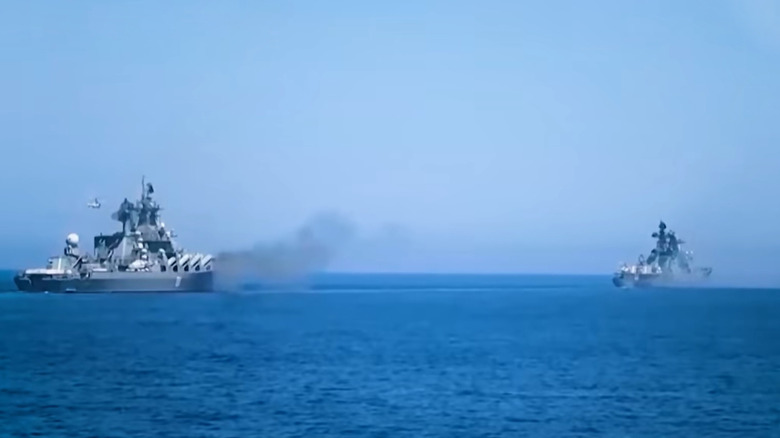
The Gorshkov-class frigate is, at least by virtue of being the sole contender, central to the Russian Navy's current surface fleet development and is representative of a focus shift to smaller ships that carry hypersonic missiles. The Admiral Amelko is the most recent example of the class and was launched at the Severnaya (Northern) Shipyard in St. Petersburg on 24 August 2025.
Russia's strategy in adopting these multi-role vessels allows its navy to operate without relying on larger destroyers or cruisers. This is part of a change of approach from trying to match the US Navy in terms of sheer numbers to a more versatile fleet that relies heavily on hypersonic missiles.
In terms of equipment, the ships are built around vertical launch systems capable of deploying a mix of cruise and anti-ship missiles. The Admiral Amelko is installed with 32-cell launch systems as opposed to the 16 installed on earlier frigates. These are capable of launching missiles such as the Kalibr and Oniks systems alongside anti-submarine weapons. The Gorshkov-class ships are also the first "surface combatants" of the Russian Navy with the capability of launching the 3M22 Zircon missile, a scramjet missile thought to be the world's fastest.
On paper, this makes the Gorshkov-class sound like a formidable foe. However, assessing the full impact of these claims is not always straightforward. Russia's naval modernization is often framed in more dramatic terms than the evidence supports, and much of the available information comes from official announcements or (sometimes state-sponsored) secondary reporting. It's all very well calling a ship a "sea terminator," but such a name has to be earned before it means anything.