

This WW1 Navy Diver Earned The Medal Of Honor Nearly 300 Feet Below The Sea
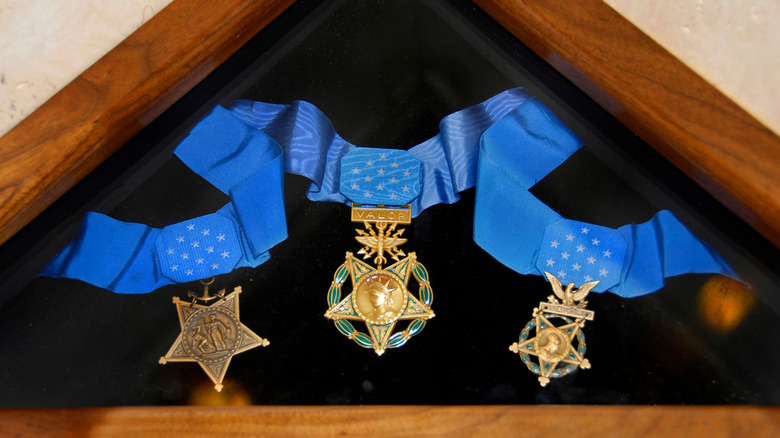
The Congressional Medal of Honor is the United States' highest award for military valor. In its more than 150-year history, only 3,552 individuals have received it. Originally conceived as a way to honor enlisted seamen and marines who performed distinguished acts of service during the Civil War, the medal now honors service members who distinguish themselves "conspicuously by gallantry and intrepidity at the risk of his life above and beyond the call of duty."
The medal was awarded much more frequently before World War I, with that time period accounting for almost 3,000 of the total awards. World War I, during which almost 5 million Americans served in uniform, resulted in only 121 Medal of Honor recipients. Some were awarded posthumously, but one recipient, Frank Crilley, was honored in 1929.
Crilley joined the United States Navy in 1900, when he was only 16 years old. By 1915, he was a Chief Gunner's Mate in the experimental diving team, a renowned but dangerous position. A WWI U.S. Navy submarine, the USS F-4, sank in March of that year with all 21 crewmen aboard. This was the first American submarine lost at sea, and the Navy wanted to raise F-4 from its final resting place just off the coast of Honolulu, Hawaii to find out what went wrong. It turned to Frank Crilley for help. To complete the mission, Crilley dove more than 300 feet down to the sub — which is 170 feet deeper than a recreational diver can get today.
Frank Crilley was honored for his bravery in a diving mission
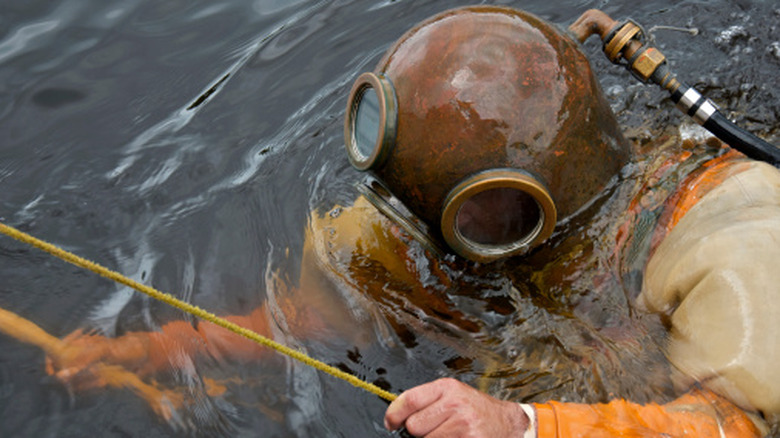
Frank Crilley made his first dive to the USS F-4 in mid-April 1915 along with four other divers. They brought a recompression chamber and a physician, along with the standard diving gear, with them. Crilley hit 304 feet on that dive, a depth record that stood for a quarter of a century. The sub was found upright on the ocean floor, and cables would be required to raise the sub. This process was a challenge because it took three hours to descend and ascend from that depth.
During a subsequent dive, one of Crilley's fellow teammates, William K. Loughman, became tangled when a ground swell caused the sub to turn over. He was stuck at about 275 feet, and Crilley volunteered for a rescue mission. After more than two hours in the depths, Crilley emerged with his teammate alive. Eventually, the Navy managed to raise F-4 and found that it sank due to corrosion of the lead lining of the battery tank, which eventually led to a loss of depth control.
Crilley had a long career with the Navy and was awarded the Medal of Honor in 1929, 14 years after his heroic rescue. Several other service members have received the Medal of Honor for deep diving, including Owen Hammerberg, who engaged in rescue operations after an incident in Pearl Harbor in 1945, almost four years after the Japanese attack on the naval base. Hammerberg, who rescued two fellow divers that were trapped during a salvage operation, received the award posthumously after he died.