

Why Do Traffic Lights In The US Not Have A Countdown Timer?
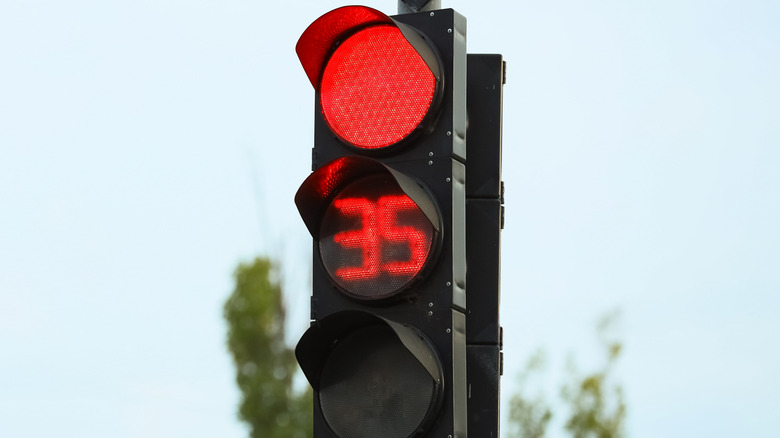
Traffic lights suddenly changing from green to yellow to red can potentially lead to risky split-second decision-making for beginner and experienced drivers alike. Other countries have countdown timers that try to address this issue, but the U.S. doesn't. Why? Well, while no government agency or city official has provided a direct answer, there are clear financial and safety-related hurdles that have likely prevented timer signals from being implemented across the U.S.
First and foremost, there's concern over these signals' impact on driver psychology. Seeing these countdown numbers could entice drivers to rush through intersections in the hope of beating the clock approach. Some might also go through intersections early in anticipation of red lights turning green, possibly leading to more accidents. Beyond that, seeing as the U.S. has loads of traffic lights in operation — at least for now; a future without any traffic lights is a possibility — updating the existing infrastructure would be expensive. Crosswalk countdown timers alone can cost up to over $1,000, so odds are adding timers to existing traffic lights would be quite a pricey endeavor.
On top of this, there's the matter of actuated intersections, which are those motivated by vehicle and pedestrian sensors rather than timers. These intersections are rather common in the U.S. and can change lights in seconds, rendering countdown timers somewhat redundant. Many other countries have implemented countdown timers, though, so let's look into those and see if the U.S. is missing out.
Countdown signals have offered mixed results
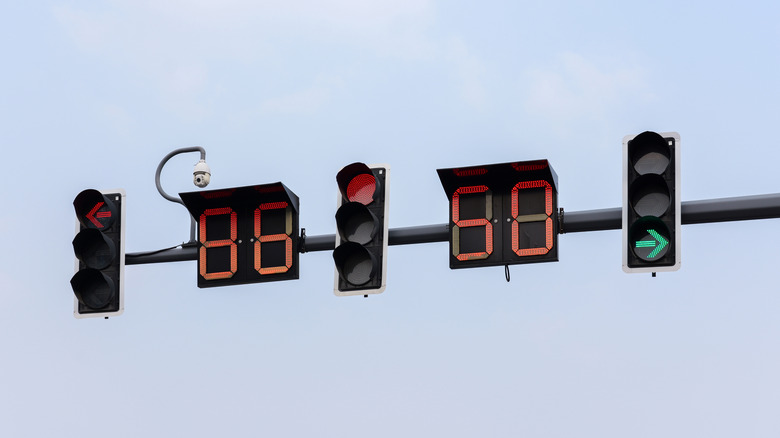
Traffic light countdown timers have become a frequent sight outside of the U.S., to varying levels of success. For instance, a study published in the journal Traffic Injury Prevention found a possible connection between countdown timers and red light violations at four Chinese intersections — although the researchers conceded that further study was needed to establish a definitive link. Conversely, a study presented at the 2010 International Conference of Chinese Transportation Professionals found that the timers reduced drivers' risky behavior. Additionally, 85% of drivers surveyed preferred having the timers present.
A 2023 meta-study published in Digital Transportation and Safety reflects this mixed showing. The 46 studies analyzed reached varying conclusions: Some suggested that intersection countdown timers benefited traffic safety, but many also found that they served as catalysts for increased danger. There were even studies where the timers were both good and bad, improving some aspects of intersection safety but negatively affecting others. Ultimately, researchers admitted that there wasn't enough research to reach a concrete conclusion on the matter and that regional differences in driving habits could impact how these intersection additions are perceived.
Perhaps someday countdown timers will come to intersections in the U.S., but for now, that doesn't seem to be part of the plan; the most infuriating traffic light in the U.S. will likely stay timer-free for a while yet. Either way, we expect these timers to be the subject of more research in the coming years, possibly solidifying their benefits or proving that they're not worth the cost of implementation.