

Who Makes Javelin Missiles?
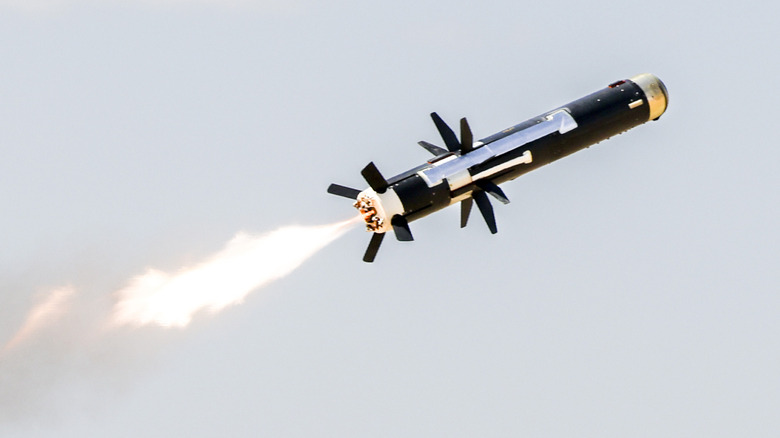
In February 2022, Russia began a full-scale invasion of Ukraine as part of Russian President Vladimir Putin's "special operation." Fast forward four years, we now know that things did not exactly go according to Russia's plan. Not only did Russia fail to meet most of its initial military objectives, they also suffered heavy casualties. While the resolve of the Ukrainian military played a massive role in the tactical defeat of Russia, this success could not have been possible had it not been for the FGM-148 Javelin, an American-made anti-tank missile that Ukraine used against the advancing Russian troops.
On paper, the FGM-148 Javelin seems like a simple shoulder-fired anti-tank guided missile. However, it's an unbelievably high-tech military weapon that played a major role in dealing Russia a series of crushing blows. In fact, such was the impact of the Javelin missile that it eventually became a cultural symbol of resistance, earning the nickname "Saint Javelin".
In the initial days of the conflict, the Javelin missiles achieved exceptional success rates over the Russian military. In fact, it is estimated that of the first 300 Javelins fired at Russian military vehicles, 280 of them hit their targets. One of the major reasons for the success of the FGM-148 Javelin was its small size and portability. At just 50 lbs (22 kg), it was light enough to be carried around and to be used for guerrilla-style defense in urban areas. Needless to say, the FGM-148 Javelin, which is manufactured by the Javelin Joint Venture (JJV), has proved to be one of the most effective unconventional battlefield weapons of the 21st century, right up there with Ukraine's old prop plane that hunts down drones.
The companies behind the Javelin Joint Venture
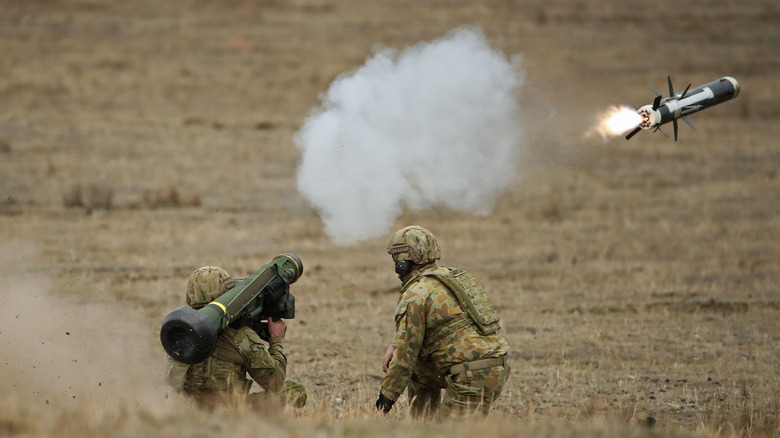
The genesis of the Javelin missile is, perhaps, as remarkable as the missile itself. While the missile is manufactured by a company called the Javelin Joint Venture, the companies behind this JV are Lockheed Martin and RTX Corporation (formerly known as Raytheon). These are major U.S. defense contractors who have often competed against each other. In this instance, however, the duo has forged an unlikely partnership in the development and manufacturing of the FGM-148 Javelin.
The development story of the FGM-148 Javelin dates back to the 1970s, when the Defense Advanced Research Projects Agency planned to develop an anti-tank weapon that would eventually replace the M47 Dragon missile. Following a long and winding bureaucratic process, the contract for the development and production of what would become the Javelin was awarded to a joint venture created by Texas Instruments (Raytheon) and Martin Marietta (Lockheed Martin).
Following a short developmental phase, the first Javelin was test-fired in 1993: almost two decades after it was first proposed. It wouldn't be until 1997 that it would reach full-rate production. The first real battlefield test of the FGM-148 Javelin was in 2003 during the U.S. invasion of Iraq. Later, it would also be used when U.S. troops were stationed in Afghanistan. As outlined earlier, the missile would achieve significant success in the initial days of the ongoing Russo-Ukrainian conflict. As of 2026, the Javelin Joint Venture (JJV) is in the process of accelerating the production of the latest version of the Javelin missile and is expected to remain a mainstay of the U.S. military inventory until at least 2050.