

China's Bizarre Shape-Shifting Robot Grows And Changes Like A Human

From Boston Dynamics' Electric Atlas to Unitree Robotics' G1, humanoid robots are becoming more human-like in many ways – and sometimes even more capable – but they are often made of pretty heavy materials and carry a chunky battery pack. Atlas weighs just short of 200 pounds and is made from titanium and aluminum. In contrast, researchers from China's Southern University of Science and Technology recently revealed a 10-pound robot made of lightweight, malleable materials.
GrowHR has the ability to change its shape depending on the task it's performing, mostly by extending and shrinking its leg-like appendages. Its adaptability allows GrowHR to swim in the water, crawl through tight spaces, and even "fly" with the help of additional fans.
Given its unique anatomy, GrowHR developers believe it could be useful for search-and-rescue missions. "This growable bio-inspired structure can be applied in field rescue missions, such as navigating through narrow gaps. Moreover, its multiple locomotion modes allow it to adapt to complex terrains," Wang Ting, a PhD Student at SUST, told Interesting Engineering.
How GrowHR mimics human biology for versatile mobility
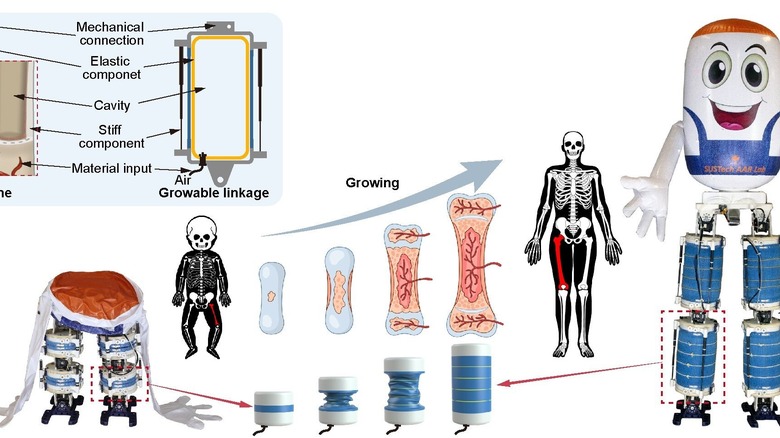
GrowHR's design is based on human anatomy and biology. While the materials are different than that of human legs, researchers were inspired by human processes to create GrowHR's shape-shifting legs. Basically, the team created "bones" from soft, airtight chambers and then encased them in a specialized fabric. Tension cables and motors keep the legs stabilized.
To mimic a human's bone growth, GrowHR gets air pumped into its chambers, reaching up to three times the original length. The soft PVC material acts as the robot's "developing bones," allowing the appendages to bend and stretch. Then, to recreate rigid "compact bones," researchers wrapped the inflatable area in a thin, non-stretchable fabric that holds the shape of the legs and provides necessary structural stiffness. This way, the robot can become stiff enough to walk while carrying things, but soft enough to absorb incoming impacts. Letting air out of the chambers shrinks GrowHR to 36% of its height so it can squeeze into tight spaces or underneath low objects.
"Deformable legs demonstrate elastic energy storage and release under external loading, allowing motions beyond the limits of rigid structures. This work pioneers a growable, multifunctional robotic design approach for dynamic, complex environments," explained the team of researchers. And unlike China's creepy AI robots, GrowHR has one singular, friendly expression.