

Be Aware: This Fire Hazard May Be Hiding In Your Garage
We may receive a commission on purchases made from links.
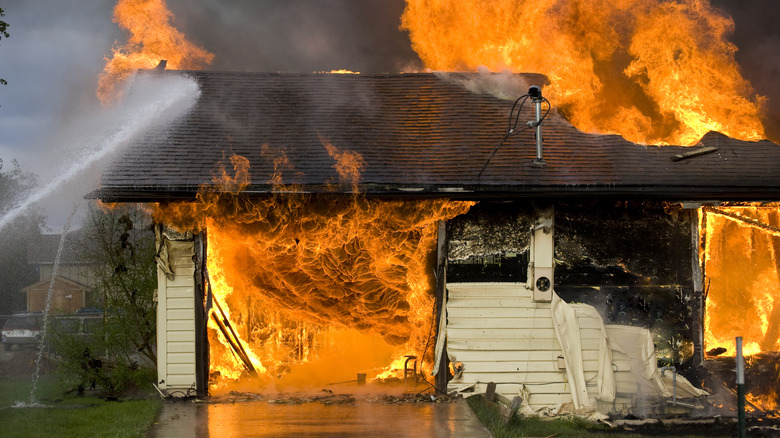
You deal with a lot of dangerous things in your garage, which is why it's vital that you take all of the proper safety precautions so you don't end up with an unexpected trip to the ER. You probably know to keep your fingers away from a moving table saw blade and make sure a jacked-up car is stable before you move around underneath it, but there are other safety hazards in your garage that you might be ignoring or otherwise unaware of. This is particularly concerning when it comes to fire safety. We all know that oil, gasoline, propane, and other flammable chemicals need to be stored safely. You might even have a few electronic gadgets that are actually fire hazards out there that you don't even know about, but there is probably at least one, more insidious, substance in your garage that can lead to house fires too –– sawdust.
Anyone who's ever done even a little bit of woodworking knows that sawdust will get everywhere if left unchecked. It usually manifests in the form of an extremely fine powder that your rapidly spinning bits and blades are all too eager to send billowing into the air to spread on every surface in sight. There are a few problems with this. The most obvious is that it makes an absolute mess, but there are some safety concerns as well. There are respiratory issues that can come from breathing too much of the stuff, but what a lot of people might not have considered is that sawdust is also highly flammable. If allowed to accumulate, this dust can prove to be an extreme safety hazard.
Sawdust is more flammable than you think

Going back to basic chemistry, you need three things to produce fire: oxygen, fuel, and an ignition source. Sawdust checks two out of three of these requirements. Everyone knows that wood is a natural fuel for fire, but the fine particulate form of sawdust is very airy, graduating it from something that can simply burn to fuel that's capable of an explosive reaction. All it needs is a spark.
Dust explosions are one of the most frequent causes of fires and explosions in lumber mills, sawmills, and other wood processing facilities. According to the Vancouver Sun, a B.C. Fire Commissioner incident reports showed that sawdust, wood shavings, and wood chips were listed as the first material to ignite in more than half of the 89 sawmill fires that took place in Interior B.C. between 2001 and 2011. "Wood dust explosions occur worldwide, which have caused massive damages to equipment, buildings, and environments, killed people, and threatened human health," states a multi-authored piece in Volume 216 of Environmental Research. This happens in both home shops and in large industrial facilities.
These explosions are less common in private homes, but that doesn't mean that they don't happen or that sawdust can't act as an accelerant that can quickly turn a small fire into a big one. According to the National Fire Association, it only takes 1/32 of an inch of dust (roughly the thickness of a paperclip) to be dangerous, while anything over ⅛-inch is considered a Division 1 hazardous location. So, it's pretty clear that keeping your workspaces clear isn't just about cleanliness. It's a vital matter of safety.
How to prevent sawdust fires
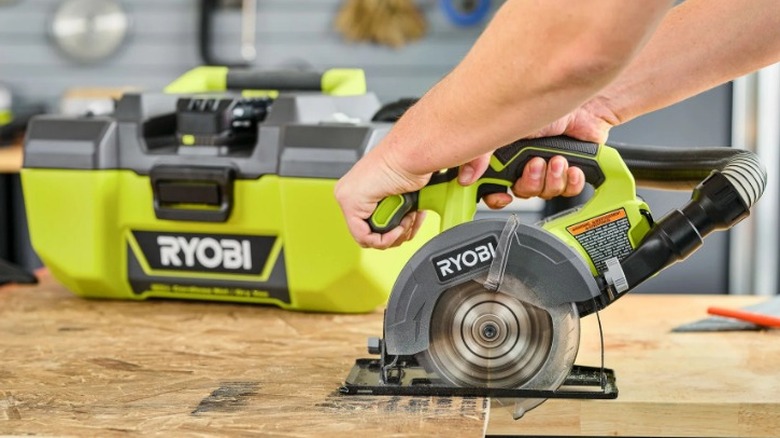
Now that we've taken a look at how dangerous sawdust can be, you might also want to consider what steps you can take to prevent an accident from occurring. One of the best prevention methods is to capture as much of the dust as possible before it has the chance to spread and settle in those difficult-to-clean nooks and crannies. There is a reason the vast majority of modern woodworking tools come with vacuum ports pre-installed. These allow you to collect sawdust before it has the opportunity to leave the tool.
Those who only do the occasional light woodworking project might be able to get away with attaching a basic shop vac to their tools, but those who practice more frequently or have a full-scale home shop will want to invest in a dedicated dust collection system. That doesn't mean you need to buy a massive industrial model, though. There are plenty of affordable dust collection systems that would be perfect for a small shop. These have specialized filters that are designed to handle fine dust without getting clogged up and killing your vacuum's motor. You can also get something like the Wen Air Filtration System, which you mount to your garage's ceiling for additional passive dust collection.
Even with all that, you'll still want to clean out your shop once in a while. Basic sweeping is fine, but vacuum collection is best as it helps to prevent the fine particles from becoming airborne and spreading around the various surfaces in your shop. You'll want to be particularly careful about keeping the areas near electrical outlets and appliances clean and dust-free.